Lumenis Be Ltd. has presented new clinical data for FoLix, ULTRApulse Alpha and Stellar M22 at the 45th Annual American Society for Laser Medicine and Surgery Conference, strengthening the medical device manufacturer’s evidence base across androgenetic alopecia, rhinophyma and photodamaged skin. The update places Lumenis’ energy-based aesthetics portfolio in a sharper clinical context as physicians, patients and payers increasingly expect aesthetic devices to show measurable outcomes rather than rely on brand familiarity or procedural momentum.
Why Lumenis’ ASLMS data matters as aesthetic devices face rising clinical scrutiny
The strategic significance of the ASLMS presentation is not simply that Lumenis showed more data. The larger point is that the aesthetics sector is moving into a more evidence-sensitive phase, where dermatology practices are under pressure to justify device investments, patients are comparing non-surgical alternatives more actively, and manufacturers are being pushed to defend claims with clinical endpoints rather than marketing language. For a company with products across skin resurfacing, pulsed light treatments and hair restoration, evidence generation is becoming part of commercial defensibility.
This matters because the market for energy-based aesthetic devices has become crowded with laser, intense pulsed light, radiofrequency and hybrid platforms promising better speed, comfort, downtime profiles and cosmetic outcomes. That makes incremental hardware differentiation harder to sustain unless the device is supported by studies that clinicians can use when deciding which platform to buy, which indication to prioritize and which patient types are appropriate. Lumenis’ ASLMS package therefore appears designed to reinforce three separate but connected claims: FoLix has a role in non-drug hair loss treatment, ULTRApulse Alpha can support more complex dermatologic resurfacing use cases, and Stellar M22 remains relevant as pulsed light platforms evolve toward faster large-area treatments.
The risk is that conference data, especially when presented as abstracts or posters, does not automatically translate into broad clinical adoption. Dermatologists and aesthetic physicians will still want to see durability, reproducibility across practice settings, patient selection clarity and long-term safety. For Lumenis, the next test is whether this data becomes part of day-to-day treatment protocols or remains primarily a scientific validation exercise for an already competitive portfolio.
How FoLix could change the commercial conversation around laser-based hair loss treatment
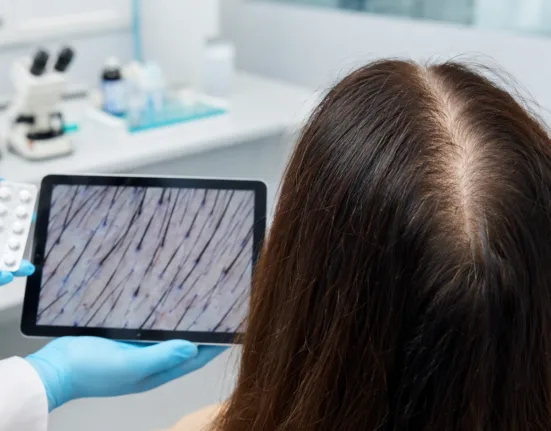
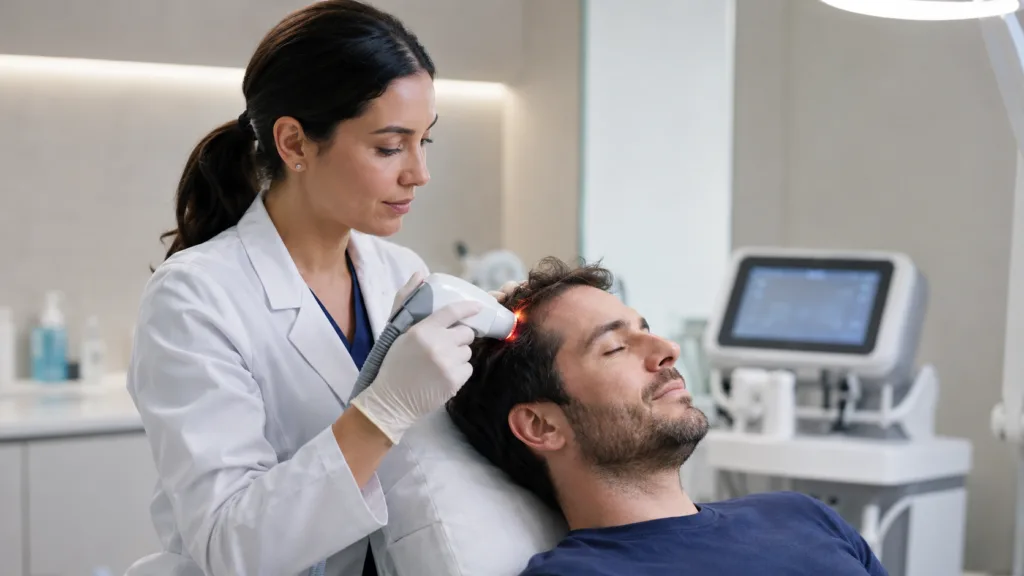
The most commercially interesting part of the update is FoLix, Lumenis’ non-ablative fractional 1565 nm laser for improving the appearance of scalp hair in adult men and women with Fitzpatrick skin types I to IV. Hair loss has traditionally been dominated by pharmacologic options, topical treatments, oral therapies, platelet-rich plasma, hair transplantation and consumer wellness products. A laser-based device that can sit inside a dermatology or aesthetics practice gives clinicians another modality, particularly for patients who prefer non-surgical or non-drug approaches.
The data presented at ASLMS appears to strengthen FoLix’s positioning in androgenetic alopecia by pointing to improvements in terminal hair count, total hair count and follicular density, with a reported majority of patients showing measurable benefit. That type of endpoint mix is important because hair loss treatment is not judged only by patient perception. Clinicians also need objective measures that can support treatment planning and expectation-setting. If a non-ablative fractional laser can produce measurable changes while avoiding systemic drug exposure, it may occupy a useful middle ground between topical regimens and more invasive interventions.
However, FoLix still faces the classic adoption challenge in aesthetic and dermatologic devices: the technology must be clinically meaningful, commercially efficient and easy to explain. Patients may be interested in a non-drug option, but practices must evaluate treatment time, session frequency, maintenance needs, staff training, patient throughput and price sensitivity. The device’s indicated population also matters. Because FoLix is positioned for adult males and females with Fitzpatrick skin types I to IV, further evidence in broader skin types, including ongoing interest in skin of color populations, will be important if Lumenis wants the platform to feel inclusive across diverse dermatology practices.
Why the mechanism-of-action data may be as important as visible hair count outcomes
The mechanistic work around FoLix may be especially important for clinicians who want to understand why the technology may work, not only whether patients see a visible change. Lumenis highlighted data suggesting that the laser may stimulate angiogenesis and dermal remodeling, biological processes that are relevant to follicle activity and tissue repair. For a category that can easily be pulled into consumer wellness language, mechanistic grounding helps keep the discussion inside clinical dermatology rather than cosmetic hype.
This is commercially useful because hair loss is emotionally charged and crowded with products that overpromise. A device manufacturer that can connect observed improvements to plausible biological pathways has a stronger chance of being taken seriously by physicians who are cautious about aesthetic claims. It also gives practices a more sophisticated explanation for patients who are evaluating FoLix against minoxidil, oral therapies, platelet-rich plasma, low-level laser therapy and transplant pathways.
The unresolved question is durability. Hair loss treatments often require maintenance, and many modalities show results that depend on patient adherence or repeated sessions. For FoLix, the next layer of clinical confidence would come from longer follow-up, more diverse cohorts, clearer responder profiles and comparative evidence against other standard options. Without that, the data may support adoption among innovation-oriented practices, but broader mainstream dermatology uptake may still move cautiously.
What ULTRApulse Alpha reveals about laser resurfacing in complex rhinophyma treatment
ULTRApulse Alpha’s rhinophyma data targets a very different part of the dermatology market. Rhinophyma, associated with sebaceous gland enlargement and connective tissue changes of the nose, can carry both functional and psychosocial burden. Treatment has historically involved ablative techniques, surgical approaches and medication strategies, with timing and combination approaches remaining clinically sensitive.
The ASLMS presentation highlighted a small clinical study of 15 patients treated with ULTRApulse Alpha, including a combination of direct beam application with deep and superficial fractional scanners. The reported outcomes, including improvement in Rhinophyma Severity Index scores, full patient satisfaction and absence of delayed healing or abnormal scarring, are encouraging for a difficult treatment area. For Lumenis, the strategic value is that ULTRApulse Alpha is being positioned not merely as a resurfacing tool for aesthetic refinement, but as a precision platform for more challenging dermatologic indications.
Still, the limitation is obvious and important. A 15-patient study can support clinical interest, but it cannot by itself settle questions about generalizability, operator dependence, recurrence, healing variability or optimal combination protocols. CO2 laser procedures require trained professionals and careful patient selection, particularly because ablative resurfacing carries risks including pigmentation changes, erythema, infection and scarring. The most meaningful next step would be broader evidence that shows whether the same outcomes can be achieved across different physicians, patient groups and severity levels.
Why Stellar M22 XPL data reflects the economics of aesthetic practice workflows
The Stellar M22 XPL update is less dramatic than a new device category, but it may be highly relevant to practice economics. Large-area photodamaged skin treatments depend on more than efficacy. They also depend on patient comfort, procedure time, consistency, staff usability and the ability to deliver uniform results without visible striping or treatment-related adverse events.
Lumenis’ highlighted e-poster data focused on an integrated approach combining high-frequency glide mode with traditional stamping, allowing faster and more uniform pulsed light treatment across larger surface areas. This is exactly the kind of incremental improvement that can matter in a busy aesthetic clinic. A platform that reduces treatment friction while preserving visible skin improvement and lesion clearance can improve scheduling efficiency, operator confidence and patient satisfaction.
The commercial challenge is that incremental workflow benefits can be hard to separate from broader platform marketing. Stellar M22 already sits in a mature category, and practices may compare it against installed devices, newer competitors and multi-technology systems. To strengthen the business case, Lumenis will need to show not only that XPL repeat mode is safe and effective, but that it meaningfully improves throughput, consistency or patient retention. In capital equipment markets, clinical performance matters, but return on device investment often decides how quickly adoption spreads.
How Lumenis is positioning itself against broader shifts in evidence-led aesthetics
The Lumenis update also reflects a wider shift in the medical aesthetics sector. Manufacturers can no longer rely only on before-and-after imagery, physician familiarity or premium branding. The most durable competitors are likely to be those that combine hardware differentiation, clinical publication strategy, practical workflow benefits and clear patient-selection guidance. ASLMS is an influential venue because it brings together physicians and researchers who are more likely to interrogate evidence quality than simply respond to product launches.
For Lumenis, this evidence-led posture is especially important because the portfolio spans multiple indications with different adoption dynamics. Hair loss treatment is a high-demand but skeptical market. Rhinophyma management is clinically complex and operator-sensitive. Photodamaged skin treatment is common but crowded. Each segment requires a slightly different proof burden. FoLix needs to show measurable hair improvement and durability. ULTRApulse Alpha needs to show precision, safety and reproducibility in difficult resurfacing use cases. Stellar M22 needs to show workflow and outcome advantages in a mature pulsed light market.
That makes the ASLMS update strategically coherent even though the indications are different. Lumenis is effectively arguing that its platforms can support both clinical depth and practice-level utility. The risk is that industry observers may still separate early scientific validation from market-shaping evidence. Strong conference presentations help build credibility, but peer-reviewed publication, real-world experience and comparative outcomes will determine whether the devices gain deeper clinical authority.
What clinicians, regulators and industry observers are likely to watch next
Clinicians are likely to focus on patient selection, durability and protocol clarity. For FoLix, that means understanding which patients with androgenetic alopecia are most likely to respond, how many sessions are needed, what maintenance looks like and how the laser fits with existing therapies. For ULTRApulse Alpha, physicians will watch whether rhinophyma outcomes can be replicated safely in broader practice. For Stellar M22, the key question is whether faster large-area treatment can maintain consistency without increasing operator risk.
Regulatory watchers will be less focused on the conference presentation itself and more attentive to how device claims remain aligned with cleared indications, safety labeling and contraindications. Energy-based aesthetic devices occupy a sensitive space because they can be marketed to consumers but are used by trained professionals in clinical or aesthetic settings. Any expansion of commercial messaging must stay grounded in intended use, patient eligibility and known risks.
For industry observers, the bigger issue is whether Lumenis can turn evidence into category leadership. The aesthetics market rewards innovation, but it also punishes overextension. FoLix gives Lumenis exposure to the large hair loss opportunity, ULTRApulse Alpha reinforces its credibility in higher-skill laser procedures, and Stellar M22 supports a recurring practice need in skin rejuvenation. The next competitive phase will depend on whether those platforms generate enough clinical confidence and economic logic to influence purchasing decisions beyond early adopters.
The bottom line is that Lumenis’ ASLMS data strengthens the clinical story around its energy-based aesthetics portfolio, but it does not end the debate. The company has added evidence in three commercially relevant areas. Now the burden shifts to durability, reproducibility and practical adoption. In aesthetic medicine, good data can open the door. The harder part is proving that physicians can build reliable, scalable treatment pathways around it.