Royal Philips has launched a next-generation suite of artificial intelligence-enabled cardiac magnetic resonance innovations aimed at streamlining workflows, improving image quality, and expanding diagnostic access. Introduced at RSNA 2025, the new solutions include SmartHeart automation, SmartSpeed Precise dual AI acceleration, and motion-resilient imaging techniques like CINE FreeBreathing and single-beat acquisition. Together, these updates mark a concerted push to democratize cardiac MR by minimizing operator dependency, scan time, and breath-hold requirements—long-standing barriers to broader use.
Why the automation of cardiac MR setup marks a major inflection point
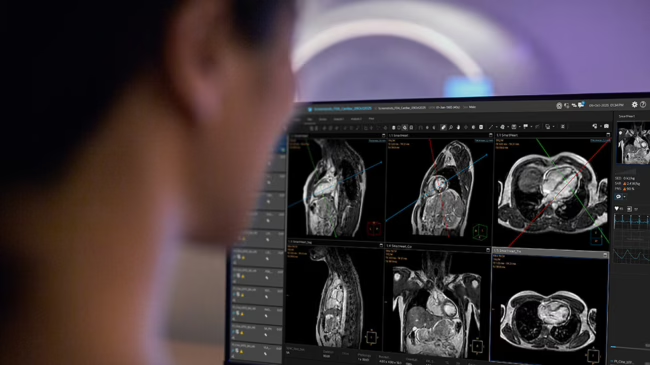
Cardiac MR is widely regarded as one of the most powerful tools for assessing myocardial structure and function. Yet it remains underutilized due to its technical complexity and dependence on highly trained technologists. With SmartHeart, Philips automates the planning of all 14 standard and advanced cardiac views in under 30 seconds. This not only reduces training time but also helps standardize image acquisition across variable staff experience levels.
Industry observers view this as more than a workflow optimization. It could be a strategic shift that enables cardiac MR adoption in secondary or resource-constrained settings, where radiology departments often struggle to staff expert-level cardiac technologists. Automating the planning process reduces skill barriers, allowing more facilities to offer cardiac MR without compromising on scan reproducibility or clinical utility.
How SmartSpeed Precise and free-breathing imaging expand patient inclusion
SmartSpeed Precise uses a dual-layer AI reconstruction model to deliver up to three times faster imaging and up to 80 percent sharper images. The acceleration works across raw signal processing and image-level refinement, which can help reduce motion artifacts and scan repeat rates. For patients, especially those with arrhythmias or poor breath-hold ability, these upgrades directly translate to shorter and more comfortable procedures.
Free-breathing capabilities and single-beat acquisition further expand access for vulnerable populations. These include elderly patients, those with respiratory issues, and individuals undergoing cardio-oncology monitoring, where frequent scanning is required. By enabling diagnostic-quality imaging even in difficult cases, Philips is effectively expanding the eligible patient pool for cardiac MR—while potentially reducing sedation or repeat scan costs.
Clinicians tracking the field believe this shift could bring cardiac MR into workflows where it was previously ruled out due to patient condition or operational logistics. For example, patients with irregular heart rhythms—who would typically yield unusable MR scans—can now be imaged without requiring strict breath-hold compliance or extended motion correction protocols.
What the shift toward quantitative imaging could mean for cardiology workflows
The inclusion of tools like CardiacQuant Perfusion and Cardiac Motion Correction suggests Philips is not merely chasing throughput, but also aiming to elevate cardiac MR as a biomarker-driven modality. By providing non-invasive, non-ionizing quantification of myocardial perfusion, the platform opens new possibilities in heart failure detection, ischemia monitoring, and longitudinal cardio-oncology tracking.
Such quantitative assessments have historically required invasive catheterization or exposure to ionizing radiation via CT perfusion. Philips’ approach, which keeps imaging entirely within the MR domain, avoids those downsides while offering reproducible metrics that can feed into electronic health records or AI-driven decision support platforms.
Regulatory analysts note, however, that these features remain under regulatory review, with several components marked as “510(k) pending” and not yet CE marked or approved for sale in the United States. Until clearance is obtained, their impact will be limited to research settings or international markets where conditional use is permitted.
Still, the movement toward objective, automated quantification aligns with cardiology’s broader shift away from visual reads and toward algorithm-assisted thresholds for diagnosis, treatment eligibility, and outcomes monitoring. As cardiac MR increasingly competes with CT angiography and echocardiography, having quantifiable perfusion data may become a key differentiator—if it can be delivered within reimbursement and workflow constraints.
What Philips’ sustainability angle reveals about its broader strategy
Philips has combined these AI enhancements with its BlueSeal helium-free magnet technology, positioning the cardiac MR suite as both clinically advanced and environmentally sustainable. While helium shortages are not yet an industry-wide crisis, large health systems and academic buyers are increasingly factoring environmental and operating cost considerations into capital equipment decisions.
By eliminating helium dependency and reducing the need for repeat scans through automation and motion correction, Philips is targeting not only improved clinical care but also long-term system-level efficiency. In this context, the AI suite is not a standalone upgrade but part of a larger positioning effort to offer durable, cost-predictable, and low-footprint imaging infrastructure.
Some competitors, including Siemens Healthineers and GE HealthCare, are also pursuing sustainability through magnet design and workflow efficiencies, but Philips’ bundling of these features into a coherent AI-centered vision may set it apart—especially as institutional procurement begins to favor platforms that align with decarbonization mandates or ESG reporting metrics.
Where real-world bottlenecks could stall the AI imaging revolution
Despite the promise, there are clear barriers to broad adoption. Foremost among them is regulatory status. Several of the newly introduced capabilities—including SmartHeart and CardiacQuant Perfusion—are not yet cleared for clinical use in key markets such as the United States. Hospitals may be reluctant to invest in or deploy these tools until regulatory approvals are secured and post-market data validate performance claims.
Reimbursement is another concern. Cardiac MR already faces pressure from faster, cheaper modalities like CT angiography, especially in community settings. Without changes in billing codes or recognition of AI-enhanced efficiency, these innovations may struggle to deliver economic returns for providers. Clinicians and administrators may need to make a case for cardiac MR’s long-term value, particularly in reducing downstream diagnostic uncertainty or avoiding invasive procedures.
Operationally, the learning curve for even AI-assisted tools remains non-trivial. While SmartHeart reduces planning complexity, integrating new workflows still requires technologist training, scanner configuration, and institutional buy-in. If the perceived complexity or transition cost remains high, even strong clinical performance may not be enough to drive widespread shift in practice.
What clinicians and industry observers will watch next
As the new Philips suite rolls out, both clinicians and regulatory watchers are expected to focus on performance in real-world hospital environments—especially how well these AI-driven tools hold up under variable staffing, patient comorbidities, and scan volume pressures. Diagnostic consistency, motion correction effectiveness, and failure rates will be key benchmarks.
Observers also suggest that prospective validation trials, particularly in high-stakes use cases such as cardio-oncology monitoring or ischemia quantification, will help determine whether Philips can convert innovation into adoption. If the data align, the company could position itself at the center of a broader redefinition of cardiac MR as a frontline, not fallback, diagnostic modality.
Final word: a forward-looking cardiac MR strategy built on automation, not just image quality
Philips’ latest launch signals a strategic effort to reposition cardiac MR as a more accessible, scalable, and reproducible modality through full-stack AI integration. By shifting the narrative from niche complexity to system-wide productivity and clinical expansion, the company is aligning product development with the real pain points of today’s radiology departments.
The next phase will depend less on technical specs and more on evidence, economics, and trust. If Philips can demonstrate that automation delivers not just speed and sharpness, but also repeatability and ROI, its cardiac MR suite may mark a turning point in cardiovascular diagnostics—one that moves MR from back room to front line.