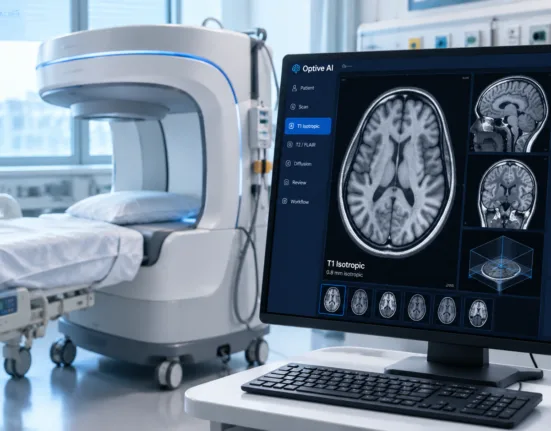
Hyperfine, Inc. has presented results from the PRIME study showing that its Swoop portable MRI system substantially reduced time to brain imaging in emergency department patients with neurological concerns. The prospective randomized study compared bedside portable MRI with conventional MRI workflow and found that portable imaging started far sooner while still detecting critical neurological findings later confirmed on conventional MRI.
Why Hyperfine’s PRIME study matters for emergency neuroimaging adoption
The most important signal from the PRIME study is not simply that portable MRI can produce clinically useful brain images. Hyperfine has already built its commercial case around that claim. The more consequential point is that the study tested whether portable MRI can fit into emergency department workflow at the point where imaging delays can affect triage, disposition, staffing pressure, and patient flow.
That distinction matters because hospitals rarely adopt new imaging platforms only because they are technologically interesting. They adopt devices when those devices solve a workflow problem that existing infrastructure cannot address efficiently. In many emergency departments, conventional MRI remains constrained by scanner access, transport logistics, staff coordination, patient monitoring requirements, and competing inpatient or outpatient demand. CT remains faster and more available, but MRI has stronger value in many neurological scenarios where tissue characterization, ischemic injury, mass effect, hydrocephalus, or other brain findings require deeper assessment.
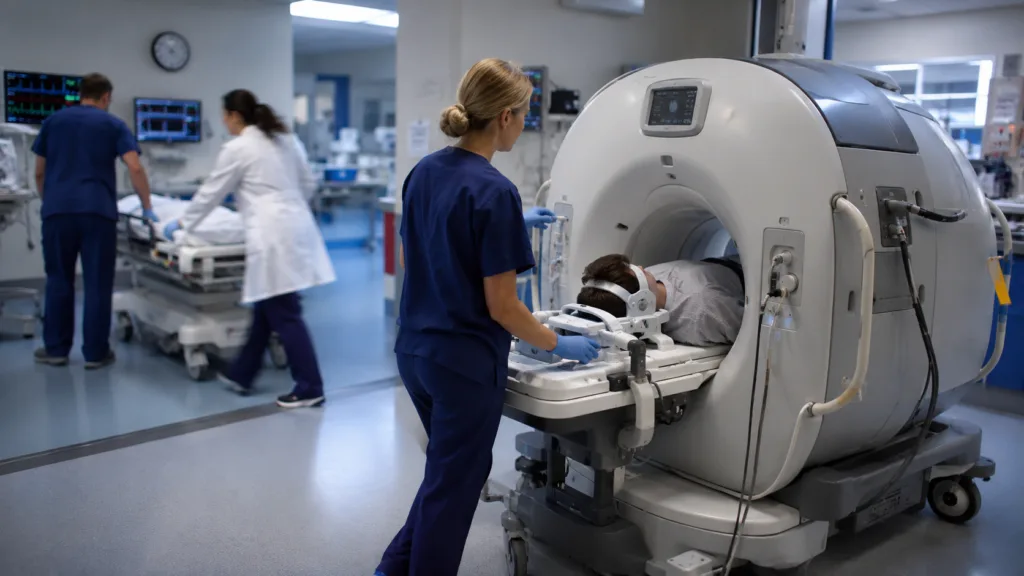
The PRIME data therefore gives Hyperfine a more operational argument. If bedside MRI can move imaging closer to the patient and reduce waiting time from many hours to nearly one hour in selected cases, the device starts to look less like a smaller version of conventional MRI and more like a workflow intervention. That is a stronger commercial story, but it also raises a harder question. Hospitals will need evidence that faster access changes decisions, reduces length of stay, improves throughput, or prevents downstream costs. Speed alone is persuasive, but procurement committees usually want proof that speed translates into measurable clinical and economic value.
What the time-to-imaging reduction reveals about ED workflow bottlenecks
The PRIME study reported a median time from imaging order to scan start of 1.28 hours in the portable MRI arm, compared with 7.76 hours in the conventional MRI-only control arm. That gap is large enough to matter beyond device marketing because it captures a familiar emergency department problem: imaging availability often functions as a hidden gatekeeper in neurological care.
In practical terms, a patient awaiting MRI can remain stuck in diagnostic limbo. Clinicians may be unable to confidently rule in or rule out certain pathologies, beds may remain occupied, and downstream services may wait for imaging confirmation before accepting or discharging a patient. Hyperfine’s data suggests that portable MRI could relieve at least part of this bottleneck by bringing the scanner to the bedside rather than moving the patient through the hospital to the scanner.
However, the operational promise should be interpreted carefully. PRIME was a single-center study with 100 participants, and workflow results can vary significantly by hospital type, MRI capacity, staffing model, emergency department crowding, and radiology availability. A tertiary emergency department with strong academic support may not fully represent community hospitals, rural facilities, safety-net hospitals, or high-volume stroke centers with different triage protocols. The next adoption question is not whether portable MRI can be faster in one controlled study. It is whether that speed advantage persists across more hospitals with different constraints.
How clinically meaningful were the neurological findings detected by portable MRI?
A key strength of the PRIME presentation is that the portable MRI arm did not only demonstrate faster scanning. Hyperfine reported that 18.6% of completed scans revealed critical pathology, including acute ischemic stroke, mass lesions, mass effect, and hydrocephalus, with those findings detected by portable MRI and confirmed on conventional MRI.
That matters because emergency imaging devices must clear a higher bar than convenience. In neurological emergencies, a faster test that misses clinically significant findings can create risk rather than efficiency. The reported confirmation on conventional MRI gives the PRIME results added credibility, especially because the detected pathologies represent conditions where earlier recognition can influence escalation, consultation, admission, monitoring, or treatment planning.
The limitation is that the study summary does not, on its own, settle the broader diagnostic performance question. Clinicians and regulators will want more granular data on sensitivity, specificity, image quality across different conditions, false negatives, false positives, unreadable scans, scan duration, patient selection, and how often portable MRI changed management. A device can be useful as an adjunct without replacing conventional MRI. Hyperfine’s challenge is to define that role clearly so clinicians know when bedside imaging is sufficient, when it is a triage tool, and when conventional MRI remains necessary.
Why portable MRI could become an adjunct rather than a replacement for conventional MRI
The likely near-term opportunity for Hyperfine is not to displace high-field MRI scanners. Conventional MRI remains the reference standard for many neurological indications and offers broader imaging capabilities, stronger resolution, and more established protocols. Hyperfine’s Swoop system is better understood as a complementary tool for settings where conventional MRI is unavailable, delayed, impractical, or operationally burdensome.
That positioning may be commercially smarter. Hospitals are more likely to evaluate portable MRI as a way to expand access and improve throughput rather than as a direct substitute for capital-intensive imaging infrastructure. In emergency departments, intensive care units, neonatal environments, and other constrained care settings, bedside imaging can address a specific access problem. It can also reduce patient transport complexity, which is especially relevant for unstable patients or those requiring monitoring.
The risk is that adjunctive technologies sometimes face reimbursement and workflow ambiguity. If portable MRI adds another imaging step before conventional MRI, hospitals may question whether it increases cost without reducing downstream utilization. Hyperfine’s strongest case will come from studies showing that portable MRI can reduce unnecessary transfers, accelerate disposition, shorten ED boarding, support earlier treatment decisions, or avoid some conventional scans in carefully defined scenarios. Without that economic layer, the technology may remain clinically intriguing but commercially uneven.
What the PRIME data means for Hyperfine’s commercial strategy
Hyperfine is still a small public medical technology company, so clinical evidence has direct importance for investor confidence and hospital sales cycles. The U.S.-based diagnostics-focused company has been trying to convert portable MRI from a novel technology category into a repeatable commercial platform. PRIME strengthens that effort by tying the Swoop system to a concrete emergency department use case rather than a general promise of accessibility.
Recent financial context adds another layer. Hyperfine reported first-quarter 2026 revenue growth from a relatively small base, with investor attention focused on unit placements, margin improvement, cash runway, and whether next-generation Swoop systems can support more consistent adoption. The stock’s recent trading around the low single-dollar range shows that market sentiment remains cautious, even as clinical data points improve. For investors, PRIME is supportive, but it is not yet a commercial inflection point by itself.
That caution is justified. Small-cap medical device companies often move through a difficult middle phase where early clinical evidence looks promising but broad adoption remains slow. Hospital procurement cycles are long. Budget committees demand return-on-investment data. Clinicians need training and confidence. Radiology departments need protocols. Emergency physicians need clarity on when to order the scan. Hyperfine’s opportunity is real, but the company must now show that PRIME-like results can translate into repeatable sales, utilization, and institutional adoption.
Why ED boarding and imaging delays could become the strongest adoption argument
The emergency department boarding angle may be one of the most commercially useful parts of Hyperfine’s story. ED boarding is not just a clinical frustration. It affects hospital capacity, patient satisfaction, staffing burden, ambulance offload delays, and financial performance. If imaging delays contribute to boarding, a device that compresses time to imaging could become attractive to administrators as well as clinicians.
Portable MRI may be especially relevant in neurological cases where uncertainty keeps patients in the emergency department longer than necessary. Faster bedside imaging could help teams decide whether a patient needs admission, specialty consultation, monitoring, transfer, or discharge planning. In theory, that could reduce friction across emergency medicine, neurology, radiology, and inpatient bed management.
Still, the evidence burden remains significant. To win administrator confidence, Hyperfine will need data beyond scan-start timing. The next level of evidence should address door-to-disposition time, length of stay, consult timing, downstream imaging utilization, admission rates, transfer avoidance, and cost per episode. If portable MRI reduces waiting without changing those outcomes, the adoption argument weakens. If it improves throughput or lowers total system burden, the commercial case becomes much stronger.
What clinicians and hospital buyers will watch after the PRIME study
Clinicians are likely to focus on diagnostic reliability, patient selection, and integration into existing neurological emergency pathways. The key question is not whether every patient with a neurological complaint should receive portable MRI. The more useful question is which patients benefit most from rapid bedside MRI before conventional imaging is available.
Stroke triage, altered mental status, suspected mass effect, hydrocephalus evaluation, and cases where CT is insufficient could become important areas for further study. However, each use case carries different clinical and reimbursement implications. A device that works well in one workflow may not automatically fit another.
Hospital buyers will also watch the staffing model. Portable MRI does not become frictionless simply because it is mobile. Sites still need trained operators, physician interpretation, scheduling rules, infection-control procedures, quality assurance, maintenance support, and coordination with radiology. Hyperfine’s Optive AI software may help improve anatomical detail and usability, but software does not remove the need for institutional workflow design.
Could Hyperfine expand portable MRI beyond early adopter hospitals?
The broader promise of portable MRI lies in access. Conventional MRI infrastructure is expensive, fixed, and unevenly distributed. Portable systems could be valuable in hospitals that cannot easily provide rapid MRI access, including smaller facilities, overcrowded centers, or care environments where transport is difficult. Hyperfine’s recent activity in India also suggests a potential international access story, particularly in markets where high-field MRI availability is limited or concentrated in major centers.
That global opportunity is attractive, but it brings its own constraints. International expansion requires regulatory clearance, local clinical validation, distribution support, service infrastructure, training, pricing flexibility, and reimbursement adaptation. A portable MRI system may be cheaper and more flexible than conventional MRI, but adoption still depends on hospital budgets and local care pathways.
For Hyperfine, this means the company must balance evidence generation with commercialization discipline. The PRIME study gives the medical device manufacturer a stronger clinical narrative, but the next phase will be judged on whether hospitals actually increase utilization, whether repeat placements grow, and whether portable MRI becomes embedded in emergency care protocols rather than used only as a specialized tool.
Why the PRIME study is promising but not yet definitive
The PRIME study is an important step because it moves portable MRI closer to the center of emergency department workflow debate. The randomized design, prospective structure, 100-participant enrollment, and conventional MRI confirmation of critical findings all strengthen the relevance of the data. The reduction in median time to imaging is also large enough to attract attention from clinicians and administrators dealing with real-world bottlenecks.
However, the study is still early evidence for a broader adoption thesis. It does not yet prove system-wide cost savings, broad diagnostic equivalence, improved outcomes, or scalability across diverse hospitals. It does not eliminate the need for conventional MRI. It does not answer every question about reimbursement, staffing, interpretation, or long-term utilization.
The balanced takeaway is that Hyperfine has strengthened the clinical and operational rationale for bedside portable MRI in emergency neuroimaging. The data supports the idea that portable MRI can reduce delays and detect meaningful pathology in selected emergency department patients. The next test is whether Hyperfine can convert that evidence into multi-site validation, repeatable hospital workflows, and a commercial model strong enough to move portable MRI from promising adjunct to routine emergency care tool.