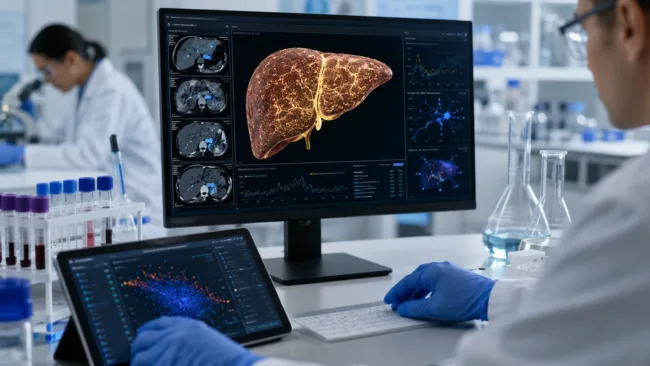
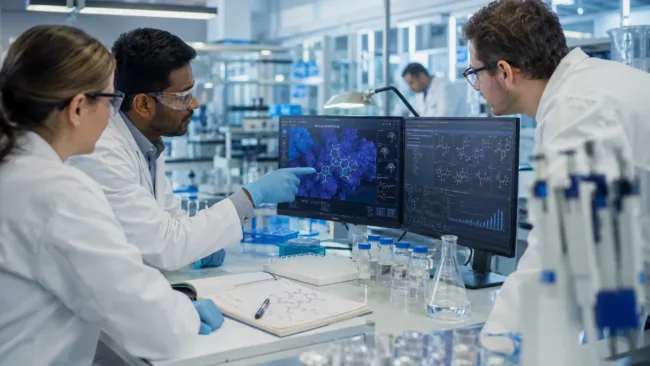
Recursion Pharmaceuticals, Inc., a clinical-stage TechBio company, will participate in a HighRes Biosolutions lightning talk at NVIDIA GTC 2026 focused on AI agents, robotics, and digital twins in self-driving laboratories and biomanufacturing. The session highlights Recursion Pharmaceuticals’ collaboration with HighRes Biosolutions to integrate robotic perception, digital lab twins, and natural language-driven orchestration into high-throughput drug discovery workflows. The announcement situates the U.S.-based biotech firm within a broader push to operationalize automated, AI-guided discovery infrastructure in clinically active pipelines.
The immediate significance lies not in conference visibility but in whether self-driving laboratory architecture is becoming deployable infrastructure rather than conceptual demonstration.
What this reveals about the industrialization of AI-driven wet and dry lab integration in clinical-stage biotech
Recursion Pharmaceuticals has spent more than a decade building integrated wet and dry lab operations capable of generating large-scale multi-omic datasets to train machine learning models. The biotech firm reports producing millions of biological data points each week, feeding foundation models that guide hypothesis generation, compound prioritization, and translational refinement.
The collaboration with HighRes Biosolutions adds technical depth to this model. HighRes Biosolutions brings robotic perception, digital representations of laboratory environments, and orchestration platforms capable of translating natural language inputs into coordinated experimental workflows. This signals a shift from isolated automation tools toward a unified execution layer in which AI agents, robotics, and computational models operate in closed-loop coordination.
Automation in pharmaceutical research is not new. High-throughput screening systems and robotic liquid handlers have existed for years. What appears more novel is the attempt to integrate physical lab systems with digital twins and AI-driven orchestration that continuously adapts experimental design based on real-time outputs. Industry observers note that such systems could reduce variability, compress iteration cycles, and enable standardized experimentation across programs.
Whether this represents true industrialization depends on reliability under production conditions. A self-driving laboratory must manage heterogeneous assays, maintain calibration integrity, and handle unexpected variability without constant manual correction. Technical sophistication alone does not guarantee operational resilience.
What this changes for data generation scale, model validation, and translational probability
Recursion Pharmaceuticals operates BioHive-2, an NVIDIA-backed supercomputing infrastructure that trains machine learning models on internally generated biological data. The company’s strategy emphasizes vertical integration, meaning data generation, model training, and experimental validation are tightly coupled.
If self-driving laboratories reduce latency between experiment and model retraining, the biotech firm could increase the speed at which biological hypotheses are tested and refined. In early discovery, time compression matters. Faster iteration can allow more candidate molecules to be evaluated within the same budget envelope. In theory, this may improve the statistical probability of identifying viable therapeutic assets.
Clinicians tracking AI-native discovery platforms are increasingly asking whether such infrastructure leads to clearer mechanistic understanding. Automated multi-omic data collection may enhance signal detection in complex biological systems. However, data volume does not automatically equate to biological insight. Model interpretability, assay quality, and rigorous validation remain critical.
Regulatory watchers also note that as algorithmic influence grows in target selection and compound prioritization, documentation standards must evolve. Agencies may seek transparency into how AI models contribute to decision-making pathways. A self-driving laboratory system that lacks auditability could face scrutiny when assets move into clinical development.
The question therefore shifts from computational capacity to validation credibility. Demonstrating that AI-orchestrated experimentation improves candidate quality will require comparative evidence, either through improved attrition rates or more efficient dose optimization strategies in early trials.
What regulators and quality leaders will examine as AI agents and robotics scale across discovery and manufacturing
The NVIDIA GTC panel includes not only Recursion Pharmaceuticals and HighRes Biosolutions but also Multiply Labs and Thermo Fisher Scientific, indicating broader industry engagement. As AI agents move deeper into laboratory execution, quality and compliance considerations intensify.
Regulators will likely focus on data integrity frameworks, traceability of experimental decisions, and reproducibility across automated systems. Digital twins that simulate laboratory environments must accurately reflect physical parameters. If AI agents adjust protocols dynamically, the logic governing those adjustments must be documented and reproducible.
In biomanufacturing contexts, scalability presents additional complexity. Laboratory-scale automation does not always translate seamlessly into good manufacturing practice environments. Process validation requirements are stringent, and any algorithmic modification of manufacturing parameters must be justified and documented. Industry observers suggest that early incorporation of compliance architecture into self-driving systems could reduce downstream friction.
There is also an ecosystem question. If automation platforms rely heavily on proprietary orchestration stacks, interoperability challenges may emerge when integrating with contract development and manufacturing organizations or external research collaborators. Standardization across vendors may become a strategic priority.
What risks remain if infrastructure ambition outpaces clinical evidence and organizational integration
The economic case for self-driving laboratories rests on productivity gains. Robotics, advanced computing infrastructure, and digital twin development require significant capital expenditure. If these investments do not translate into faster progression to clinical proof of concept, the return on investment may be questioned.
There is operational risk as well. Integrating AI agents with physical laboratory hardware introduces points of failure. Software bugs, sensor errors, and calibration drift can disrupt experiments. Robust monitoring systems and fallback protocols are necessary to prevent small technical issues from cascading into data integrity problems.
Cultural integration within research teams is another factor. Transitioning from manually directed experimentation to orchestration-driven workflows changes the role of bench scientists. Adoption depends on trust in automated systems and clarity around human oversight responsibilities. Industry observers note that technology adoption often fails not because of technical limits but because of organizational resistance or unclear governance.
From a competitive standpoint, not all AI-focused biotech firms are pursuing heavy robotics integration. Some companies emphasize partnerships with external laboratories and cloud-native modeling approaches to limit fixed costs. If those lighter models achieve comparable clinical outcomes, vertically integrated self-driving lab systems may face scrutiny over capital intensity.
At the same time, if Recursion Pharmaceuticals demonstrates that integrated automation materially improves discovery output and candidate quality, the firm could set a new operational benchmark. Success would validate the premise that infrastructure depth can become a strategic differentiator in drug discovery.
The upcoming NVIDIA GTC platform therefore serves as more than a marketing event. It is a public articulation of an infrastructure strategy that will be judged over time by translational outcomes, regulatory robustness, and economic performance. The biotechnology sector has long sought to industrialize discovery. The emergence of coordinated AI agents, robotics, and digital twins suggests that industrialization efforts are entering a more cohesive phase.
Whether this evolution meaningfully shifts clinical productivity remains an open question. The next indicators to watch include the pace of candidate advancement, evidence of improved reproducibility, and clarity around regulatory documentation standards for AI-guided experimentation. For Recursion Pharmaceuticals, the burden of proof will rest not on computational scale but on therapeutic impact.