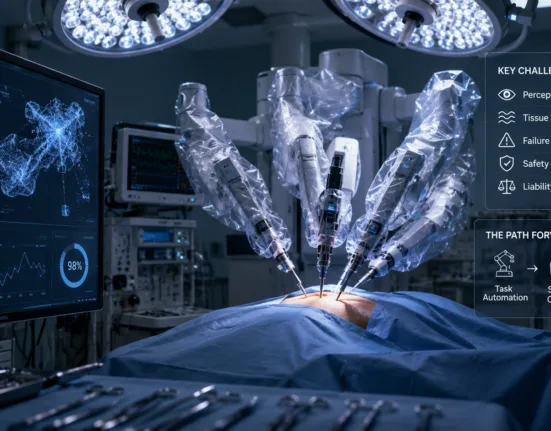
Vicarious Surgical Inc. has initiated a major operating model shift by outsourcing core software development for its robotic surgery platform to a global engineering services provider. The decision reflects the company’s strategy to tighten cash burn, improve engineering milestone predictability, and redeploy internal resources toward system integration and clinical readiness milestones.
The partnership marks a significant structural evolution for the U.S.-based surgical robotics firm, which will now rely on an external team to develop key subsystems including control software, imaging, and workflow orchestration. The move aligns with broader cost-optimization efforts the company has flagged over the past year and suggests a readiness to scale development without expanding fixed internal headcount.
Why software outsourcing reflects a transition from prototyping to platform readiness
Outsourcing software development for a surgical robot is not a trivial pivot. For Vicarious Surgical, it marks a shift from iterative prototyping toward a more disciplined execution environment. This transition is particularly notable because the company is still pre-commercial and navigating toward its first-in-human clinical trial. Outsourcing critical software functions at this stage implies that internal resources were nearing operational limits or becoming financially unsustainable.
The shift also underscores how surgical robotics firms at this stage must balance agility with regulatory rigor. As platform complexity increases, maintaining milestone momentum while also satisfying design controls, traceability, and quality systems becomes exponentially harder to do in-house. The hybrid model adopted by Vicarious Surgical—internal innovation teams paired with outsourced software execution—may allow for faster scale without sacrificing focus on FDA-facing deliverables.
The company’s CEO, Stephen From, indicated that the external firm’s experience with similarly complex systems was a key factor in the decision, suggesting that software modularity and engineering process maturity will become gating factors for progress in the coming quarters.
What this restructuring reveals about execution pressure across the surgical robotics sector
Vicarious Surgical is not the only company in this space facing execution headwinds. From Asensus Surgical’s ongoing capital constraints to CMR Surgical’s challenges around manufacturing scale-up in Europe, many firms operating outside the orbit of Intuitive Surgical or Medtronic are being forced to rethink their development model.
What distinguishes Vicarious Surgical is the timing and transparency of this move. Rather than quietly integrating contract developers, the company has publicly committed to a formal transition plan, suggesting it wants investors and regulators to view this as a deliberate step toward maturity, not a reactive cost-cutting measure.
Sector analysts note that this strategy may also be a defensive measure to preserve runway while avoiding a dilutive financing event. If the outsourced model stabilizes the roadmap, it could help support valuation as the company inches closer to regulatory inflection points.
However, the visibility of the shift also brings scrutiny. Regulatory agencies such as the U.S. Food and Drug Administration tend to scrutinize organizational and process changes during preclinical and investigational stages, especially for class III devices like robotic systems.
The regulatory stakes: Will a new software development partner delay or de-risk submissions?
While the company has framed the outsourcing deal as a velocity-enhancer, regulatory watchers are likely to question whether shifting responsibility for software development mid-stream could introduce friction into Vicarious Surgical’s investigational device exemption (IDE) pathway or first-in-human application timelines.
Software intended to control motion, visualization, and intraoperative workflows falls squarely under IEC 62304 regulatory scrutiny. Any change in development infrastructure, source control, verification and validation protocols, or documentation traceability may require additional disclosures or audits during IDE review or pre-submission engagements.
The company has not indicated whether the external partner is ISO 13485-certified or whether the engagement includes full alignment with Vicarious Surgical’s internal quality systems. While the onboarding is reportedly structured to maintain workstream continuity, FDA concerns about architectural consistency or feature validation across software revisions could still arise.
If successful, however, the outsourcing arrangement could offer the agency greater process transparency through modular documentation and structured releases—a known advantage when dealing with large-scale digital surgical platforms.
Internal teams pivot to integration as software partner ramps execution
The second-order implication of this deal is the recalibration of Vicarious Surgical’s internal teams. By moving core engineering functions outside the company, internal resources are being freed to focus on integration, verification, and overall system orchestration. This specialization could enable more coherent design freeze execution and better trial-readiness preparation.
However, the loss of embedded institutional memory from internal software developers—those most familiar with prototype quirks and iterative evolution—raises potential risks during integration and debugging phases. If the software partner lacks context around historical design decisions or fails to maintain version parity with hardware iteration cycles, schedule slippage could still occur.
Clinicians who have interacted with Vicarious Surgical’s system in usability studies or development partnerships will be watching closely for signs of regression or stalled iteration. Any deterioration in response time, haptics, image latency, or workflow coherence would likely signal transitional frictions within the outsourced model.
What clinicians and investors will be tracking ahead of the next clinical milestone
The company’s broader capital allocation and timeline discipline will now come under closer scrutiny. Stakeholders are likely to track several signals in the months ahead:
Vicarious Surgical’s ability to hit a credible design freeze date will serve as a leading indicator of platform stability under the hybrid model. Without this milestone, trial start projections will remain speculative.
The pace of preclinical testing across simulated or cadaveric procedures will also be critical. Clinicians want assurances that outsourced modules do not introduce novel failure modes or regress usability gains.
Transparency around regulatory engagement—such as pre-submission feedback or IDE filing dates—will help validate the outsourced model’s compliance posture.
If these milestones are met without visible delay or revision, the software partnership may be seen as a disciplined, capital-efficient maneuver. If timelines slip or filings get delayed, the decision could backfire and reinforce investor concerns about premature scaling.
Competitive implications for the surgical robotics field
The move sets Vicarious Surgical apart from competitors still clinging to vertically integrated development. It suggests that next-generation surgical platforms may no longer be built entirely in-house, especially when capital is constrained and development timelines are long.
This modular, outsourced model could appeal to other emerging players with limited bandwidth, though it also raises the bar for supplier oversight, compliance coordination, and quality system integration. If successful, Vicarious Surgical may emerge as a blueprint for how lean surgical robotics firms can scale without overextending.
Conversely, larger firms like Johnson & Johnson’s Ottava program or Medtronic’s Hugo system may continue to view vertical integration as essential to clinical control and differentiation. The field is now testing divergent strategies around development philosophy as much as technical design.