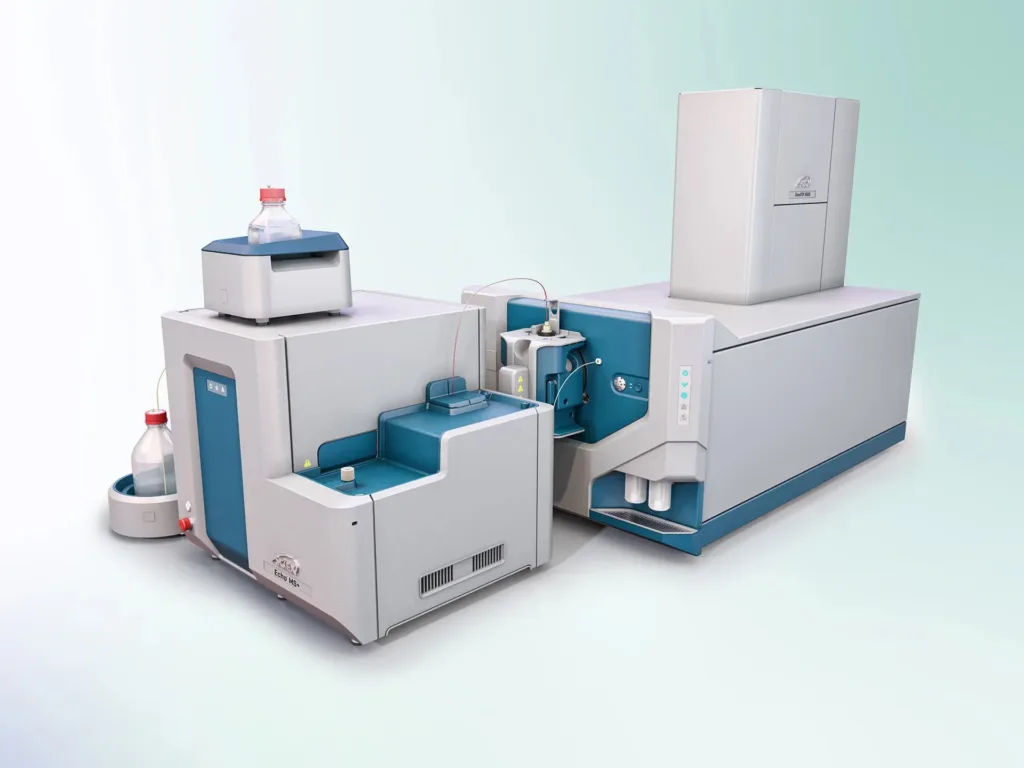
SCIEX, a Danaher life sciences operating company, announced that its Echo MS+ system is now compatible with the ZenoTOF 8600 mass spectrometer, extending high-throughput, label-free screening workflows to the company’s highest-sensitivity accurate mass platform within research and drug discovery environments.
From an industry perspective, the significance of this integration lies less in the headline claim of higher throughput and more in what it enables operationally for laboratories that sit at the intersection of early discovery, proteomics, and ultra-low sample analysis. High-throughput mass spectrometry has historically forced labs to compromise between speed, sensitivity, and sample consumption. This move signals a deliberate attempt by SCIEX to collapse those trade-offs into a single workflow that scales without rewriting assay design from scratch.
How Echo MS+ and ZenoTOF 8600 integration reshapes throughput-driven mass spectrometry strategies at scale
High-throughput mass spectrometry is not a new aspiration, but adoption has lagged behind automation in adjacent screening technologies. Traditional LC-MS workflows, even when optimized, impose physical limits through chromatography, carryover risk, and sample preparation overhead. Acoustic ejection platforms such as Echo MS+ remove some of those constraints, yet sensitivity ceilings have historically limited their application to certain compound classes or abundance ranges.
By pairing Echo MS+ with the ZenoTOF 8600 system, SCIEX is effectively repositioning acoustic sample introduction as a front-line screening approach rather than a niche alternative. The ZenoTOF architecture has been marketed around enhanced ion utilization and sensitivity, particularly for low-abundance species. Industry observers note that combining this with contactless nanoliter-scale sampling directly addresses one of the most persistent objections to acoustic MS workflows, namely the fear that speed comes at the expense of depth.
For large discovery organizations running thousands of samples per day, this integration shifts the calculus. Rather than treating accurate mass confirmation as a downstream bottleneck, labs can increasingly design workflows where high-confidence identification occurs earlier, reducing rework and redundant assays. The result is not just faster screening but a compression of decision timelines across discovery programs.
Why direct, label-free measurement at nanoliter scale changes assay economics, not just speed
Much of the commercial messaging around acoustic mass spectrometry emphasizes speed metrics such as samples per second. What matters more operationally is the knock-on effect on assay economics and resource utilization. Label-based screening remains common because it is scalable and predictable, but it introduces its own costs, including reagent complexity, signal artifacts, and limited applicability to certain targets.
Direct, label-free mass spectrometry allows labs to interrogate native compounds and proteins without proxy readouts. When this can be done using as little as a few nanoliters of sample, the economics change materially. Industry analysts tracking discovery operations point out that protein scarcity, not instrument time, is increasingly the limiting factor in early-stage programs, especially in biologics and complex modality pipelines.
The Echo MS+ and ZenoTOF 8600 combination directly addresses this constraint by allowing reliable measurements from significantly smaller quantities. That capability is particularly relevant for academic-industry collaborations, rare target exploration, and early feasibility studies where sample replenishment is slow or expensive. Over time, this shifts budget allocation away from repeated expression and purification cycles and toward broader hypothesis testing.
Competitive implications for mass spectrometry vendors targeting automated discovery workflows
The analytical instrumentation market has become increasingly polarized between ultra-high-end platforms optimized for depth and robustness, and high-throughput systems optimized for screening volume. SCIEX’s strategy here suggests a bid to blur that distinction and capture customers who want both within a single vendor ecosystem.
Competitors offering acoustic or rapid-fire MS solutions have often relied on triple quadrupole systems or lower-resolution instruments to achieve throughput targets. While those approaches remain valid for quantitation, they do not fully address the growing demand for accurate mass data earlier in the workflow. By extending Echo MS+ compatibility beyond the ZenoTOF 7600 to the higher-performance ZenoTOF 8600, SCIEX is signaling that it sees accurate mass not as a premium add-on but as a baseline expectation.
This creates pressure on rival vendors to either enhance sensitivity within their own high-throughput platforms or risk being segmented into narrower use cases. Industry observers believe this could accelerate consolidation of workflows around fewer, more flexible platforms rather than a patchwork of specialized instruments.
What this integration reveals about automation convergence in modern discovery laboratories
One of the subtler implications of the Echo MS+ and ZenoTOF 8600 integration is its alignment with broader laboratory automation trends. High-throughput screening no longer exists in isolation but as part of integrated, end-to-end discovery pipelines that include robotic handling, data management, and AI-assisted analysis.
The ability of the combined system to couple with front-end automation is not incidental. Discovery organizations are increasingly designing facilities around continuous workflows rather than discrete assay stages. In this context, any analytical bottleneck becomes disproportionately expensive. Industry insiders suggest that platforms which can slot cleanly into automated pipelines without bespoke customization will see disproportionate adoption over the next five years.
This integration positions SCIEX not merely as an instrument supplier but as a workflow enabler, an important distinction as procurement decisions shift from individual principal investigators to centralized operations teams focused on throughput, uptime, and standardization.
Regulatory boundaries and use-case clarity remain critical despite research-focused positioning
While the integration is firmly positioned within research use cases, regulatory boundaries still matter. SCIEX explicitly distinguishes between research-use instruments and its clinical diagnostic portfolio, and that distinction will remain important as high-throughput MS techniques edge closer to translational and preclinical decision-making.
Regulatory watchers caution that while label-free, direct measurement offers clear scientific advantages, its path into regulated environments is less straightforward. Validation, reproducibility across sites, and long-term stability under continuous operation will all be scrutinized if such workflows are to inform later-stage development or regulated bioanalysis.
For now, the Echo MS+ and ZenoTOF 8600 pairing is best understood as a discovery-stage accelerator rather than a clinical analytics solution. Maintaining clarity around intended use will be important to avoid overextension and customer confusion.
Risks and adoption hurdles laboratories will assess before scaling deployment
Despite its promise, adoption is not automatic. High-throughput mass spectrometry platforms often encounter resistance from labs invested heavily in established LC-MS infrastructure. Transitioning assays to acoustic workflows requires upfront method development, staff training, and confidence that data continuity will be preserved.
Additionally, while nanoliter-scale sampling reduces sample consumption, it increases sensitivity to variability in upstream preparation. Industry practitioners note that success with acoustic MS workflows depends as much on disciplined sample handling as on instrument performance. Organizations lacking mature automation practices may struggle to extract full value from the integration.
Cost considerations also remain. High-end accurate mass spectrometers represent significant capital investments, and the incremental value of enhanced throughput must be justified against alternative approaches such as parallelization or outsourcing. Early adopters are likely to be well-funded pharmaceutical companies and large research institutes rather than smaller biotech firms.
What industry observers are likely to watch next as SCIEX extends the Echo MS+ ecosystem
Looking ahead, industry observers will focus on whether SCIEX continues to broaden Echo MS+ compatibility and how quickly real-world performance data emerges from customer laboratories. Peer-reviewed publications and conference presentations demonstrating reproducibility, robustness, and decision impact will matter more than throughput benchmarks alone.
There will also be attention on software integration, particularly around data handling and interpretation at scale. High-throughput accurate mass data is only valuable if it can be processed and contextualized efficiently. Any friction at the data layer could blunt the operational gains promised at the instrument level.
Ultimately, this integration should be viewed as part of a longer-term strategy to redefine how mass spectrometry fits into modern discovery pipelines. If SCIEX can demonstrate that high sensitivity, speed, and automation can coexist without compromise, it will strengthen its position in a market increasingly defined by workflow cohesion rather than individual instrument specifications.