Bendit Technologies has secured 510(k) clearance from the U.S. Food and Drug Administration for its Bendit17 steerable microcatheter, a device the company describes as the smallest steerable microcatheter available for use in neurovascular and peripheral endovascular interventions. With U.S. commercialization slated to begin in January 2026, the Israel-based medical device manufacturer is also pursuing regulatory approvals in global markets as it seeks to scale production and adoption.
Why steerable catheter platforms are entering a new phase of innovation
The regulatory nod for the Bendit17 signals more than a product launch. It reflects a strategic shift in how manufacturers are approaching catheter design, especially in the neurovascular domain. Industry observers tracking this category suggest that steerable catheters are increasingly viewed as precision tools for operators working in complex anatomy, not just delivery conduits for embolic or retrieval devices. Traditional microcatheters have long relied on pre-shaped tips, passive torque transmission, and guidewire support to navigate vascular pathways. The introduction of active, real-time steerability—particularly in a sub-2 Fr profile—represents a meaningful advancement in the evolution of endovascular tools.
Clinicians involved in endovascular procedures have increasingly expressed demand for devices that reduce catheter exchanges, enable quicker access, and minimize procedural risk. The Bendit17’s ability to navigate without a guidewire introduces a design shift that could reduce operator burden and procedural time, particularly in cases where anatomy is tortuous, calcified, or otherwise high-risk. If that capability proves stable and predictable under real-world use, it could position the Bendit17 as a category disruptor.
What the Bendit17 could change in neurovascular and peripheral procedures
For interventionalists operating in the neurovascular space, procedural control and fine navigation are critical. The ability to direct a catheter through sharp vessel turns, reach distal territories without prolapse, and maintain positional stability during device deployment can often define success or failure in procedures such as aneurysm coiling, AVM embolization, or stroke interventions. The addition of a low-profile, steerable catheter may reduce the number of steps involved in reaching the target lesion, decreasing radiation exposure and contrast agent use for both the patient and operator.
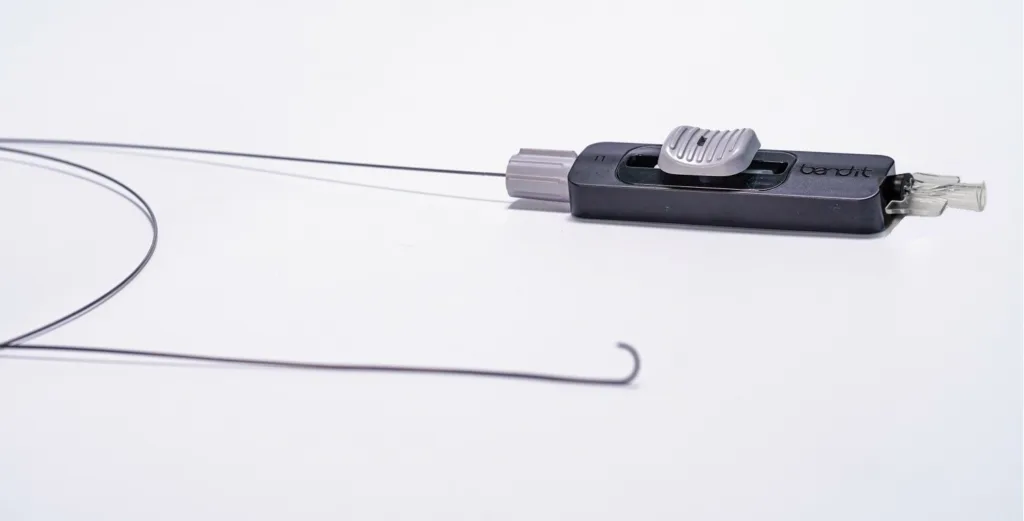
While the benefits of steerability have been recognized in larger-profile catheters, the challenge has always been miniaturization without compromising structural integrity. By offering an ultra-thin platform with internal steering, Bendit Technologies is making a bet that interventionists are ready for an intuitive tool that can reach more challenging anatomy while supporting broader clinical workflows.
From a clinical workflow standpoint, Bendit Technologies also aims to reduce guidewire dependence, which has historically added complexity and friction to microcatheter procedures. If the Bendit17’s performance holds up across patient types and use cases, it could reduce total procedural steps while improving overall control, a combination that resonates strongly with experienced operators seeking to minimize variability and risk.
How the device compares with other steerable systems in the field
While the Bendit17 may be among the smallest steerable microcatheters cleared to date, the broader field is no stranger to steerable technology. Companies such as Penumbra, Medtronic, and Stryker Neurovascular have all introduced catheter systems with deflectable or articulating tips aimed at addressing similar challenges. What differentiates the Bendit17 is its focus on ultra-low profile and steerability without a guidewire, which, if clinically validated, could provide unique utility in narrow, tortuous vessels or in situations where wire access is limited.
Another distinguishing factor lies in the Bendit17’s potential ability to offer continuous tip articulation with radiopaque visualization, enabling the operator to make fine directional adjustments without catheter rotation. Industry analysts who have reviewed early prototypes suggest that this kind of design could make a difference in high-precision procedures like embolization of distal AVMs or selective intra-arterial drug delivery.
Still, competition in the steerable space remains fierce. Other manufacturers have the advantage of larger installed user bases, broader product portfolios, and established training pathways. Bendit Technologies will likely need to demonstrate not just product superiority but also ease of use, reliability, and value in the context of a comprehensive neurovascular toolkit.
What adoption may depend on beyond clinical performance
Even with regulatory clearance secured, the commercial rollout of the Bendit17 will be shaped by multiple external factors. One of the most important is operator training. Devices that require a different tactile feedback, steering motion, or deployment technique can take time to integrate into routine workflows. To gain traction in U.S. hospital systems and interventional radiology departments, Bendit Technologies will need to invest in proctoring programs, device simulations, and in-lab demonstrations to reduce adoption barriers.
Reimbursement will also be a crucial part of the equation. Although the device falls under existing procedural codes for microcatheter-based interventions, payers and hospital systems may require data on procedural efficiency, cost reductions, or improved outcomes to justify premium pricing. In the current economic climate, where value-based care metrics are increasingly tied to purchasing decisions, new device platforms must offer tangible, quantifiable benefits.
Another factor will be manufacturing scalability. While Bendit Technologies has stated it is in the final stages of production ramp-up, long-term commercial success depends on consistency of product quality and a reliable supply chain. Medical device buyers tend to avoid supply-side risks, especially in acute care settings where procedural delays can impact patient outcomes. Investors watching the company’s rollout will be paying close attention to its ability to meet demand while maintaining manufacturing precision and support infrastructure.
What regulators and clinicians will watch after launch
With the U.S. Food and Drug Administration clearance now complete, regulatory focus will shift toward post-market surveillance and real-world performance data. One area likely to draw scrutiny is the guidewire-free navigation claim. While the 510(k) pathway allows for clearance based on substantial equivalence, novel capabilities that deviate from standard practice often attract closer monitoring, especially if procedural complications or atypical use patterns emerge in the field.
Clinical users, meanwhile, will be evaluating the Bendit17 across multiple use cases. Its effectiveness in navigating distal cerebral vessels, maintaining torque stability in dynamic anatomy, and resisting kinking or deformation under stress will determine whether it becomes a go-to tool or remains confined to niche applications. If it gains traction in high-volume neurovascular centers, its adoption could spread quickly, especially among younger operators who are more comfortable with emerging technologies.
Additionally, academic users may push for registry data, case series publications, or comparative trials to better understand where the Bendit17 fits within the evolving treatment landscape. Without published evidence or peer-reviewed support, even the most innovative devices can struggle to gain institutional trust.
What this moment could mean for Bendit Technologies’ strategic direction
For Bendit Technologies, the clearance of the Bendit17 represents a pivotal moment. It brings the company from the realm of R&D and prototype testing into the commercial arena. Success will now depend on execution across multiple fronts: clinician education, supply chain integrity, field support, and data generation. The company is also expected to pursue additional global clearances, a strategy that may bring both opportunity and regulatory complexity as device expectations differ across jurisdictions.
While the current announcement centers on the U.S. Food and Drug Administration’s clearance for a single microcatheter product, the broader implication is that Bendit Technologies is positioning itself as a platform innovator in endovascular navigation. If it can establish clinical credibility and prove that its technology scales across other vessel sizes, procedures, or specialties, the company may find itself with a competitive foothold in a high-value segment.
Still, risks remain. Market penetration in the neurovascular device space typically requires years of sustained investment, consistent clinical engagement, and product iteration. Moreover, the steerable catheter category is still young, and physician preferences may evolve as more vendors enter the space with their own approaches to real-time steering.
How Bendit Technologies manages this post-clearance phase—balancing innovation with reliability and clinical integration—will ultimately determine whether the Bendit17 becomes a milestone product or merely an early iteration of a longer-term steerable catheter journey.