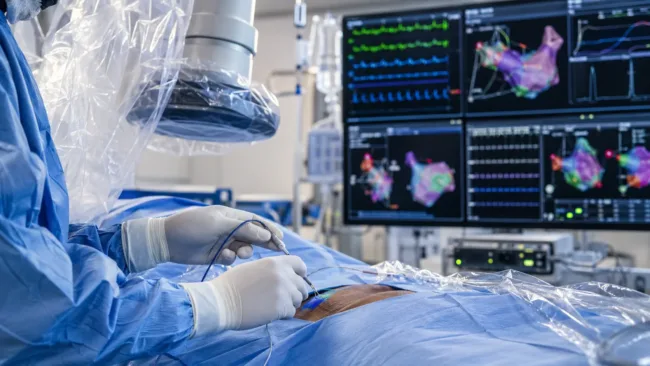
BEAVERTON, Ore., Jan. 12, 2026 — YorLabs Inc. has announced the successful first clinical use of its FDA 510(k)-cleared Intracardiac Imaging System during an atrial fibrillation ablation procedure at Oregon Health & Science University. The procedure marks the debut of a Zero-CapEx, single-operator intracardiac echocardiography (ICE) platform that bypasses traditional capital equipment models in favor of software-defined, wireless imaging designed for seamless cath lab integration.
What the first-in-human use confirms about ICE adoption friction and capital bottlenecks
The initial clinical use of the YorLabs system provides tangible evidence that a streamlined, cost-neutral ICE platform can function effectively in high-acuity settings without traditional console-based infrastructure. Historically, widespread ICE adoption has been hampered not only by the steep capital investment required for dedicated ultrasound consoles, but also by the need for additional trained personnel to operate them.
This operational friction is particularly pronounced in smaller hospitals, ambulatory surgical centers, and mid-tier procedural labs that may perform electrophysiology (EP) and interventional cardiology (IC) procedures but lack the economic latitude for high-end ICE systems. By designing a platform that is compact, software-driven, and deployable under a zero-capital model, YorLabs is attempting to open ICE imaging to a significantly broader segment of the U.S. procedural market.
Early user feedback from OHSU clinicians suggests the system not only integrated well with existing workflows but delivered image quality suitable for real-time procedural guidance. If this performance holds up across multiple clinical settings, YorLabs could be setting a precedent for broader procedural democratization in image-guided therapies.
Why the Zero-CapEx model matters for the electrophysiology ecosystem in 2026
The use of ICE is becoming increasingly central to procedural safety and efficacy in cardiac ablation, left atrial appendage closure, transseptal access, and emerging structural interventions. ICE offers clear advantages over TEE, including reduced anesthesia need, better patient comfort, and continuous real-time feedback during interventions.
However, ICE systems remain underpenetrated in community hospitals and secondary centers, largely due to acquisition and maintenance costs. YorLabs’ Zero-CapEx model shifts the discussion from asset purchase to procedural enablement, allowing labs to access advanced imaging on a per-use or subscription basis. This strategy mirrors broader medtech trends where recurring revenue and usage-based pricing models are replacing one-time capital sales.
Regulatory observers suggest that such models could gain traction with hospital administrators under pressure to contain CapEx and avoid long depreciation cycles—particularly when technological advances may quickly render traditional ultrasound platforms obsolete. For YorLabs, this model could enable faster market entry, especially in cost-sensitive environments like integrated delivery networks and accountable care organizations.
What distinguishes YorLabs technically—and where clinical caution is warranted
The current iteration of the YorLabs platform supports high-resolution 2D ICE imaging and is operated via a tablet-like interface controlled by a single physician. Its software-defined architecture allows wireless deployment, offering portability and workflow flexibility that most console-based systems lack.
The firm has also articulated plans to expand into 4D ICE, which would bring volumetric imaging into its portfolio. However, the 4D upgrade is still in development, which limits the system’s suitability for procedures that now rely heavily on real-time volumetric guidance—particularly in structural interventions involving the left atrium or pulmonary veins.
Clinicians familiar with 4D ICE tools from Philips or Siemens will note that real-world procedural differentiation often comes down to subtle improvements in imaging granularity, catheter visualization, and anatomical landmark recognition. It remains to be seen whether a capital-light system can deliver on those clinical nuances without the hardware acceleration and integrated ecosystem that traditional players offer.
Another open question surrounds durability and support. Wireless systems often require robust IT integration, cybersecurity protocols, and frequent firmware updates. Hospitals may view these as potential vulnerabilities in sterile, high-pressure procedural environments where latency, connectivity, or software errors could introduce clinical risk. YorLabs will need to demonstrate rigorous uptime reliability and streamlined IT onboarding during its limited market release.
What this milestone reveals about the evolving regulatory posture for image-guided procedural tools
YorLabs’ successful 510(k) clearance suggests a favorable regulatory pathway for imaging platforms that do not introduce new therapeutic mechanisms but instead optimize workflow, reduce cost, or expand access. Since the system builds on predicate ICE technology while innovating around form factor and delivery model, it falls into a class of imaging solutions that regulators can greenlight without full premarket approval (PMA) review.
That said, reimbursement parity will be a separate challenge. If hospitals and payers do not view the YorLabs ICE system as equivalent in function and outcome to legacy consoles, adoption could be stymied despite operational appeal. Industry analysts will be watching closely to see how the Centers for Medicare and Medicaid Services (CMS) treat billing for procedures conducted with YorLabs ICE and whether payers will require documentation of cost-benefit validation.
Further, as ICE becomes embedded in hybrid procedures—such as combined atrial fibrillation and left atrial appendage closure cases—multi-modality imaging interoperability will become critical. YorLabs’ ability to integrate with mapping systems, ablation catheters, and robotic guidance platforms could determine whether its solution remains standalone or becomes part of a broader digital procedural ecosystem.
Why site selection and clinician endorsement could accelerate mainstream viability
Oregon Health & Science University is not just a procedural proving ground. As a national reference center, OHSU’s adoption carries signaling value to other hospitals, many of which look to academic centers for validation of new imaging and therapeutic tools. YorLabs’ early association with leading interventionalists lends the company both clinical and market credibility ahead of its wider U.S. rollout.
The firm’s marketing emphasis on “fit and feel” within the existing cath lab, along with physician-centered controls, suggests a deliberate focus on usability and operational confidence. Clinicians are often reluctant to change established imaging platforms unless usability gains are immediate and obvious. YorLabs’ success will hinge not only on image quality but on its ability to convince interventionalists that the new system reduces mental and procedural burden.
What the next 12 months will test in YorLabs’ platform scalability and competitive resilience
YorLabs is entering a market that, while ripe for disruption, is tightly held by a few dominant players with deep R&D pipelines and long-term hospital contracts. Companies such as Boston Scientific, Siemens Healthineers, and GE HealthCare are increasingly embedding imaging capabilities into broader cardiovascular platforms with native integration across devices, navigation tools, and EMR systems.
To survive and scale, YorLabs will need to deliver not just a viable product, but a superior delivery model. This includes demonstrating service efficiency, training simplicity, rapid setup, and sustainable pricing. It may also mean forging alliances with EP catheter makers, robotic navigation systems, or cloud-based imaging analytics firms to expand its value proposition beyond standalone imaging.
Should its limited release in 2026 show strong physician adoption and low complication rates, YorLabs could emerge as a catalyst for ICE commoditization—flattening the cost curve and forcing incumbents to reprice or rethink their own platform economics. But if 4D capabilities are delayed or early adopters report quality concerns, the firm could struggle to convert procedural enthusiasm into enterprise procurement.