Vivatides Therapeutics has raised an oversubscribed $54 million Series A round to advance its extrahepatic RNA therapeutics platform, move multiple pipeline programs toward clinical development, and expand its global research and development footprint. For a biotechnology company founded in 2025, the speed of its seed and Series A financing sequence suggests investors are not simply funding another early-stage RNA story, but placing a targeted bet on one of the field’s hardest unsolved problems: how to deliver RNA medicines beyond the liver.
What makes this financing noteworthy is not the dollar amount alone, although $54 million is meaningful for a newly formed platform company. The more important signal is where the capital is being aimed. Vivatides Therapeutics says the proceeds will support its extrahepatic delivery platform, accelerate several programs into clinical development, and strengthen both its team and research network. That positioning matters because RNA therapeutics has already proved its scientific legitimacy in liver-directed applications, but the next commercial and clinical leap depends on whether developers can reproducibly reach tissues outside the liver with acceptable potency, selectivity, and safety.
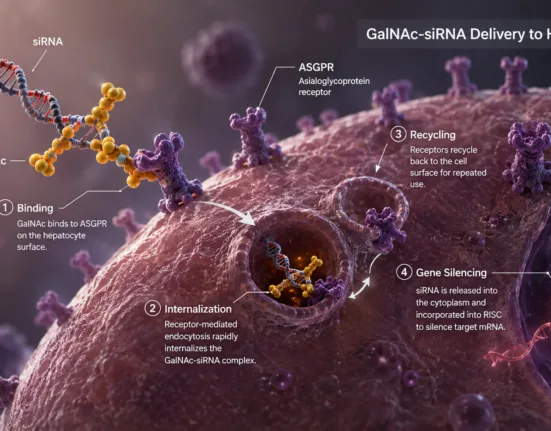
That is the real backdrop to this story. The RNA field no longer needs to prove that small interfering RNA or antisense oligonucleotide medicines can work in humans. It needs to prove that the modality can escape its current organ bias. Liver delivery has been a strength because hepatocytes are relatively accessible through established conjugation and uptake approaches. But that success has also become a strategic bottleneck. If companies cannot move beyond hepatic biology, the field risks being perceived as narrower than its scientific promise implies. Vivatides Therapeutics is trying to position itself on the side of that bottleneck where the next wave of value could be created.
Why extrahepatic RNA delivery could determine whether the modality reaches its next growth phase
The company’s framing is that extrahepatic delivery is the gateway to larger chronic disease markets and to disease areas that remain underserved by current RNA platforms. That is a reasonable thesis. Once delivery expands into tissues relevant to cardiometabolic disease, hypertension, oncology, inflammation, or other high-prevalence conditions, the addressable market grows dramatically. But it is also where technical difficulty rises sharply. Reaching a broader range of tissues is not simply an incremental extension of liver delivery. It demands new ligand strategies, different biodistribution profiles, better control over off-target exposure, and a more nuanced understanding of tissue-specific uptake and toxicity.
This is why Vivatides Therapeutics’ claims around ligand conjugation, delivery efficiency, tissue targeting specificity, and safety are the most commercially relevant elements in the release. Those are exactly the parameters that industry observers would use to judge whether a platform has substance or whether it is still operating at the level of broad scientific ambition. The challenge for the Suzhou- and Boston-linked biotechnology firm is that it has disclosed encouraging in vivo results, but not yet the kind of program-level data package that would allow external experts to compare the platform rigorously against competing approaches.
In that sense, the financing is both validating and incomplete. It validates that investors believe the team has enough technical credibility and enough early translational momentum to warrant aggressive backing. At the same time, it leaves the central scientific question unanswered for the broader market: which tissues, which targets, what magnitude of knockdown or modulation, and under what tolerability profile? Until those details emerge, Vivatides Therapeutics remains a promising platform story rather than a clinically de-risked one.
What this financing reveals about investor appetite for platform companies solving RNA’s hardest delivery problem
The release repeatedly emphasizes execution speed, platform breadth, and leadership experience. That combination is deliberate. In platform biotechnology, especially in RNA, investors often back teams before they back definitive clinical assets. The logic is that a strong delivery engine can generate multiple shots on goal, potentially across both small interfering RNA and antisense oligonucleotide formats. Vivatides Therapeutics says its capabilities span both modalities, which is strategically important because it suggests optionality in target selection, mechanistic design, and partnership potential.
This breadth could become a real advantage if the company can show that its delivery chemistry is adaptable rather than narrowly optimized for one use case. A platform that supports both small interfering RNA and antisense oligonucleotides can appeal to a broader set of disease biology, from transcript knockdown to splice modulation and other gene-expression control strategies. But platform breadth can also mask early-stage uncertainty. A diversified pipeline sounds attractive, yet without disclosed lead programs or clear prioritization, investors and future partners will still want to know where the first clinical proof point will come from.
The oversubscribed nature of the round also deserves interpretation. In biotech financing language, oversubscription can indicate enthusiasm, scarcity value, or both. In this case, it likely reflects the persistent attractiveness of modality-enabling technologies, even in a market that has become more selective about preclinical platform stories. Investors appear willing to fund early companies when the technical problem is large enough, the addressable upside is broad enough, and the management pedigree looks credible enough. Extrahepatic RNA delivery meets all three criteria, at least on paper.
Why the absence of disclosed clinical assets still leaves major translational and regulatory questions open
For all the appeal of the story, the missing details are substantial. The release says the company plans to accelerate multiple pipeline programs into clinical development and move forward with preclinical optimization and IND-enabling studies. That language signals proximity to the clinic, but not entry into it. This distinction matters. Preclinical delivery success can be impressive and still fail to translate because toxicology, manufacturability, dosing durability, immunogenicity, and tissue-specific exposure can all become limiting once a development candidate is pushed toward regulatory review.
Regulatory clarity is also still emerging in this category. While regulators are increasingly familiar with RNA-based medicines, extrahepatic delivery systems introduce new complexities. Reviewers will likely focus not only on target engagement and efficacy rationale, but also on tissue exposure patterns, accumulation risk, long-term tolerability, and the reproducibility of manufacturing for conjugated or otherwise engineered delivery systems. For companies in this space, the regulatory burden is often not about whether RNA can work, but about whether a specific delivery architecture can be characterized well enough to support safe human testing.
That means the next meaningful milestone for Vivatides Therapeutics is not just a larger financing or a new research collaboration. It is a data-rich preclinical disclosure that identifies lead programs, target tissues, pharmacology, safety signals, and the rationale for candidate selection. Without that, the market has a platform narrative but not a development roadmap that external stakeholders can independently assess.
How Vivatides Therapeutics could differentiate itself in a crowded but still immature RNA innovation race
The extrahepatic RNA field is attractive precisely because it is still immature. That creates room for new entrants, but it also means competition will intensify quickly as more biotechnology firms and larger RNA players pursue non-liver delivery. In such an environment, differentiation will depend less on the general claim of working beyond the liver and more on the quality of specific enabling evidence. Which tissues can be reached consistently? Can repeat dosing be managed? How clean is the safety profile? Can the platform support scalable chemistry, manufacturing, and controls? And can the first few programs be chosen in ways that maximize the probability of a clear clinical readout?
Vivatides Therapeutics appears aware of this, which is why the release stresses not only delivery technology but also sequence design and target discovery. That suggests the company wants to be viewed as an integrated RNA innovator rather than a chemistry-only shop. If that model works, it could support faster internal program generation and possibly make the platform more attractive for strategic partnerships. But integration also raises execution demands. Building delivery capabilities, discovery infrastructure, translational biology, and global development operations at the same time is expensive and operationally complex, even with a strong Series A balance sheet.
This is where the financing’s size becomes both an advantage and a test. Fifty-four million dollars can fund real progress, especially in a focused platform company. But it is not unlimited capital. The biotechnology firm will still need to prioritize carefully, because extrahepatic RNA development can consume cash rapidly once toxicology packages, process development, and candidate selection efforts intensify.
What clinicians, regulators, and biotech investors are likely to watch next from this extrahepatic RNA platform
The near-term watchpoints are straightforward even if the science is not. Clinicians tracking the field will want to know which diseases Vivatides Therapeutics is pursuing first and whether those indications are chosen for biological tractability rather than market storytelling. Regulators will want evidence that the delivery system’s safety and distribution can be characterized with enough precision to justify human testing. Investors will want to see whether the company can convert platform promise into discrete assets with milestone visibility.
That is why this financing should be read as an enabling event, not a validation endpoint. It tells the market that Vivatides Therapeutics has momentum, credible backers, and a thesis aligned with one of RNA medicine’s biggest opportunity gaps. It does not yet prove that the company has solved extrahepatic delivery at a clinically meaningful level. The most interesting part of the story is therefore still ahead.
If Vivatides Therapeutics can show robust tissue-specific delivery, a tolerable safety profile, and disciplined program selection, it could become one of the more important early platform names in the next chapter of RNA therapeutics. If it cannot, this round will look like many early biotech financings that correctly identified a major problem but underestimated the difficulty of translating an elegant platform concept into reproducible human medicine. For now, the financing matters because it signals where sophisticated capital believes RNA innovation still has room to run: not in proving the modality exists, but in proving it can go where it has not reliably gone before.