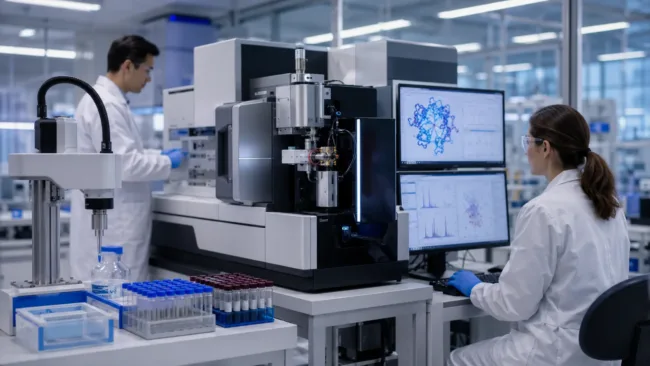
As 2026 begins, a new class of biotechnology companies is gaining prominence, not for any single drug, but for how they discover them. These firms, often referred to as AI-native biotechs, are reengineering the drug discovery process around machine learning. Unlike traditional pharmaceutical companies that apply algorithms to specific decision points in an existing workflow, these emerging players embed artificial intelligence into the foundation of their research infrastructure. Their labs are designed not just to test hypotheses, but to generate, label, and refine data that improve the performance of predictive models with every cycle.
This distinction is no longer theoretical. Venture capital flows, platform build-outs, and early preclinical progress suggest that artificial intelligence is becoming more than an efficiency tool in biotechnology. It is beginning to define a new operational category—one that could challenge the boundaries of how drugs are discovered, validated, and prioritized. Whether that distinction holds at the clinical and commercial level remains to be seen, but the direction of travel is clear: in 2026, AI-native discovery platforms are poised to shape how the next generation of biotech companies will be built and benchmarked.

What separates AI-native biotech from algorithm-enhanced pharma
In traditional pharmaceutical companies, artificial intelligence is often applied as a support function. It may help rank targets, predict off-target effects, or assist with patient stratification. However, in most cases, the core discovery process still depends on manual experimentation, siloed data, and static endpoints. Algorithms are applied late in the pipeline or after critical decisions have already been made.
AI-native platforms reverse that structure. They treat data not as a byproduct, but as infrastructure. These companies build wet labs specifically to produce machine-learning-compatible data from the outset. Their biology is tightly coupled with compute, and their learning cycles are iterative rather than linear. Experimental outputs are structured, tagged, and re-ingested into predictive models that inform what to test next.
This architecture is evident in companies like Talus Bioscience Inc., which has developed a live-cell regulome profiling system to capture transcription factor activity across hundreds of targets simultaneously. Instead of relying on in vitro binding assays or static pathway predictions, Talus measures how compounds alter regulatory networks inside native human cells. This provides a rich, functional signal that its AI models use to optimize lead compounds in real time.
Xaira Therapeutics, one of the most well-funded AI-native biotech firms to date, follows a similar closed-loop philosophy. While still in partial stealth, the company has described an infrastructure that blends generative molecular design, automated synthesis, and high-dimensional biological readouts—all governed by feedback-driven machine learning models. By aligning algorithmic design with biological effect, Xaira aims to compress discovery cycles and improve the fidelity of early candidate selection.
Inceptive, focused on programmable RNA therapeutics, brings an additional dimension to the category. Its platform includes a language-to-function pipeline that translates computationally designed ribozymes into wet-lab-tested outputs. Here, the loop between model generation and biological validation is not a handoff, but a continuous flow of data that improves both sides.
Why real-time feedback from human cells is becoming a competitive moat
The strength of AI-native platforms lies not just in the sophistication of their models, but in the relevance of their data. Many legacy datasets used in pharmaceutical discovery are outdated, low-resolution, or poorly annotated. They were not designed for machine learning, and their value decays quickly as new technologies emerge.
AI-native firms sidestep this problem by producing their own proprietary datasets in a structured, repeatable manner. This is especially valuable in systems biology, where cellular behavior is influenced by multiple interacting variables. Platforms that can monitor how compounds perturb transcriptional programs, protein complexes, or cell-state transitions in real time have a significant advantage over those that rely on static snapshots.
Deep Genomics exemplifies this approach in the context of RNA therapeutics. Its Saturn platform is designed to model how genetic mutations affect RNA splicing and translation, then predict which interventions can correct those errors. Every experimental output becomes a new training data point, enhancing the platform’s ability to generalize across targets and modalities.
Genesis Therapeutics brings another variation, using graph neural networks trained on wet-lab validated molecular data. Its physics-informed models integrate structural dynamics with machine learning to identify drug-like compounds with favorable binding characteristics. The system is designed to run autonomously, proposing and refining candidates without the need for human intervention at every step.
By embedding real-time biological feedback into their learning cycles, AI-native companies are creating data moats that deepen over time. The more they test, the more they learn—not just about individual targets, but about the broader landscape of chemical and biological interaction. This compounding advantage is difficult for traditional companies to replicate without a fundamental redesign of their lab and data infrastructure.
Who is building the most scalable AI-native pipeline in 2026
As the field matures, scalability will separate early leaders from speculative ventures. Not all AI-native platforms are equally equipped to handle the volume, complexity, and operational discipline required to turn discovery into development.
Xaira Therapeutics is among the most closely watched firms in this category. Backed by over one billion dollars in funding and led by a team of machine learning and biotech veterans, Xaira is building a full-stack discovery engine with in-house wet labs, cloud-native data pipelines, and vertical integration from concept to candidate nomination. Its platform is designed to support dozens of programs simultaneously, each governed by real-time model performance and biological readouts.
Genesis Therapeutics has demonstrated strong traction through partnerships and in-house programs. Its use of AI-augmented structure-based drug design enables it to explore chemical space more efficiently than traditional high-throughput screening methods. By tightly coupling physical simulation with machine learning, Genesis is able to prioritize candidates with both binding affinity and favorable drug-like properties.
Inceptive is positioning itself around programmable RNA, with a unique emphasis on sequence design, cellular translation, and ribozyme activity. Its platform includes custom-built tools for high-throughput RNA synthesis and function testing, giving it the ability to explore complex sequence-function relationships at scale.
Talus Bioscience, while smaller in scope, occupies a critical space in transcription factor modulation. Its regulome data could serve as the foundation for discovering therapies targeting one of the most elusive classes of intracellular proteins—those that govern gene expression across disease states. By offering a window into functional biology that most companies cannot access, Talus has the potential to influence not just compound selection but target nomination itself.
Why this shift signals more than just a platform upgrade
Skepticism around artificial intelligence in biotech is understandable. For years, the industry has seen waves of hype around in silico screening, virtual trials, and predictive biomarkers that failed to materialize. What distinguishes the current AI-native movement is not a new algorithm, but a new operating model. These companies are not plugging tools into old workflows—they are rebuilding the workflows entirely.
The implications of this shift extend beyond discovery speed. AI-native platforms promise greater translatability, reduced reliance on animal models, and earlier identification of failure modes. By generating clean, consistent data across multiple cell types and perturbations, these systems are more likely to identify biologically meaningful effects that hold up in preclinical and clinical settings.
Regulators are beginning to take notice as well. Agencies such as the U.S. Food and Drug Administration have opened the door to digital evidence, model-informed development, and AI-assisted trial design. Companies that can produce robust, interpretable datasets from integrated platforms will be better positioned to engage regulators early and justify novel endpoints or adaptive study designs.
For investors and strategic acquirers, the question is shifting from whether AI can help, to which platforms can scale. Licensing deals, co-development partnerships, and pipeline visibility will all be used to assess whether these AI-native platforms are generating real assets or simply promising architecture.
What to watch in 2026 as the AI-native category matures
The coming year will offer several tests of the AI-native thesis. Key readouts from early-stage programs will show whether compounds discovered through these platforms behave differently in animal models and, eventually, in humans. Validation from large pharmaceutical companies, whether through partnerships, acquisitions, or joint ventures, will also indicate how seriously the industry takes this new category.
Equally important will be how these companies manage growth. As they move from discovery to development, AI-native firms must prove that their infrastructure can scale without sacrificing quality or insight. That includes hiring, data governance, intellectual property strategy, and manufacturing considerations.
Ultimately, AI-native biotechs will be judged not just by their algorithms but by their outcomes. If they can deliver candidates with better selectivity, safety, or efficacy profiles, the category will not only be justified, it will be inevitable.