
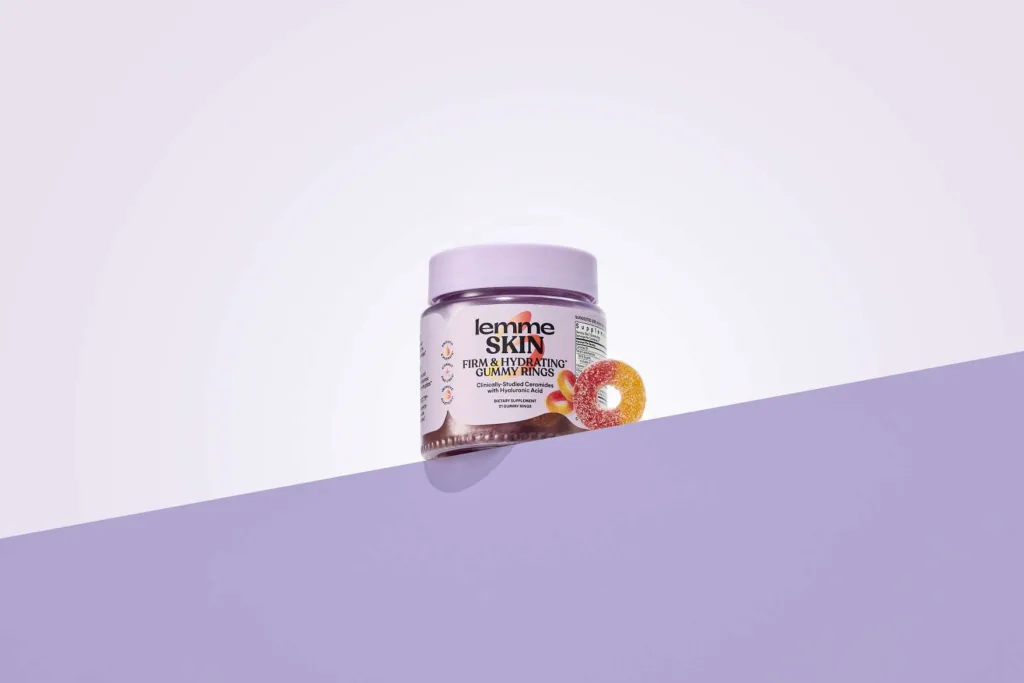
Lemme Inc. has launched Lemme Skin Firming & Hydrating Gummy Rings, a $30 tropical fruit dietary supplement formulated with Ceramosides, hyaluronic acid, sea buckthorn and vitamins C and E. The privately held wellness company is making the product available through its website from July 21, 2026, before an exclusive nationwide launch at Target on August 16.
The commercial proposition is straightforward: convert the science associated with oral phytoceramides into a playful gummy format that can compete for consumers who already spend on topical skin care, collagen powders and beauty supplements. Lemme says the product is designed to improve hydration, support firmer-looking skin, improve elasticity and reduce the appearance of fine lines and wrinkles in as little as 14 days.
The evidence behind that timeline is more substantial than a purely theoretical ingredient story, but it remains important to distinguish clinical research on Ceramosides from clinical testing of the complete Lemme formulation. The company’s announcement did not disclose a finished-product study demonstrating that the gummy rings themselves produced the promoted outcomes.
What is genuinely new about Lemme Skin beyond the novelty of its ring-shaped gummy format?
Lemme describes the launch as the first gummy ring vitamin formulated with clinically studied ceramides. That first-of-its-kind description is a company claim and should be understood primarily as a format and category-positioning statement, rather than evidence of superior clinical performance.
The ring shape nevertheless has commercial significance. Supplements intended for daily use depend heavily on adherence, and taste, texture and routine convenience can influence whether consumers continue taking them long enough to assess any perceived benefit. A tropical fruit gummy ring also gives Lemme a visually distinctive product for social media, creator marketing and physical retail displays.
The formulation places Ceramosides at the centre of a broader “Skin Smoothing Complex” that also includes hyaluronic acid and sea buckthorn. Vitamins C and E add recognisable antioxidant ingredients that consumers already associate with skin care, although the presence of several familiar components does not establish that their combination will generate an additive or synergistic benefit.
Lemme co-founder Kourtney Kardashian Barker said indirectly that the product reflected her belief that wellness and skin care could be supported from within. Chief Medical Officer Kathleen Valenton similarly attributed the formulation strategy to the decline in skin ceramides associated with ageing and their role in maintaining hydration and barrier integrity.
That positioning gives the launch a credible biological narrative. Ceramides are important lipids within the stratum corneum, where they contribute to the barrier that limits water loss and helps protect the skin from external stressors. The more demanding question is whether an oral consumer supplement can deliver a visible and repeatable effect large enough to justify continued monthly purchases.
How strong is the Ceramosides evidence behind Lemme’s 14-day skin improvement message?
Ceramosides is a wheat-derived polar lipid complex developed by Seppic. It contains sphingolipids, including glucosylceramides, alongside digalactosyl diglycerides. The ingredient has been evaluated in controlled human studies, giving Lemme more support than would be available for an untested botanical mixture or a formulation built solely around mechanistic assumptions.
A peer-reviewed, double-blind, randomised, parallel-group study enrolled 72 women with dry, wrinkled skin and allocated them to an oil form of the wheat polar lipid complex, a powder form or placebo. Each group included 24 participants and at least ten postmenopausal women. Supplementation continued for 56 days, with skin measurements conducted at baseline and after 14, 28 and 56 days.
The researchers assessed hydration, transepidermal water loss, elasticity, skin surface characteristics and wrinkle depth. They reported improvements in hydration, smoothness and elasticity, alongside reductions in water loss, roughness and wrinkle depth, after 14 days of supplementation. Benefits were also reported in the postmenopausal subgroup.
This study design provides a stronger basis than an uncontrolled consumer survey because it incorporated randomisation, blinding, a placebo comparator and objective skin measurements. The inclusion of multiple assessment points also allowed investigators to examine how the effects developed over time rather than relying on a single end-of-study comparison.
There are still meaningful limitations. Seventy-two participants represent a relatively small evidence base, particularly after division into three study groups. The participants were women with dry skin and signs of mild-to-moderate skin ageing, meaning that results should not automatically be generalised to all ages, skin types or baseline conditions.
All three authors were full-time employees of Seppic Research and Innovation, which supplied Ceramosides and sponsored the research. Industry sponsorship does not invalidate a randomised study, but it increases the importance of independent replication, transparent reporting and confirmation across larger and more diverse populations.
The study also found that the observed benefits were not maintained after supplementation ended. That finding supports the biological plausibility of an effect linked to continued consumption, but it also makes repeat purchasing central to the product’s commercial economics.
Why does evidence for Ceramosides not automatically prove that the finished Lemme gummy works?
Clinical evidence attached to a branded ingredient can support a formulation when the commercial product uses the same ingredient at the studied daily dose. It does not automatically demonstrate that every finished supplement containing that ingredient will reproduce the same outcomes.
Lemme’s launch announcement did not disclose the amount of Ceramosides provided in the recommended daily serving. It also did not publish comparative bioavailability data, dissolution testing or a controlled study of the complete Lemme Skin Firming & Hydrating Gummy Rings formulation.
Those details matter because dose, ingredient form, manufacturing consistency, storage stability and adherence can influence product performance. A gummy matrix may be an attractive delivery system, but the evidence must connect the quantity consumed through that delivery system with the quantity used in the underlying clinical research.
The additional ingredients create another evidentiary distinction. Oral hyaluronic acid, sea buckthorn and antioxidant vitamins have each been studied in different contexts, but research on separate ingredients cannot be combined mathematically to predict the outcome of Lemme’s specific formulation. It would therefore be premature to conclude that the gummy’s multi-ingredient composition produces greater benefits than Ceramosides alone.
The strongest accurate description is that Lemme Skin contains a clinically studied phytoceramide ingredient associated with improvements in several measured skin parameters. The available public information does not establish that the finished gummy has undergone its own randomised clinical trial.
A product-specific study would materially strengthen the proposition. Such research could evaluate the marketed serving, verify adherence, measure relevant skin parameters at predefined intervals and document tolerability under conditions that resemble real consumer use.
How does United States supplement regulation shape Lemme’s skin-firming claims?
Lemme Skin is a dietary supplement, not an approved dermatology treatment. The United States Food and Drug Administration does not generally approve dietary supplements or their structure and function claims before products reach the market.
Manufacturers remain responsible for ensuring that supplements are safe, properly manufactured and accurately labelled. Companies making structure and function claims must possess substantiation showing that those claims are truthful and not misleading, while applicable labelling must carry the required disclaimer explaining that the claims have not been evaluated by the United States Food and Drug Administration.
This framework explains the wording used around Lemme Skin. Expressions such as supporting the skin barrier, improving hydration, promoting firmer-looking skin and reducing the appearance of fine lines occupy the cosmetic wellness space. They are different from claims that a product can diagnose, treat, cure or prevent a dermatological disease.
The distinction is particularly important because consumers may interpret phrases such as “clinically studied” or “clinically backed” as meaning that the complete product received regulatory review or successfully completed a drug-style clinical development programme. In this case, the clinical evidence applies principally to the branded Ceramosides ingredient.
For Lemme, disciplined communication will be as important as product presentation. The company can build a strong marketing story around the ingredient research without implying that the gummy has been approved by a regulator or proven as a treatment for dry skin, wrinkles or impaired barrier disorders.
Why could Target distribution matter more commercially than the gummy-ring novelty?
The planned Target launch provides Lemme with a national retail channel capable of moving the product beyond celebrity followers and direct-to-consumer shoppers. Physical availability can support discovery, impulse purchases and comparison with adjacent collagen, hair, skin and nail supplements.
An exclusive nationwide rollout also gives Target a differentiated product while providing Lemme with a concentrated retail test. Shelf placement, inventory turnover, regional demand and repeat purchasing should offer more meaningful evidence of commercial traction than launch-day attention alone.
At $30, Lemme Skin occupies an accessible premium position. The price is high enough to support a clinically positioned beauty narrative but remains below many specialist nutricosmetic regimens, powders and multi-product skin supplement subscriptions. The gummy format may further reduce the psychological barrier for consumers who dislike capsules or powders.
Retail reach will not remove the category’s underlying retention challenge. Skin appearance changes can be gradual, subjective and affected by weather, topical products, hydration, diet, sun exposure and hormonal factors. Consumers who cannot perceive a meaningful improvement within the promoted timeframe may be less likely to repurchase, even if the ingredient produces modest changes on objective instruments.
Taste and texture may win the first sale. Perceived benefit, dosing convenience and confidence in the evidence will determine whether the product becomes a durable part of the Lemme portfolio.
What should the industry watch after Lemme Skin reaches Target stores nationwide?
The first test will be whether Lemme publishes a complete Supplement Facts panel that clearly connects the commercial dose of Ceramosides with the quantities evaluated in human studies. Transparent dosing would make it easier for retailers, industry analysts and consumers to assess how closely the product follows the ingredient’s evidence base.
The second test will be product-specific evidence. A randomised trial of the finished gummy would help determine whether the formulation improves hydration, elasticity, transepidermal water loss or wrinkle measurements under controlled conditions. It could also establish whether any changes remain clinically or cosmetically meaningful beyond statistical significance.
Commercially, repeat sales will be more informative than initial social media interest. Lemme has the brand visibility to create a strong launch, while Target supplies national reach. Neither guarantees that consumers will continue purchasing a supplement whose benefits require consistent use and may diminish after supplementation stops.
Quality control and claims discipline will also shape long-term credibility. Gummy supplements must maintain ingredient stability and serving consistency throughout their shelf life, while promotional language must preserve the distinction between evidence for Ceramosides and evidence for the complete product.
Lemme Skin therefore enters the market with a better ingredient story than many novelty-led beauty gummies, but not yet with definitive proof for the marketed formulation. The Target rollout will show whether flavour, format, celebrity reach and credible phytoceramide research can produce something harder to manufacture than a colourful gummy ring: sustained consumer trust and repeat demand.
