UroGen Pharma has submitted a New Drug Application to the United States Food and Drug Administration for UGN-103, moving its next-generation mitomycin formulation toward a potential 2027 approval in adults with recurrent low-grade intermediate-risk non-muscle invasive bladder cancer. The submission is supported by the Phase 3 UTOPIA study, where 77.8% of patients achieved a complete response at three months and the estimated six-month duration of response among responders reached 94.5%. UGN-103 is intended to preserve the sustained bladder exposure delivered through UroGen Pharma’s RTGel technology while simplifying manufacturing and preparation compared with the company’s already approved ZUSDURI product.
The filing is particularly important because UGN-103 is not being developed to create an entirely new therapeutic category. Instead, UroGen Pharma is attempting to build on a commercial market it has already begun establishing with ZUSDURI, which the FDA approved in June 2025 for the same recurrent low-grade intermediate-risk non-muscle invasive bladder cancer setting. ZUSDURI generated $50.4 million during the second quarter of 2026, up 73% sequentially, giving UroGen Pharma real-world commercial evidence that physicians are adopting non-surgical chemoablative treatment for recurrent disease.
UTOPIA results give the UGN-103 NDA a strong efficacy foundation despite the single-arm design
UTOPIA is a single-arm, multicenter Phase 3 study involving 99 patients with recurrent low-grade intermediate-risk non-muscle invasive bladder cancer. Participants received 75 milligrams of UGN-103 through intravesical instillation once weekly for six weeks, with complete response at three months serving as the primary endpoint and responders followed for as long as 12 months to assess durability.
The three-month complete response rate was 77.8%, with a 95% confidence interval of 68.3% to 85.5%. Among responders, the six-month duration-of-response estimate was 94.5%, with a 95% confidence interval ranging from 86.1% to 97.9%. UroGen Pharma said both measures were consistent with the efficacy observed in the separate pivotal ENVISION trial of ZUSDURI, while appropriately cautioning that the two studies were not designed for formal cross-trial comparisons.
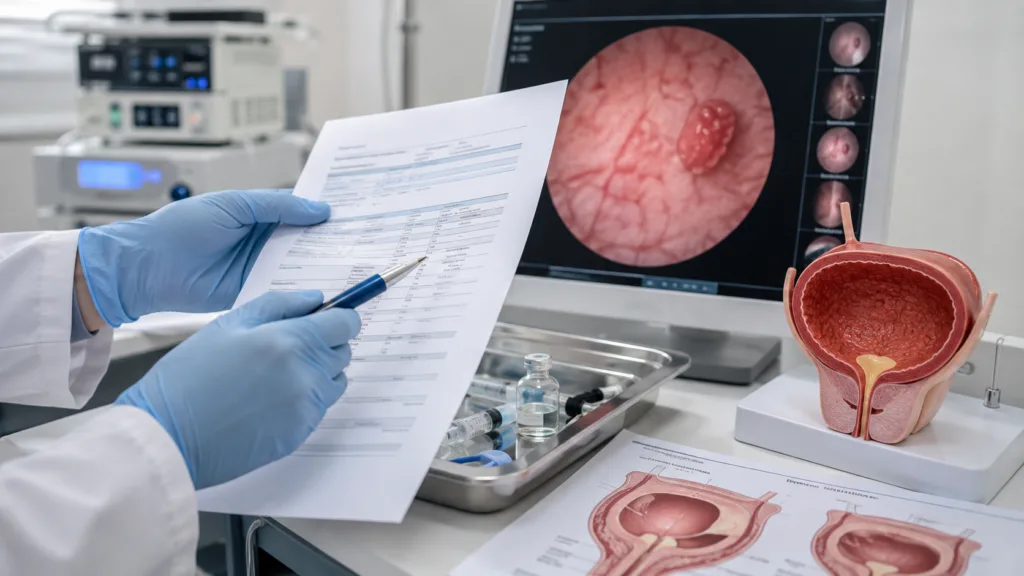
That distinction is important when assessing UGN-103. The investigational formulation is not attempting to demonstrate that it is clinically superior to ZUSDURI. Its value proposition is that it may preserve a familiar level of tumor control while offering operational improvements in manufacturing, reconstitution and product handling. If the FDA accepts the UTOPIA package, UroGen Pharma could therefore introduce a product whose differentiation is partly logistical rather than based on a dramatically different pharmacological effect.
The underlying clinical need remains substantial. UroGen Pharma estimates that roughly 82,000 people in the United States develop low-grade intermediate-risk non-muscle invasive bladder cancer each year, including around 59,000 experiencing recurrent disease. Up to 70% of non-muscle invasive bladder cancer patients experience at least one recurrence, which can lead to repeated transurethral resection of bladder tumor procedures.
UGN-103 could strengthen a franchise already generating rapid ZUSDURI commercial growth
ZUSDURI gives UroGen Pharma an unusually useful commercial foundation for an investigational follow-on product. Second-quarter ZUSDURI sales reached $50.4 million, representing 73% growth from the first quarter, while the company had activated 1,444 sites of care and reached 452 unique prescribers by June 30. Repeat prescribers increased to 204, or approximately 45% of the prescribing base, compared with 40% during the first quarter.
Longer-term ZUSDURI clinical data also provide support for the broader treatment concept. Among patients achieving complete response at three months in the ENVISION trial, estimated duration of response at 36 months was 64.5%, while median duration had not been reached after median follow-up of 35.5 months. The durability was achieved without maintenance therapy, an attribute UroGen Pharma believes can reduce treatment burden.
UGN-103 retains the company’s reverse-thermal RTGel platform but uses a lyophilized mitomycin formulation licensed from medac under a January 2024 agreement. UroGen Pharma says the formulation is designed to enable a more streamlined manufacturing process, simplified reconstitution and an extended shelf life after preparation, characteristics that could matter as utilization expands across community urology practices.
The intellectual property position could also become commercially important. UroGen Pharma says patents covering the combination of its RTGel technology with medac’s mitomycin formulation, as well as use of UGN-103 in this disease setting, are expected to provide protection into July 2044. The company has separately received a patent allowance covering treatment of recurrent low-grade intermediate-risk non-muscle invasive bladder cancer without transurethral tumor resection, potentially strengthening protection for both ZUSDURI and UGN-103.
UroGen is already positioning UGN-103 beyond the initial recurrent bladder cancer indication
The submitted indication may represent only the first commercial use of UGN-103. UroGen Pharma expects to initiate a randomized Phase 3 study evaluating UGN-103 in high-risk non-muscle invasive bladder cancer during the second half of 2026 and plans another study in 2027 evaluating the drug as adjuvant treatment for newly diagnosed intermediate-risk disease.
That expansion strategy could increase the value of UGN-103 considerably if the initial NDA succeeds. Rather than merely replacing or supplementing ZUSDURI in an established population, UroGen Pharma could potentially move its sustained-release mitomycin approach into additional stages of bladder cancer care.
The company is simultaneously advancing UGN-104 in low-grade upper tract urothelial cancer and UGN-501, an investigational oncolytic virus for high-grade non-muscle invasive bladder cancer. The UGN-501 Investigational New Drug application has been accepted by the FDA, with Phase 1 development expected to begin during the fourth quarter of 2026.
The strategy increasingly positions RTGel as a platform rather than a one-product technology. ZUSDURI and JELMYTO already demonstrate that UroGen Pharma can deliver mitomycin through sustained-release formulations into different parts of the urinary tract, while UGN-103 could improve the economics and operational characteristics of the bladder cancer franchise if approved.
URGN shares reflect increasingly positive sentiment as revenue growth reduces development-stage risk
UroGen Pharma entered the August 17 session with considerably more commercial momentum than a traditional clinical-stage biotechnology company. Total second-quarter revenue reached $72.5 million compared with $24.2 million a year earlier, driven largely by the ZUSDURI launch, while quarterly net loss narrowed sharply to $14.4 million from $49.9 million. Cash, cash equivalents and marketable securities totaled approximately $108 million at June 30.
The company has nevertheless increased spending to capitalize on the launch. Full-year 2026 operating expense guidance was raised to between $260 million and $270 million as UroGen Pharma accelerates ZUSDURI promotional activity, patient awareness programs and development work across UGN-103 and UGN-501. The company is therefore converting improving revenue into a broader investment cycle rather than immediately prioritizing profitability.
URGN shares were trading around $49.15 on August 17, up approximately 1.9%, giving UroGen Pharma a market capitalization of roughly $2.4 billion. The positive move suggests the NDA submission is being received constructively, although much of UGN-103’s value may already be reflected in expectations after management had previously guided to a third-quarter filing.
The more meaningful valuation event will be the FDA’s acceptance of the application and eventual regulatory decision. UGN-103 has already demonstrated a complete response rate close to 78%, durable responses through six months and clinical behavior broadly consistent with the product that established UroGen Pharma’s current bladder cancer franchise. The NDA now tests whether those results, combined with manufacturing and formulation improvements, are sufficient to turn UGN-103 into the next commercial layer of a rapidly expanding urothelial cancer business.