
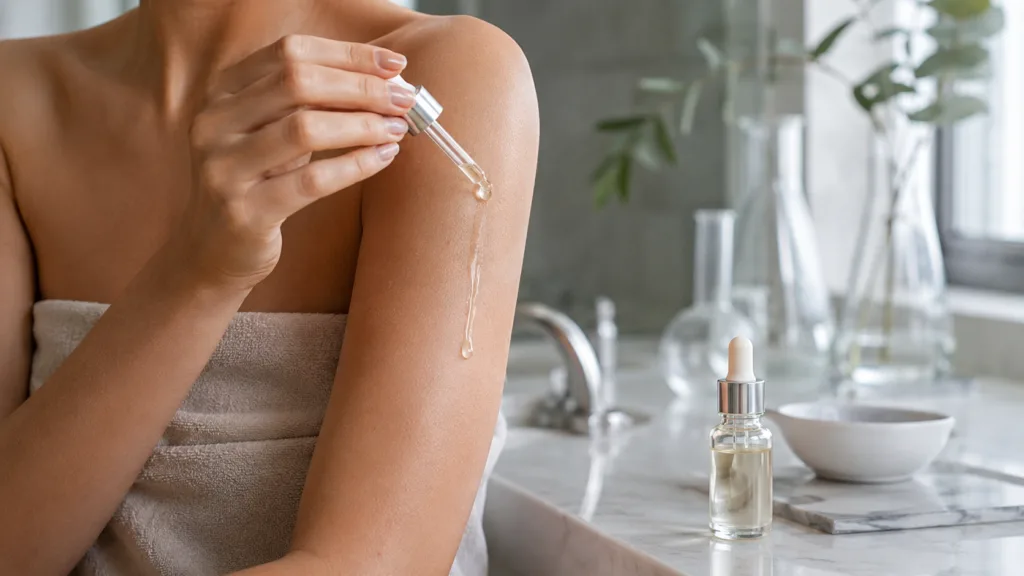
Rion Aesthetics has expanded its plated Skin Science portfolio with BODY Serum, a 75 mL topical product that brings the company’s platelet-derived exosome technology into body skincare for the first time. Priced at $338 and positioned for areas including the arms, chest, abdomen and legs, the product represents a significant expansion of the plated platform from high-end facial skincare into a much larger treatment area and potentially a broader premium aesthetics market.
The August 18, 2026 announcement is built around a 12-week clinical study in which the company reported that 95% of participants saw brighter or more radiant-looking skin, 95% reported improved hydration, 86% reported improvement in the appearance of fine lines and wrinkles, and 86% reported reduced visible redness. Clinical evaluation also identified improvements in the appearance of crepey skin, firmness, elasticity, pigmentation and overall skin appearance, according to Rion Aesthetics.
Those results give plated Skin Science more than a technology story to take into the body-care category. However, they need to be interpreted at the appropriate evidence level. The announcement does not disclose the BODY Serum study’s participant number, comparator, randomisation, blinding, statistical analysis or whether the full dataset has been peer reviewed. Several headline percentages are patient-reported outcomes, meaning the study supports the company’s cosmetic claims but does not yet provide the kind of evidence package needed to make stronger conclusions about comparative efficacy.
The launch is therefore interesting for a different reason. Rion Aesthetics is testing whether exosome skincare can move from a concentrated facial product into routine treatment of much larger skin areas without losing the scientific positioning, physician-channel credibility and premium pricing that helped establish plated Skin Science.
How does plated BODY Serum extend platelet-derived exosome skincare beyond facial products?
BODY Serum uses Rion Aesthetics’ proprietary Renewosome technology, based on highly purified platelet-derived exosomes. The formulation also contains a peptide complex including palmitoyl tripeptide-38, palmitoyl pentapeptide-4 and palmitoyl dipeptide-10, alongside a hydration system containing hyaluronic acid, glycerin, betaine and pentylene glycol. The full ingredient list identifies human platelet extract among the formulation components.
Exosomes are extracellular vesicles involved in cell-to-cell signalling. Rion Aesthetics’ platform emerged from regenerative medicine research associated with Mayo Clinic physician-scientists, and platelet-derived exosomes have subsequently been investigated across skin rejuvenation and other aesthetic applications. Mayo Clinic has described a growing evidence base for topical platelet-derived exosomes while emphasizing that injectable applications remain a separate clinical-development question.
For BODY Serum, Rion is translating that scientific story into a consumer cosmetic proposition rather than introducing a therapeutic product. The company says the serum is intended to improve the visible appearance of firmness, texture, tone, redness and other signs associated with aging body skin. That distinction is important because terms such as “regenerative” can sound pharmaceutical even when the commercial product is being sold for cosmetic appearance claims.
The formulation has also been adjusted for the economics of treating far more skin. BODY Serum contains 75 mL and costs $338, compared with $258 for a 15 mL bottle of plated INTENSE Serum. That means BODY Serum provides five times the volume for about 31% more total cost. Its price works out to roughly $4.51 per mL compared with $17.20 per mL for INTENSE Serum, although the comparison should not be interpreted as equivalent dosing because the formulations and exosome concentrations are not necessarily the same.
That packaging decision may prove commercially important. A facial serum can succeed with a small bottle and very small application volume. Body treatment needs enough product for regular use across the chest, upper arms, legs or abdomen, making per-millilitre economics substantially more visible to consumers.
How convincing are the 12-week BODY Serum results behind Rion Aesthetics’ launch claims?
The BODY Serum study provides encouraging product-specific signals, but the public disclosure remains relatively limited. Rion Aesthetics reported high proportions of participants observing improvements in radiance, hydration, wrinkles and redness after 12 weeks, while clinical assessment identified improvement across additional skin-quality measures. The company has not, in the launch materials reviewed, disclosed enough methodological detail to establish how large the improvements were, how they compared with placebo or another body product, or how consistently objective and subjective measures aligned.
That does not mean the technology starts from zero. Earlier plated formulations have been evaluated in published research. A 2022 Aesthetic Surgery Journal study enrolled 56 participants to evaluate a topical human platelet extract formulation for facial skin rejuvenation, although the study was prospective, single-arm and non-randomised. Subsequent work has included evaluation of platelet-derived topical products for facial redness, photoaged hands and biological markers associated with skin aging.
A separate study comparing plated human platelet extract with a vitamin C formulation on the dorsal hands followed participants for 12 to 26 weeks and reported that the platelet-derived treatment performed similarly to vitamin C for hand rejuvenation. Importantly, the investigators also acknowledged limitations including a small number of men, limited representation of darker skin types, participant attrition and a nonblinded, nonrandomised design.
The evidence therefore creates biological and clinical context for BODY Serum without functioning as direct proof of BODY Serum itself. Different formulations, anatomical sites, dosages and study designs cannot simply be treated as interchangeable.
What does the wider clinical evidence say about exosomes for aesthetic skin rejuvenation?
A 2026 systematic review and meta-analysis in Aesthetic Surgery Journal offers a useful snapshot of how quickly exosome aesthetics is developing. Across eligible studies using various exosome sources and delivery approaches, the analysis estimated average facial wrinkle reduction of 20.2%, while several other skin outcomes improved in the roughly 14.7% to 23.4% range.
The same review, however, highlighted exactly why individual product claims require caution. Exosome source, formulation, administration route, treatment duration and measurement methods varied substantially. Many studies involved small populations, lacked control groups or were nonrandomised, while follow-up commonly lasted only six to 12 weeks. The authors concluded that larger randomised trials, better standardisation and longer follow-up remain necessary.
That evidence landscape makes plated Skin Science unusual compared with many beauty products because there is genuine peer-reviewed research around platelet-derived topical exosomes. At the same time, the scientific literature is not yet mature enough to treat all exosome cosmetics as a clinically interchangeable class or to assume that results from one formulation establish efficacy for another.
BODY Serum consequently arrives in a category where consumer enthusiasm may move faster than evidence standardisation. Rion Aesthetics’ advantage is that it already has published research around its underlying platelet-derived platform. Its challenge is demonstrating that the new body-specific formulation produces reproducible benefits under appropriately controlled conditions.
Why does the regulatory distinction between cosmetic and therapeutic exosome products matter?
BODY Serum should not be confused with an FDA-approved drug or biologic. Under United States law, cosmetic products and ingredients generally do not undergo FDA premarket approval, except for certain color additives. The Modernization of Cosmetics Regulation Act has expanded FDA oversight through requirements including facility registration, product listing and safety substantiation, but that framework remains different from the premarket approval pathway used for drugs and biological products.
The distinction becomes particularly important around exosomes because the FDA has separately warned about unapproved exosome products marketed for treating diseases and medical conditions. Those warnings concern therapeutic uses that can fall under drug and biologic regulation and should not automatically be applied to a topical cosmetic making appearance-related claims.
Rion Aesthetics itself illustrates the regulatory separation. Its commercial plated products are topical cosmetic formulations, while the company has also supported an investigator-initiated Phase 1 study of an injected Purified Exosome Product after an Investigational New Drug application was allowed to proceed. An IND permits clinical investigation and is not marketing approval.
For BODY Serum, the commercial test will therefore be consumer adoption and the credibility of cosmetic evidence rather than a pharmaceutical-style regulatory milestone.
Can premium body skincare become the next growth engine for plated Skin Science?
Rion Aesthetics has already been investing as though demand for plated Skin Science will continue expanding. In June 2025, the company opened a 14,000-square-foot manufacturing facility in Rochester, Minnesota, dedicated to producing its platelet-derived Renewosome technology. Rion said at the time that the investment followed triple-digit demand growth and was intended to increase production capacity while keeping exosome manufacturing under its control.
Commercial momentum was still central to the company’s messaging in February 2026. Rion cited Guidepoint Qsight sales measurement data from more than 3,400 United States aesthetics practices when saying plated Skin Science had captured the largest share of professional-grade skincare category expansion year over year. The underlying sales figures were not disclosed in the announcement, so the claim provides directional evidence of momentum rather than a full financial picture.
BODY Serum now gives that manufacturing infrastructure another outlet. Instead of asking consumers to add another facial serum to an already crowded routine, plated Skin Science is opening a comparatively less developed premium category where the company believes advanced treatments remain underrepresented.
The $338 price will naturally narrow the addressable customer base, but it also fits the professional-grade positioning that has supported plated Skin Science so far. Distribution through licensed skincare professionals may help preserve that clinical-aesthetic identity even as direct online sales make BODY Serum accessible without an office procedure.
The next meaningful test is not whether the phrase “regenerative body skincare” attracts attention. It almost certainly will in a beauty market increasingly interested in longevity, biotechnology and cellular signalling. The harder test is whether BODY Serum can generate repeat purchases across a much larger treatment area and whether Rion Aesthetics eventually publishes enough detail from its 12-week study to let clinicians and industry observers judge the magnitude, durability and reproducibility of the product’s effects.
If those two pieces come together, BODY Serum could become more than another extension of plated Skin Science. It could show whether platelet-derived exosome skincare has enough evidence and consumer willingness to pay to move from a high-end facial niche into routine whole-body care.