
Curium’s proposed acquisition of Lantheus Holdings Inc. for up to approximately $8 billion is one of the clearest signs that radiopharmaceutical competition is shifting from individual products toward vertically integrated platforms. Under the transaction announced in August, Lantheus shareholders are due to receive $102.50 per share in cash at closing plus contingent value rights worth up to another $12 per share if specified commercial milestones are achieved through 2030. The merger is expected to close in the first half of 2027, subject to shareholder and regulatory approvals.
The structure matters because Lantheus is already a substantial commercial business. The company generated $388.2 million of worldwide revenue in the second quarter of 2026, including $240.4 million from prostate cancer imaging agent PYLARIFY, $88.3 million from DEFINITY and $39.6 million from Neuraceq. Lantheus also ended June with $593.3 million of cash and equivalents, giving Curium a profitable commercial platform rather than a speculative development-stage acquisition.
Why is Lantheus strategically valuable beyond PYLARIFY?
PYLARIFY is central to the deal because it has become one of the most important prostate-specific membrane antigen PET imaging agents in the United States. Yet Curium’s interest appears broader than simply purchasing an established diagnostic franchise. Lantheus has built capabilities spanning radiodiagnostics, targeted radionuclide therapy development and acquisitions intended to broaden its presence across oncology and neurology.
Curium brings a different set of strengths. It operates a global radiopharmaceutical manufacturing and distribution network, and the proposed combination would create an organisation serving oncology, neurology and cardiology patients in more than 70 countries. Transaction documents describe a company extending across the nuclear-medicine value chain from isotope production and manufacturing to diagnostic imaging and targeted radionuclide therapy.
That matters because radiopharmaceuticals are unusually dependent on infrastructure. Many products use radioactive isotopes with limited half-lives, meaning manufacturing, scheduling, logistics and proximity to treatment centres can be almost as important as intellectual property. Owning more of that chain can reduce operational friction and create an advantage when launching products across multiple geographies.
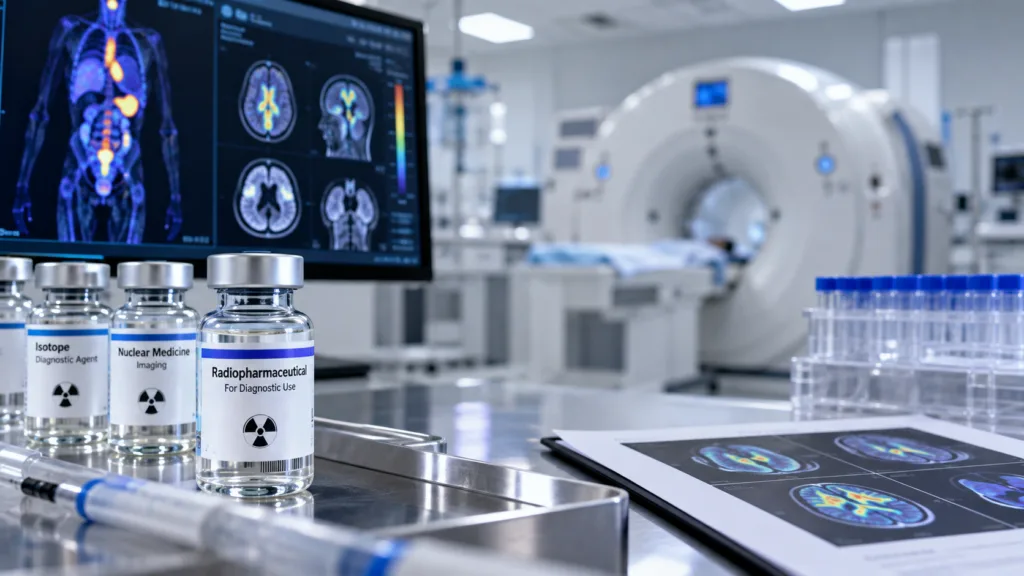
Is radiopharmaceutical manufacturing becoming a competitive moat?
Traditional pharmaceuticals can often be manufactured centrally and stored for extended periods. Radiopharmaceuticals operate under tighter physical constraints because radioactive decay creates time-sensitive production and distribution requirements. A company that owns isotope access, manufacturing sites, regulatory expertise and distribution routes can therefore build advantages that are difficult for a pure research company to replicate quickly.
This helps explain why major pharmaceutical groups have invested heavily in radioligand therapy and related infrastructure. The commercial attraction is obvious in oncology, where targeted radioactive payloads can deliver radiation directly to tumour-associated markers. But as more products advance, the industry also faces questions around isotope availability, plant capacity, quality systems, transport and treatment-centre readiness.
Curium’s combination with Lantheus therefore has a platform logic. Rather than licensing individual candidates and relying extensively on external supply networks, an integrated business could potentially move assets from development through manufacturing and distribution within a broader internal system. That does not eliminate execution risk, but it changes where competitive advantage can arise.
What does the contingent value right reveal about the deal?
The acquisition agreement provides $102.50 per Lantheus share in cash at closing and up to another $12 through non-transferable contingent value rights. The maximum consideration values the transaction at approximately $8 billion. Curium and Lantheus said the full potential value represented a 38% premium to Lantheus’ unaffected 60-day volume-weighted average price and a 29% premium to its unaffected 30-day volume-weighted average price.
The CVR is more than a financing detail. It effectively divides valuation between value Curium is willing to pay with certainty and value dependent on future performance. That can be useful when a buyer and seller disagree about how aggressively emerging products should be valued, especially in a sector where regulatory milestones, adoption curves and manufacturing execution can materially alter commercial outcomes.
For Lantheus shareholders, it creates a trade-off. The base cash payment provides certainty, while the additional $12 depends on commercial milestones that may or may not be achieved. Reuters reported that the maximum $114.50-per-share consideration represented a roughly 14.9% premium to Lantheus’ prior closing price, while analysts viewed the guaranteed component as reasonable but not exceptionally generous.
That structure could become increasingly common in healthcare transactions where buyers want late-stage or recently launched assets but remain unwilling to pay entirely upfront for optimistic commercial forecasts.
Does PYLARIFY concentration create a risk Curium must solve?
Lantheus’ second-quarter numbers illustrate both the strength and the concentration of its commercial franchise. PYLARIFY generated $240.4 million of the company’s $388.2 million in quarterly revenue, or roughly 62% by simple calculation. PYLARIFY sales were also down 4.1% year over year in the quarter, while total company revenue increased 2.7%.
That does not make the asset unattractive. A product generating nearly a quarter-billion dollars in quarterly revenue can provide substantial cash flow and market access. But concentration raises the strategic importance of broadening the portfolio, particularly as competition in prostate cancer imaging and radiopharmaceuticals develops.
Curium may therefore be buying both scale and diversification potential. Lantheus provides a strong United States commercial engine, while Curium brings global manufacturing and geographic reach. The transaction thesis becomes stronger if the combined group can use that infrastructure to support multiple diagnostics and therapeutics rather than remaining disproportionately dependent on a handful of mature products.
Could regulatory scrutiny become the biggest obstacle before closing?
The parties expect the transaction to close in the first half of 2027, which leaves a meaningful regulatory review period. Curium and Lantheus both participate in radiopharmaceutical markets, and Reuters noted that analysts anticipate scrutiny because of their positions in diagnostic nuclear medicine.
The key issue will be how regulators define the relevant markets. If particular radiodiagnostic products, isotopes or distribution networks are viewed as concentrated, authorities could examine whether combining the companies reduces competition or increases control over critical supply infrastructure. Geographic definitions may also matter because radiopharmaceutical distribution is constrained by decay and logistics in ways that make national or regional infrastructure particularly important.
Even if the transaction closes without major remedies, scrutiny itself highlights a broader industry reality: nuclear-medicine infrastructure is becoming strategically important enough that ownership concentration may attract more regulatory attention.
What would make the Curium-Lantheus combination work?
Successful integration will depend on whether Curium can connect Lantheus’ United States commercial presence with its own manufacturing and global network without disrupting products whose reliability depends on precise operating execution. Radiopharmaceutical businesses do not have much tolerance for manufacturing interruptions, logistics failures or quality problems because short-lived isotopes cannot simply be placed in inventory for long periods.
The upside is significant if integration works. Curium could gain a stronger United States position, while Lantheus products and pipeline assets could gain access to a broader global infrastructure. The combined company would also have greater ability to spread fixed manufacturing and distribution capabilities across multiple products.
That is why the transaction should be viewed as more than another healthcare takeover. Curium is paying up to $8 billion for commercial products, pipeline options and something increasingly scarce in radiopharma: an integrated route from radioactive isotope infrastructure to physicians and patients. As the field becomes more crowded, that physical network may prove almost as valuable as the molecules moving through it.