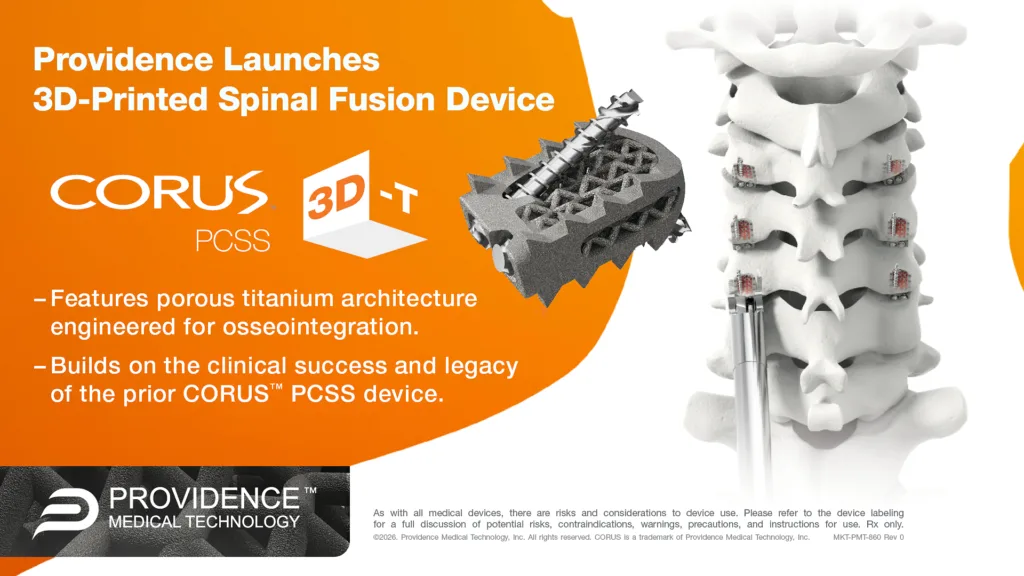
Providence Medical Technology, a privately held spinal device manufacturer based in Pleasanton, California, announced on October 13, 2026, that it had received United States Food and Drug Administration 510(k) clearance for CORUS Posterior Cervical Stabilization System 3D-T, a new version of its implant platform incorporating a three-dimensionally manufactured porous titanium lattice. The system is designed to provide supplemental stabilization during posterior cervical fusion in patients with cervical degenerative disc disease, combining integrated screw fixation with an implant structure intended to accommodate bone graft and support bone ingrowth.
The company will introduce CORUS PCSS 3D-T to spine surgeons at the North American Spine Society’s 2026 Annual Meeting, taking place from October 14 through October 17 in San Antonio, Texas. The modified implant retains the fundamental design, treatment approach and intended surgical technique of the established CORUS PCSS platform while introducing a porous titanium architecture. Providence says the updated structure provides approximately 1.5 times the surface area and eight times the surface roughness of the original machined implant.
The announcement is supported by a previously published randomized clinical trial involving the earlier posterior cervical stabilization platform. In that investigation, patients receiving supplemental posterior stabilization during three-level anterior cervical fusion achieved a 61% fusion success rate at 12 months, compared with 17% among those undergoing anterior fusion alone. However, these results belong to the earlier device and treatment strategy, not a direct clinical comparison demonstrating that the newly cleared 3D-T implant improves outcomes over its predecessor.
The regulatory milestone therefore combines an established surgical approach with an engineering modification intended to improve the interface between implanted titanium and bone. Its clinical and commercial importance will depend on whether surgeons find the additional porous structure useful in achieving reliable fusion without increasing procedural complexity, implant-related risks or healthcare costs.
How does CORUS PCSS 3D-T use porous titanium to support cervical fusion?
CORUS PCSS 3D-T is designed for implantation through a posterior surgical approach, positioning stabilization devices bilaterally across the facet joints of the affected cervical spine segments. The implants incorporate integrated screw fixation and contain spaces for bone graft material. Their objective is to stabilize the treated segments while bone fusion develops between adjacent vertebral structures.
The major engineering change involves a three-dimensionally manufactured porous titanium lattice. The structure is intended to resemble selected characteristics of cancellous bone, the porous internal bone tissue that helps distribute mechanical loads and supports biological remodeling. Providence states that the lattice has been designed with pore characteristics informed by existing scientific literature concerning bone ingrowth.
The material architecture is intended to provide a surface into which new bone may grow while maintaining sufficient structural support during the fusion process. The implant also includes space for bone graft, an important component of the biological process required to establish fusion. However, providing additional surface area does not automatically mean that bone will grow more rapidly or that a higher proportion of patients will achieve successful fusion.
Providence reports a 50% increase in implant surface area and an eightfold increase in surface roughness compared with the original machined design. Those figures describe engineering characteristics rather than observed clinical outcomes. A direct study would be needed to determine whether the changes produce fewer cases of nonunion, improved functional recovery or reduced revision surgery.
The company has retained the established CORUS surgical technique, which could reduce the need for surgeons familiar with the predecessor device to adopt an entirely different procedure. Nevertheless, the performance of the new implant must still be assessed according to its own design, indications and instructions for use.
Why does cervical degenerative disc disease create a need for supplemental posterior stabilization?
Cervical degenerative disc disease can involve deterioration of the discs and surrounding structures in the neck, potentially causing pain, nerve compression, neurological symptoms or spinal cord dysfunction. Patients may require surgery when symptoms are severe or persistent and appropriate nonsurgical treatment has not produced sufficient improvement. The surgical approach depends on the affected levels, spinal alignment and neurological findings.
Anterior cervical discectomy and fusion is an established procedure in which damaged disc material is removed and adjacent vertebrae are stabilized to encourage fusion. Although the approach can provide substantial symptom relief, the probability of achieving solid fusion may be affected by the number of operated levels. Long multilevel constructs can be particularly demanding because fusion must develop across several separate segments.
Failure to achieve solid bony fusion is known as pseudarthrosis or nonunion. It may contribute to persistent symptoms, implant-related complications or the need for further surgery. However, radiographic nonunion does not automatically mean that every patient will experience clinical symptoms or require revision.
Supplemental posterior stabilization aims to increase mechanical support by adding fixation through the back of the cervical spine. This creates a circumferential construct involving anterior and posterior components. The approach may improve stability but introduces additional procedural steps, operating time and potential risks associated with accessing posterior anatomy.
Providence describes its treatment philosophy as Total Segmental Fusion, which seeks to stabilize the relevant joints within a cervical spinal segment. The benefit of this strategy must be considered against the increased surgical intervention required, particularly when determining which patients are most likely to benefit from supplemental fixation.
What did the randomized CORUS study establish about fusion success at 12 months?
The strongest published clinical evidence behind Providence’s existing cervical platform comes from a multicenter randomized study involving patients undergoing three-level cervical fusion. The investigation compared anterior cervical discectomy and fusion alone with the same anterior procedure supplemented by posterior cervical fusion using an investigational posterior cervical stabilization system. The study was designed to assess both radiographic fusion and clinically relevant outcomes.
A protocol-defined interim analysis included 202 patients with available 12-month outcomes. Among the 100 participants evaluated in the combined anterior-posterior fusion group, 61 achieved the study’s predefined fusion success criteria. In comparison, 17 of 102 participants receiving anterior fusion alone met the same criteria, producing rates of 61% and 17%, respectively.
The difference was statistically significant, with a reported p-value below 0.001. Fusion success required evidence of bridging bone and sufficiently limited motion across the treated levels. These criteria provide a more rigorous definition than simply observing that implanted hardware remained in place.
The study therefore offers randomized evidence supporting the addition of posterior stabilization to three-level anterior cervical fusion in the selected population. However, it does not isolate the effect of the CORUS device from the broader effect of performing a supplemental posterior fusion procedure. That distinction is essential when interpreting the results as evidence for a specific implant design.
The trial also did not compare the new porous titanium CORUS PCSS 3D-T configuration against the earlier machined device. Consequently, the 61% fusion success rate cannot be attributed to the new lattice or surface roughness characteristics.
Why did the 24-month trial results attract attention from spine surgeons?
The same randomized investigation included a 24-month analysis evaluating a broader composite outcome incorporating fusion, improvement in neck disability, neurological status and freedom from surgical revision. At that assessment, 30 of 59 patients in the combined anterior-posterior group met the composite success criteria, compared with 13 of 57 patients receiving anterior fusion alone. The corresponding success rates were approximately 51% and 23%.
The investigators also reported a substantial numerical difference in revision surgery. One of 59 patients in the combined fusion group underwent revision, compared with 13 of 57 patients in the anterior-only group. These rates were approximately 2% and 23%, respectively, with a reported statistically significant difference.
Among the 13 revisions in the anterior-only group, 11 were performed to address symptomatic nonunion. This supports the interpretation that improved fusion stability was relevant to the difference in subsequent surgical intervention. However, the findings must be considered within the study’s defined patient population and the smaller group with available 24-month follow-up.
The denominators at 24 months are important because they differ from the 202 patients included in the 12-month assessment. The reported results should not be presented as though all originally evaluated patients had completed two years of follow-up. The investigators described the publication as a protocol-defined interim analysis.
The trial also reported adverse-event frequencies of 46% in the combined fusion group and 65% in the anterior-only group. This observation suggests that adding the posterior procedure did not produce a higher overall adverse-event rate in the assessed population, but it does not establish that the combined approach is universally safer or appropriate for every patient. Surgical risks remain dependent on patient characteristics and procedural circumstances.
These results provide meaningful evidence for the predecessor treatment strategy. They are particularly relevant to surgeons treating multilevel cervical disease where nonunion is a significant concern, while leaving the incremental contribution of the 3D-T redesign unresolved.
What does the FDA 510(k) clearance establish about the updated CORUS implant?
Providence has announced FDA 510(k) clearance for the product it markets as CORUS PCSS 3D-T. Separately, the FDA’s public records include clearance K253676, issued on May 14, 2026, for a related product identified as CORUS Posterior Cervical Stabilization System 3D. That public clearance describes a porous titanium implant manufactured using an additive process, although the manufacturer’s October announcement does not identify a 510(k) number specifically under the 3D-T branding.
This naming distinction should be preserved rather than assuming that every related CORUS trade name refers to a separately cleared device. The publicly documented CORUS PCSS 3D labeling identifies posterior stabilization for up to three consecutive cervical levels within C3 to C7. It also specifies use in skeletally mature patients with degenerative disc disease and requires combination with appropriately cleared or approved anterior cervical stabilization hardware at the corresponding levels.
The underlying device is intended to be used with autogenous or allogenic bone graft. It is not described as a standalone replacement for every form of cervical instrumentation. The exact marketed labeling for the 3D-T configuration remains important when determining its permitted use.
FDA substantial equivalence review differs from the approval process for higher-risk devices subject to premarket approval requirements. It establishes that a device meets the applicable criteria for marketing based on comparison with appropriate legally marketed devices and supporting evidence. It does not establish clinical superiority over earlier CORUS implants or other posterior fusion systems.
The available FDA documentation for the related porous CORUS device includes mechanical testing addressing subsidence, expulsion, screw fixation, compression loading and lattice characteristics. Such testing supports assessment of engineering performance and substantial equivalence. It does not replace long-term clinical evidence concerning fusion rates, patient function or revision surgery.
How could 3D-printed titanium change competition in the spinal implant market?
Additive manufacturing has become increasingly important in spinal implants because it allows manufacturers to produce complex porous structures that would be difficult to create using conventional machining. These designs can offer controlled geometry, surface characteristics and internal spaces for bone graft. Manufacturers have adopted porous titanium across several categories of spinal fusion implants.
The opportunity for Providence is therefore not simply the introduction of 3D printing into spine surgery. Instead, the company is integrating porous titanium into a posterior cervical fixation platform for which it already has a published randomized clinical study supporting its treatment approach. This combination may provide a differentiated offering for surgeons interested in supplemental fixation during multilevel procedures.
However, competing manufacturers also offer advanced implant materials, porous structures and different methods of achieving cervical stabilization. Procurement decisions often consider evidence quality, implant cost, availability, compatibility with surgical techniques and hospital purchasing arrangements. Providence has not disclosed comparative pricing or a cost-effectiveness analysis for CORUS PCSS 3D-T.
The company is privately held and has not reported revenue forecasts attributable to the new configuration. Its commercial progress will therefore be more readily assessed through product availability, surgeon adoption, clinical reporting and distribution expansion than through public earnings estimates.
What will Providence demonstrate at NASS 2026, and what evidence is still needed?
The North American Spine Society meeting provides an opportunity for Providence to demonstrate the new implant’s architecture, surgical instrumentation and procedural workflow to spine specialists. The event also creates a setting for discussions about the previously published randomized trial and the implications of supplemental posterior stabilization. The announcement identifies the meeting as the product’s first public showcase but does not disclose a new clinical trial result specifically for CORUS PCSS 3D-T.
An important next step would be comparing the new porous implant’s performance with that of the earlier CORUS configuration under clinically relevant conditions. Outcomes could include radiographic fusion, implant migration, subsidence, screw-related complications, postoperative pain and revision surgery. Evidence concerning surgical handling and reproducibility across multiple centers could also clarify practical differences between the designs.
Long-term follow-up will matter because successful spinal fusion is a biological process that develops over months, while device-related complications may emerge after the immediate recovery period. Mechanical testing can demonstrate that an implant meets specified performance requirements, but it cannot establish every clinical consequence of implantation. The appropriate evidence must connect the engineering modification with actual patient outcomes.
Providence’s latest clearance advances a spinal fusion platform supported by notable randomized evidence from its predecessor device and associated surgical strategy. The 3D-printed porous lattice introduces an engineering feature designed to improve the bone-implant interface, but its incremental clinical value remains unproven. The decisive question is whether the modified implant can preserve the earlier platform’s demonstrated fusion advantages while delivering additional benefits that matter to surgeons, patients and healthcare providers.