NRx Pharmaceuticals, Inc. (Nasdaq: NRXP) has secured approval from the U.S. Food and Drug Administration for its preservative-free ketamine injection, marking a major regulatory breakthrough for the biotechnology company as it prepares to enter the commercial injectable drug market. The approval, granted ahead of the FDA’s November 10 target date, authorizes a formulation manufactured without benzethonium chloride, a preservative that has raised toxicological concerns and remains present in certain traditional ketamine products.
The approval follows the FDA’s review of an Abbreviated New Drug Application and allows NRx Pharmaceuticals to move toward supplying its American-manufactured ketamine to hospitals and clinics. The development could introduce another domestic supply option for an injectable anesthetic that has faced persistent shortages, while establishing an important commercial milestone for the company’s broader pharmaceutical strategy.
Importantly, the regulatory decision concerns preservative-free ketamine for uses covered by its approved labeling, rather than an authorization to treat depression, post-traumatic stress disorder or suicidal ideation. NRx Pharmaceuticals continues to pursue separate clinical and regulatory pathways for psychiatric indications, including its investigational NRX-100 program.
Why NRx Pharmaceuticals’ FDA approval of preservative-free ketamine could address critical injectable drug shortages
The FDA approval arrives against a backdrop of longstanding supply challenges affecting ketamine injection in the United States. The medication has been used in clinical practice for decades, primarily as a general anesthetic in surgical and diagnostic procedures, but manufacturing disruptions and product discontinuations have complicated availability.
NRx Pharmaceuticals indicated that ketamine injection has remained on the FDA drug shortage list since 2018, highlighting the need for reliable production and distribution. The company believes its newly approved formulation could help strengthen domestic supply while providing healthcare professionals with an alternative to products containing benzethonium chloride.
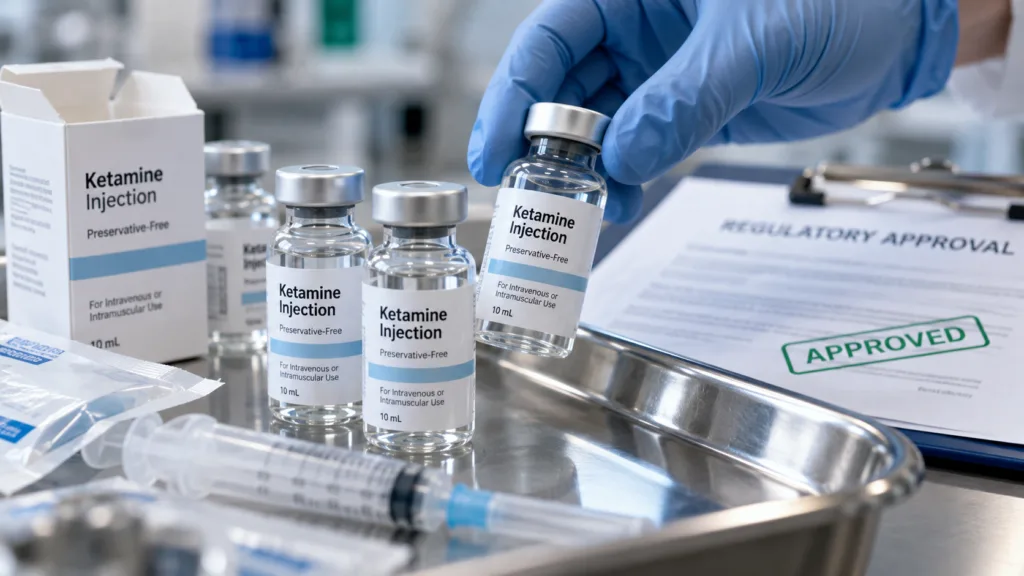
Ketamine is particularly valuable in anesthesia because its pharmacological properties differ from those of many conventional anesthetic agents. It produces dissociative anesthesia through effects on N-methyl-D-aspartate receptors and can preserve certain protective airway reflexes, although clinically significant respiratory complications remain possible.
The medication is used in various healthcare settings, including operating rooms, emergency departments and specialized procedures. Its role in clinical anesthesia makes reliable access important for institutions that depend on injectable medicines to manage patients undergoing treatment.
NRx Pharmaceuticals Chairman and Chief Executive Officer Jonathan Javitt indicated that the approval would allow the company to introduce a preservative-free option while addressing persistent supply concerns. He also emphasized the significance of domestic manufacturing capabilities and the company’s collaboration with Nephron Pharmaceuticals.
The announcement represents a transition from regulatory preparation toward commercial execution. NRx Pharmaceuticals stated that manufactured supply is already available, allowing it to proceed with product labeling and preparations for distribution to healthcare facilities.
However, FDA approval does not automatically resolve the broader ketamine shortage. The extent to which the new product improves access will depend on production capacity, distribution arrangements, purchasing decisions and the company’s ability to maintain a consistent supply.
How removing benzethonium chloride from ketamine injection could influence medication safety and repeated treatment
A defining feature of the newly approved formulation is the absence of benzethonium chloride, an antimicrobial preservative historically used in certain injectable ketamine preparations. The ingredient has attracted regulatory scrutiny because of its toxicological properties and restrictions on its use in particular pharmaceutical and consumer product categories.
NRx Pharmaceuticals has emphasized that the FDA has not designated benzethonium chloride as Generally Recognized as Safe and that regulatory restrictions apply to its use in certain products. The company believes removing the preservative could offer an important alternative for patients who receive repeated ketamine treatments.
Its concerns are supported by a toxicology assessment submitted as part of a citizen petition seeking changes to the use of benzethonium chloride in ketamine products. According to NRx Pharmaceuticals, the assessment identified circumstances in which exposure during routinely administered treatment could exceed a referenced FDA maximum daily exposure threshold.
These findings provide context for the company’s formulation strategy, but they should not be interpreted as proof that every existing ketamine product containing the preservative is unsafe when administered according to its approved labeling. The toxicological implications depend on exposure, concentration, route of administration and clinical circumstances.
Similarly, approval of a preservative-free formulation does not establish that it produces superior clinical outcomes compared with other approved ketamine injections. Comparative safety benefits would require appropriate supporting evidence, particularly when assessing repeated exposure or specific patient populations.
The absence of a preservative also does not eliminate ketamine’s established pharmacological risks. Ketamine administration requires appropriate clinical monitoring because adverse reactions may include increases in blood pressure, emergence reactions, respiratory complications and other effects associated with general anesthesia.
Healthcare professionals must continue to follow the approved prescribing information, including requirements involving administration, monitoring, contraindications and precautions. The formulation change addresses an inactive ingredient rather than removing the risks associated with ketamine itself.
Nevertheless, the availability of an additional preservative-free product may be relevant to hospital formularies and clinical procurement decisions. Institutions evaluating injectable drug options often consider formulation characteristics alongside supply reliability, acquisition cost and established safety requirements.
For NRx Pharmaceuticals, the approval validates its ability to manufacture a formulation without relying on the preservative that has historically been used in certain ketamine products. Whether that distinction translates into a sustained clinical or commercial advantage will become clearer after distribution begins.
How Nephron Pharmaceuticals’ domestic manufacturing technology supports the new FDA-approved ketamine formulation
NRx Pharmaceuticals is working with Nephron Pharmaceuticals in West Columbia, South Carolina, to manufacture its preservative-free ketamine using modern blow-fill-seal technology. The manufacturing approach integrates container formation, filling and sealing within an automated process designed for sterile pharmaceutical production.
Blow-fill-seal technology has attracted interest within the injectable medicines industry because it can support high-volume manufacturing while reducing certain handling steps associated with conventional container-filling processes. Its suitability depends on the product, packaging configuration and validated manufacturing controls.
The partnership reflects NRx Pharmaceuticals’ objective of returning more sterile injectable drug production to the United States. The company has argued that traditional, labor-intensive manufacturing methods can make domestic production of older generic medicines economically challenging.
Modernized production processes could potentially improve manufacturing efficiency and contribute to a more resilient supply chain. However, sustained performance will depend on production yields, regulatory compliance, packaging integrity and the ability to scale output without compromising quality.
Ahead of the approval, NRx Pharmaceuticals announced that three commercial manufacturing lots of preservative-free ketamine had successfully completed process validation under applicable Good Manufacturing Practice requirements. The company also reported stability data supporting two years of product stability, consistent with its longer-term expectations.
These developments helped establish manufacturing readiness before the FDA completed its application review. Having commercial product available may allow the company to shorten the period between regulatory authorization and initial distribution.
The regulatory process had previously included questions concerning the certification of the medication vial’s luer-lock connection. In August, the company reported that the FDA had completed its first-cycle review without identifying major deficiencies involving the drug product, formulation, labeling or chemistry, manufacturing and controls.
The remaining packaging-related issue was subsequently addressed through the regulatory process, allowing the application to proceed toward final approval. The October decision therefore represents the culmination of both pharmaceutical review and manufacturing-related regulatory activities.
NRx Pharmaceuticals’ ability to establish a dependable domestic supply will be particularly important because sterile injectable shortages often involve challenges extending beyond product approval. Manufacturing continuity, facility performance and distribution logistics can determine whether additional approved products meaningfully improve availability.
The new approval provides a regulatory foundation, but commercial performance will depend on how effectively NRx Pharmaceuticals and its manufacturing partner translate that authorization into sustained market supply.
What FDA approval of preservative-free ketamine means for NRx Pharmaceuticals’ depression treatment pipeline
The preservative-free ketamine approval is distinct from NRx Pharmaceuticals’ ongoing development programs targeting serious psychiatric disorders. Although ketamine has attracted substantial interest for its rapid antidepressant effects, the newly approved generic injection does not carry an FDA-approved indication for treating depression or suicidal ideation.
The company is separately pursuing regulatory approval for NRX-100, an intravenous ketamine treatment being developed for depression and suicidality. This program involves different clinical and regulatory considerations from the approved injectable ketamine formulation.
NRX-100 has received FDA Fast Track designation for suicidal ideation associated with depression, including bipolar depression. Fast Track designation can facilitate regulatory engagement for investigational treatments addressing serious conditions, but it does not establish efficacy or guarantee marketing authorization.
NRx Pharmaceuticals is also advancing NRX-101, an oral combination of D-cycloserine and lurasidone intended to address serious depressive disorders. The program has received Breakthrough Therapy designation for suicidal bipolar depression, reflecting preliminary evidence considered relevant to its potential therapeutic development.
In a separate development, the Defense Advanced Research Projects Agency awarded an approximately $11.25 million contract in October to support evaluation of NRX-101 combined with robotic neuronavigated transcranial magnetic stimulation. The research is intended to investigate an accelerated treatment approach for patients with depression.
These initiatives reflect NRx Pharmaceuticals’ broader interest in therapies involving NMDA receptor modulation and related central nervous system pathways. However, the programs differ substantially in formulation, administration and intended clinical use, making it essential to distinguish the approval status of each treatment.
The company’s newly approved ketamine injection could provide a commercial foundation while its investigational psychiatric programs continue through their respective development pathways. Revenue generation, if achieved, could contribute to the company’s broader operations, although the timing and scale of commercial sales remain uncertain.
For clinicians and patients, the most immediate significance of the FDA decision is the availability of an additional approved injectable ketamine formulation for established medical uses. The removal of benzethonium chloride and the addition of domestic manufacturing capacity distinguish the product from certain existing supplies.
Future clinical questions will include whether preservative-free formulations offer measurable advantages in specific treatment settings and whether expanded production improves hospital access during periods of shortage. Those questions will require clinical evidence and real-world manufacturing and distribution experience.
NRx Pharmaceuticals has achieved an important regulatory milestone by bringing preservative-free ketamine through the FDA’s generic drug approval process. The next stage will determine how effectively the company can deliver the product to healthcare providers while continuing its separate efforts to develop innovative treatments for depression and other central nervous system disorders.