Trividia Health, Inc. has issued an updated correction notice for its TRUE METRIX, TRUE METRIX AIR, TRUE METRIX GO and TRUE METRIX PRO blood glucose monitoring systems in the United States, expanding earlier communication around the E-5 Error Code. The Florida-based diabetes device manufacturer said it is updating labeling, coordinating with the U.S. Food and Drug Administration, and developing updated meter software as part of a future upgrade program for affected devices.
Why the TRUE METRIX correction matters beyond a routine labeling update for diabetes devices
The significance of the Trividia Health correction lies in the gap between device performance, user interpretation and clinical urgency. Blood glucose meters are not passive wellness accessories. They are everyday decision tools used by people managing diabetes, including patients whose treatment decisions may depend on timely detection of extremely low or extremely high glucose readings. When an error code creates the possibility of delayed recognition, the risk is not merely technical. It becomes a usability, safety communication and post-market surveillance issue.
The updated notice also highlights a broader pressure point in diabetes device regulation. Mature diagnostic devices such as blood glucose meters can appear relatively stable from the outside, especially when compared with continuous glucose monitoring systems or connected insulin delivery platforms. However, even established meter categories carry patient safety risks when labeling, software logic, user behavior and treatment urgency intersect. For clinicians and regulators, the question is not only whether the meter produces accurate readings under normal conditions. The sharper issue is how clearly the system guides users when it does not produce a result.
That distinction matters because the TRUE METRIX correction is not framed as a market withdrawal, but as a correction involving updated instructions, user messaging and planned software changes. This places the issue in a familiar but difficult middle ground for device manufacturers. The product may remain in use for many users, but the risk profile is no longer being managed only through original labeling. It now depends on whether pharmacies, distributors, healthcare professionals and patients receive, understand and act on revised information.
How the E-5 Error Code issue exposes the importance of error handling in glucose monitoring
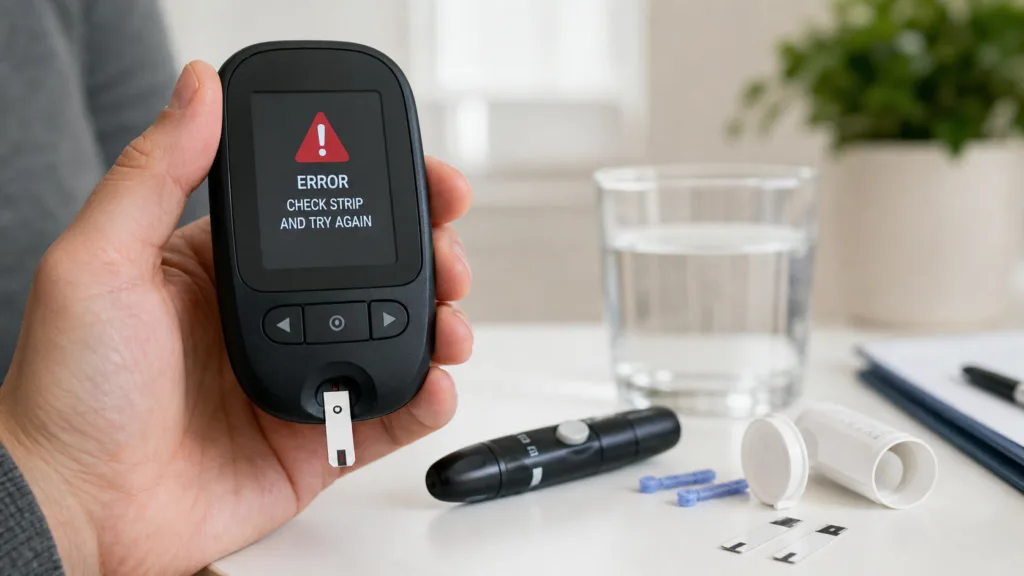
The E-5 Error Code sits at the center of this correction because error interpretation can affect how quickly users respond to abnormal glucose conditions. Trividia Health’s updated communication states that delayed recognition of extremely low or extremely high blood glucose levels could increase the risk of serious health complications or treatment delays. That language matters because it shifts attention from the meter as a measurement device to the meter as a decision interface.
In diabetes care, ambiguity can be clinically costly. A person who receives an error message may repeat a test, delay action, assume a strip or meter problem, or seek an alternative reading. For lower-risk users, that delay may be inconvenient. For people on intensive insulin therapy, sulfonylureas, or those with frequent hypoglycemia or hyperglycemia events, the same delay could become more consequential. Trividia Health has specifically identified these higher-risk groups as users who should consider transitioning to an alternative testing method until updated systems become available.
The device industry takeaway is that error codes are not minor user-interface details. They are part of the safety architecture. In high-frequency home diagnostics, a device must communicate failure states as clearly as it communicates valid results. That requirement becomes even more important when users include elderly patients, people with fluctuating glucose levels, and individuals who may not have immediate clinical support at the moment of testing.
Why Trividia Health’s planned software update is the real test of corrective strategy
The most consequential part of the update is Trividia Health’s decision to pursue updated software for TRUE METRIX meters as its long-term corrective strategy. Labeling changes may reduce confusion, but software changes suggest the medical device manufacturer sees a deeper need to alter how the meter handles or communicates the E-5 Error Code. That makes the future upgrade program central to how the correction will be judged.
For medical device manufacturers, software-led corrections can be both cleaner and more complicated than paper-based notices. A label update can be distributed quickly, but it depends heavily on user compliance and channel discipline. A software update can address the underlying interaction more directly, but it requires manufacturing readiness, replacement logistics, user identification, inventory coordination and clear communication across retail and distribution networks.
That creates an execution challenge. Trividia Health said updated meters are expected to become available across the TRUE METRIX product family in the near future, after which it plans a comprehensive upgrade program to replace meters currently in the field. Until that program is available, affected users remain dependent on updated instructions, alternative testing decisions where appropriate, and communication from pharmacies, mail-order companies and distributors.
What clinicians and pharmacists are likely to watch as the TRUE METRIX upgrade program develops
Clinicians and pharmacists will likely focus on whether the correction reaches the patients most exposed to harm. The updated notice identifies people relying on intensive insulin therapy, sulfonylureas, or glucose monitoring because of frequent hypo- or hyperglycemia events as higher-risk groups. That is clinically important because these populations may need faster and more reliable interpretation when a meter fails to provide a reading.
The distribution model adds another layer of complexity. Trividia Health said the correction affects all TRUE METRIX, TRUE METRIX AIR, TRUE METRIX GO and TRUE METRIX PRO branded meters distributed in the United States, including cobranded products sold under store or distribution partner names. This means the communication challenge is not confined to one branded retail shelf. It runs through pharmacy chains, mail-order suppliers, distributors and private-label arrangements.
For pharmacists, the practical burden may involve identifying affected products, helping users understand the correction, and directing them to updated instructions or support channels. For clinicians, the key issue is whether patients at elevated risk are aware of the notice and whether they have access to alternative glucose testing methods when needed. The correction therefore tests not only Trividia Health’s device strategy, but also the resilience of the diabetes care supply chain around post-market safety communication.
Why this correction reflects a wider regulatory focus on connected and software-dependent medical devices
The TRUE METRIX update also fits into a broader regulatory environment in which software, usability and post-market corrections are receiving sharper attention. Blood glucose meters may not always be viewed in the same category as complex connected devices, but their risk profile increasingly depends on the same themes: user interface design, software behavior, labeling clarity and real-world monitoring.
Regulatory watchers are likely to view the correction through the lens of whether the mitigation is proportionate to the risk. The immediate labeling and messaging updates address awareness. The planned software update suggests a more durable correction. The future replacement program would then determine whether the mitigation reaches the installed base at scale. Each step reduces a different part of the risk, but each step also introduces a different execution dependency.
This is where the correction becomes strategically relevant for the wider diagnostics sector. Device makers often face the difficult task of correcting fielded products without unnecessarily alarming users or disrupting care continuity. In diabetes management, that balance is especially delicate because users may still need to test glucose levels daily while awaiting updated hardware or instructions. The safer communication strategy must therefore be clear enough to change behavior, but practical enough to avoid creating confusion that could itself delay testing.
What remains unresolved for Trividia Health, distributors and affected TRUE METRIX users
The biggest unresolved issue is timing. Trividia Health has said updated meters are expected to become available in the near future, but the operational details of the upgrade program will determine how quickly the correction translates into field-level risk reduction. Industry observers will want to see how the U.S.-based diabetes device manufacturer identifies affected users, manages cobranded inventory, coordinates with retail and mail-order partners, and communicates replacement steps.
Another unresolved issue is user behavior. A correction can only work if people understand what has changed and why it matters. That is harder in home-use diagnostics than in institutional settings because patients may not read updated booklets, may no longer have original packaging, or may use supplies sourced through multiple channels. The presence of a serial number search tool and updated product notices can help, but the real test is whether the message reaches people who are most likely to experience harm from delayed recognition.
There is also a reputational dimension. Trividia Health supplies affordable blood glucose monitoring products through TRUE and store-brand labels, which places it in a value-sensitive segment of diabetes care. In that market, trust is not built only on price or availability. It is built on the perception that devices are reliable, instructions are clear, and corrections are handled transparently. The planned software update and meter replacement program may help preserve that trust, but execution will matter more than intent.
What this means for the future of home diabetes monitoring device safety
The Trividia Health correction reinforces a larger lesson for the diabetes technology market: the safety of home-use devices depends as much on communication design as on measurement capability. A blood glucose meter must not only detect glucose accurately under normal test conditions. It must also guide users safely when testing fails, readings are unclear, or repeat action is required.
For the broader medical device sector, the TRUE METRIX update shows why post-market corrections are becoming more visible even in established categories. As devices become more software-mediated and more deeply embedded in daily self-care, manufacturers must treat labeling, software logic, error codes and upgrade pathways as parts of the same safety system. Regulators are unlikely to view these issues as isolated documentation matters when they affect treatment timing.
For Trividia Health, the next phase is therefore less about announcing a correction and more about proving the correction can be operationalized. The future upgrade program will need to be clear, accessible and broad enough to cover branded and cobranded meter users. Until then, clinicians, pharmacists, regulators and diabetes care stakeholders will be watching whether the updated instructions reduce risk and whether the software-based solution arrives with enough speed and clarity to restore confidence.

What Trividia Health’s TRUE METRIX correction reveals about diabetes device risk communication added by Pallavi Madhiraju on
View all posts by Pallavi Madhiraju →