UCB has signed a definitive agreement to acquire Candid Therapeutics for up to $2.2 billion, adding the investigational BCMA-directed T-cell engager cizutamig to its immunology pipeline. The Belgian biopharmaceutical company is positioning the deal as a next-generation autoimmune disease transaction, with cizutamig already in multiple Phase 1 studies across more than 10 autoimmune indications.
Why UCB’s Candid Therapeutics acquisition changes the autoimmune T-cell engager race
The strategic significance of the transaction lies less in Candid Therapeutics’ current clinical maturity and more in the therapeutic wager UCB is making. T-cell engagers have historically been associated with oncology, where redirecting immune cells toward malignant targets has become a powerful but safety-sensitive treatment strategy. UCB is now backing the idea that a similar mechanism, carefully redesigned and controlled, can be used to reset immune dysfunction in autoimmune and inflammatory diseases.
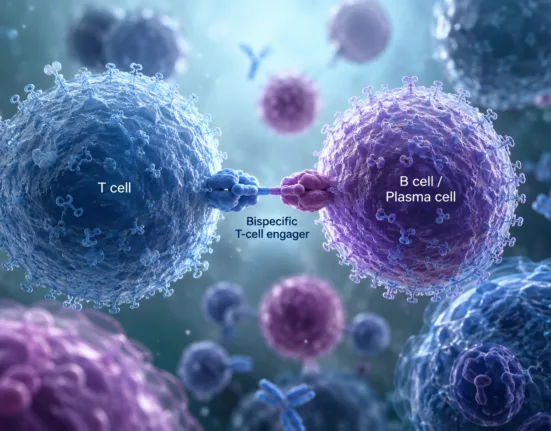
That is a bold move because autoimmune treatment has long been dominated by chronic suppression rather than deep biological reset. Existing biologics and small molecules can manage disease activity, reduce flares, and slow progression, but many still require continuous dosing and leave unresolved questions around durability, relapse, safety, and payer acceptance. Candid Therapeutics brings UCB an asset designed to deplete BCMA-expressing plasma cells and B-cells through CD3-mediated T-cell cytotoxicity, a mechanism that could theoretically produce deeper control in antibody-mediated autoimmune conditions.
The risk is equally obvious. Cizutamig remains investigational and has not been approved by the U.S. Food and Drug Administration or other health authorities. Phase 1 exposure in more than 100 patients across multiple myeloma and autoimmune diseases offers an early clinical foundation, but it does not yet answer the central questions that will define the asset’s value. UCB must still prove that cizutamig can deliver durable autoimmune benefit without importing the toxicity concerns that have followed T-cell engager biology in oncology.

How cizutamig could expand UCB’s immunology pipeline beyond conventional biologics
Cizutamig is designed as a bispecific antibody directed at BCMA on plasma cells and CD3 on T-cells. That design matters because BCMA has become an important target in B-cell and plasma cell biology, especially in diseases where pathogenic antibodies may drive inflammation or tissue damage. For UCB, the acquisition gives it a possible bridge between its established immunology franchise and a more aggressive future built around immune cell redirection.
The commercial context is important. UCB generated €7.7 billion in revenue in 2025 and has identified five core medicines, including BIMZELX, RYSTIGGO, ZILBRYSQ, FINTEPLA, and EVENITY, as growth engines for the coming decade. Adding Candid Therapeutics is therefore not a rescue transaction. It is a pipeline expansion move by a company already leaning into immunology and neurology as its core disease areas.
The unresolved question is whether cizutamig can become more than a platform narrative. In autoimmune drug development, broad indication potential can be attractive, but it can also hide execution complexity. A molecule being studied across more than 10 autoimmune indications creates optionality, but it also requires disciplined prioritization, clean biomarker logic, careful dose selection, and convincing disease-by-disease clinical readouts. UCB is not just buying an asset. It is buying a clinical decision tree.
Why the Antengene and Candid Therapeutics deals point to a broader UCB immune reset strategy
The Candid Therapeutics acquisition follows UCB’s recently announced transaction with Antengene, creating the impression of a more deliberate platform strategy in next-generation immunology. Rather than placing one isolated bet on one molecule, UCB appears to be assembling capabilities across B-cell targets and disease mechanisms. That could allow the Brussels-based biopharmaceutical company to pursue immune reset through multiple biological routes.
This is where the deal becomes more interesting for industry observers. Autoimmune therapeutics are entering a phase in which the winning companies may not be those with another incremental anti-inflammatory agent, but those that can prove deeper, safer, and more durable disease modification. The market has already seen rising interest in targeted B-cell depletion, FcRn blockade, plasma cell targeting, and cell therapy-inspired mechanisms adapted for immune-mediated disease. Candid Therapeutics gives UCB a stronger seat at that table.
However, immune reset remains a powerful phrase that still needs clinical proof. Regulators, clinicians, and payers will not reward platform ambition unless it translates into measurable outcomes, manageable adverse events, and meaningful durability versus existing standards of care. If cizutamig requires complex administration, intensive monitoring, or produces safety concerns disproportionate to the autoimmune disease setting, adoption could narrow quickly.
What Two River and Vida Ventures reveal about biotech company creation economics
The acquisition also highlights the role of biotech company creation platforms in compressing the timeline from asset formation to strategic exit. Two River helped found Candid Therapeutics alongside Third Rock Ventures, while Vida Ventures backed the company as part of its broader life sciences investment strategy. Candid Therapeutics was formed through the merger of TRC 2004 and Vignette Bio, bringing together sourced assets, management capability, and investor backing into a focused autoimmune T-cell engager company.
For Two River and Vida Ventures, the deal validates a model that combines early asset identification, global sourcing, venture formation, and clinical execution. The uploaded material indicates that TRC 2004 sourced one of Candid Therapeutics’ lead assets from China, underscoring how biotech creation increasingly depends on global asset arbitrage rather than purely domestic discovery. That model can create value quickly when a strong scientific thesis meets large pharmaceutical company appetite.
The limitation is that rapid value realization does not automatically equal clinical validation. A $2.2 billion transaction, including $2.0 billion upfront and up to $200 million in milestones, signals UCB’s confidence and competitive urgency. It does not prove that cizutamig will succeed in Phase 2 or Phase 3 autoimmune trials. For the wider biotech market, the deal may encourage more company creation around immune reset mechanisms, but it could also raise valuation expectations before the clinical field has fully matured.
Why investors may see the $2bn upfront payment as both strategic and demanding
From an investor sentiment perspective, the upfront structure is hard to ignore. UCB is paying $2.0 billion upfront for a privately held clinical-stage company whose lead asset remains in Phase 1 autoimmune studies. The additional $200 million in potential milestones is modest relative to the upfront component, which suggests that the competitive value was attached to immediate control of the platform rather than distant contingent economics.
UCB shares recently traded around €231.20 on Euronext Brussels, with market data showing a 52-week range of roughly €146.05 to €289.50 and a market capitalization near €43.9 billion. That context matters because the acquisition is meaningful but not company-defining in balance sheet terms. Investors are likely to judge the transaction less on near-term earnings impact and more on whether it strengthens UCB’s long-term immunology growth story after a strong 2025 performance.
The sentiment read is cautiously constructive, but not risk-free. Strategic investors may like that UCB is adding differentiated science in a disease area it understands. More skeptical observers may question whether the company is paying a premium for early-stage immunology optionality at a time when autoimmune T-cell engager safety, durability, and payer logic remain unproven. In plain English, this is not a cheap lottery ticket. It is a high-conviction wager with a large upfront cheque.
What clinicians and regulators will watch next as cizutamig moves deeper into autoimmune trials
Clinicians will focus first on whether cizutamig can produce clinically meaningful responses in specific autoimmune indications rather than broad mechanistic promise. Disease selection will be critical. Conditions with strong pathogenic antibody biology, clear unmet need, and measurable endpoints may provide the best early proving ground. Myasthenia gravis and rheumatology-associated interstitial lung disease, which have been associated with Candid Therapeutics’ development plans, could be especially closely watched because they combine serious disease burden with evolving treatment landscapes.
Regulators will look closely at cytokine release risk, infection risk, immune depletion depth, retreatment logic, and long-term monitoring requirements. A T-cell engager for autoimmune disease must meet a different tolerance threshold than one used in advanced cancer. Patients with chronic immune-mediated diseases may be treated earlier and for longer horizons, meaning the acceptable balance of benefit and risk is tighter.
The commercial challenge will come later, but it is already visible. If cizutamig can demonstrate durable immune reset, payers may accept premium pricing for severe, refractory disease. If the benefit looks incremental versus established biologics or emerging alternatives, reimbursement could become tougher. UCB must therefore build not only a clinical case, but a health-economic case around fewer relapses, reduced steroid use, better quality of life, and potentially lower long-term treatment burden.
What UCB’s Candid Therapeutics deal signals for autoimmune biotech M&A in 2026
The broader market signal is that autoimmune drug development is moving into a more aggressive mechanistic era. Large pharmaceutical companies are no longer only looking for safer anti-inflammatory agents or line extensions. They are searching for technologies that may change the depth and durability of response, especially in diseases where B-cells, plasma cells, and autoantibodies play central roles.
For smaller biotechs and venture firms, Candid Therapeutics shows that platform formation around validated immune biology can still command major strategic interest, even before late-stage data. That could support more venture capital formation around bispecific antibodies, targeted depletion strategies, and immune reset concepts. It may also intensify competition for globally sourced assets from China and other innovation hubs where early clinical programs can be developed quickly.
For UCB, the next proof point will not be the closing of the transaction, which is expected by the end of the second quarter or early third quarter of 2026 subject to antitrust clearance and customary conditions. The real proof point will be whether cizutamig can generate disease-specific data strong enough to justify accelerated development. Until then, the deal should be read as a strategically coherent but clinically early move into one of immunology’s most closely watched frontiers.
Why this deal matters beyond the headline valuation
The Candid Therapeutics acquisition is important because it shows how far autoimmune therapy has moved from symptom control toward the more ambitious idea of immune system reprogramming. UCB is not merely adding another biologic to its pipeline. It is trying to secure a position in a future market where disease-modifying depth, durability, and immune reset claims may separate premium therapies from crowded anti-inflammatory categories.
The caution is that the science still has to earn the valuation. T-cell engagers are potent tools, and potency is both the opportunity and the risk. If UCB can demonstrate that cizutamig depletes pathogenic immune cell populations while maintaining a tolerable safety profile in autoimmune patients, the acquisition could look prescient. If safety, dosing, or indication selection becomes messy, the deal may be remembered as an expensive early-stage bet. Either way, UCB has made the autoimmune T-cell engager race harder for rivals to ignore.