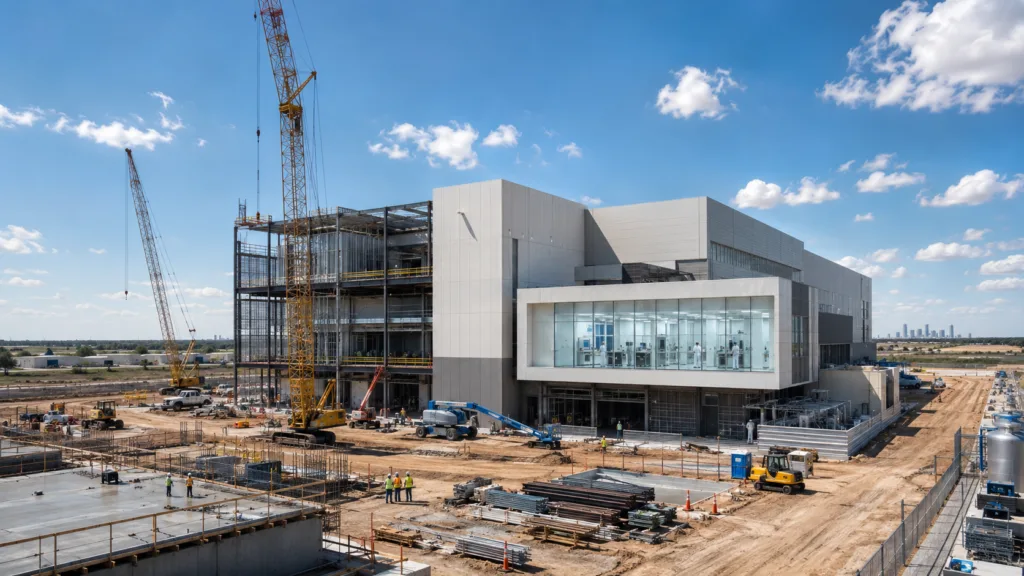
Novartis AG has started construction on its planned radioligand therapy manufacturing centre in Denton, Texas, advancing a new United States production site for precision oncology treatments. The facility is expected to become operational in 2028 and is intended to expand Novartis AG’s capacity to manufacture time-sensitive radioligand therapies as demand grows across cancer care.
Why Novartis’ Texas RLT centre matters beyond another US manufacturing announcement
The Denton project is more than a capacity addition. It reflects how radioligand therapy is pushing pharmaceutical manufacturing into a more geographically sensitive, operationally demanding model than conventional small-molecule or biologics production. For Novartis AG, the strategic issue is not simply whether it can build another plant, but whether it can create a production and distribution network that keeps pace with an oncology category where each dose is time-bound, highly specialized, and dependent on coordination between manufacturing sites, nuclear medicine teams, logistics partners, hospitals, and treating clinicians.
Radioligand therapy combines a targeting molecule with a therapeutic radioisotope, allowing radiation to be delivered to cancer cells expressing specific molecular targets. That mechanism gives the modality strong clinical appeal in selected cancers, but it also creates a supply chain challenge that is unusually unforgiving. Unlike many oncology drugs that can be warehoused and shipped through conventional cold-chain systems, radioligand therapies are constrained by radioactive decay, patient-specific scheduling, site readiness, and nuclear handling requirements. The Denton site therefore matters because physical proximity to treatment centres can directly influence delivery reliability, appointment adherence, and the ability of health systems to expand usage without creating operational bottlenecks.
This is where Novartis AG’s timing becomes important. The Swiss pharmaceutical group already markets radioligand therapy products and is studying the modality across broader cancer settings, but commercial scale will depend on whether manufacturing infrastructure can support clinical ambition. If radioligand therapy remains confined to niche use in advanced disease, a smaller network may be sufficient. If it moves into earlier treatment lines or additional tumour types, the manufacturing footprint must become more resilient. The Denton facility is a bet that the second scenario is more likely.
What the Denton site changes for radioligand therapy access in the United States
The planned Texas facility adds a southern United States node to Novartis AG’s radioligand therapy manufacturing network, which already includes sites in New Jersey, Indiana and California, with an additional Florida site planned. That geographic spread matters because radioligand therapy delivery is not only a production problem. It is a coordination problem. Manufacturers need to match production timing to patient appointments, while hospitals need trained staff, nuclear medicine infrastructure, radiation safety protocols, imaging capabilities, and reimbursement confidence.
For clinicians, the potential benefit of a broader manufacturing network is not abstract. A missed or delayed dose can disrupt treatment schedules and create anxiety for patients already navigating complex cancer care. For oncology centres, predictable supply can determine whether a therapy is offered broadly, reserved for select patients, or avoided because operational friction is too high. By placing a facility in Denton, Novartis AG is strengthening coverage for a large and fast-growing region that includes major cancer centres, community oncology networks, and expanding healthcare infrastructure across the southern United States.
The limitation is that manufacturing capacity alone cannot guarantee adoption. Radioligand therapy requires multidisciplinary readiness. Nuclear medicine departments, medical oncologists, radiation safety officers, payers, pharmacies, and hospital administrators must all align before treatment volumes can grow meaningfully. Smaller centres may still face staffing, infrastructure, referral, or reimbursement hurdles even if supply improves. In that sense, Denton can reduce one bottleneck, but it cannot remove all the barriers that stand between regulatory approval and routine oncology use.
How Novartis is trying to defend its early lead in targeted radiopharmaceuticals
Novartis AG has been one of the most visible large pharmaceutical groups in radioligand therapy, and the Texas centre reinforces a strategy that combines clinical pipeline development with manufacturing ownership. That combination is strategically important because targeted radiopharmaceuticals are not easily scaled through conventional outsourced manufacturing models. Control over production, quality systems, isotopes, logistics, and release timing can become a competitive advantage, especially if multiple players begin competing for the same hospital slots, specialist staff, and patient populations.
The genuine novelty in the Denton announcement is not the concept of another radioligand therapy site. Novartis AG had already disclosed plans for the facility earlier in 2026. What changes now is that construction has begun, which moves the project from strategic intent into execution. In an industry where manufacturing announcements can sound impressive long before they deliver supply, breaking ground matters because it starts the countdown toward operational qualification, workforce hiring, regulatory readiness, and integration into the broader network.
However, the execution risk should not be understated. Radioligand therapy manufacturing involves complex regulatory, safety, and quality requirements. Facilities must meet pharmaceutical manufacturing standards while also handling radioactive materials under strict controls. Any delay in construction, licensing, validation, isotope sourcing, workforce training, or quality system implementation could push timelines beyond 2028. For a company positioning capacity as part of its oncology advantage, the market will eventually judge the Denton site by reliability, not ribbon-cutting.
Why manufacturing scale is becoming a clinical and commercial differentiator in oncology
The Novartis AG project highlights a broader change in oncology: manufacturing is becoming part of the therapeutic proposition. In conventional drug markets, differentiation often centres on efficacy, safety, dosing convenience, and price. In radioligand therapy, those factors remain important, but supply consistency becomes unusually central. A therapy that performs well in trials may still struggle commercially if hospitals cannot reliably schedule, receive, administer, and get reimbursed for doses.
This creates a strategic opening for larger pharmaceutical companies with the capital to build dedicated infrastructure. Smaller radiopharmaceutical developers may generate promising clinical data, but they often face a harder path in scaling manufacturing networks, securing isotope supply, and persuading major oncology centres that treatment logistics will be dependable. Novartis AG’s investment therefore serves two purposes. It expands supply for existing and future therapies, and it raises the infrastructure bar for competitors seeking to challenge its position.
The unresolved question is whether scale will translate into sustainable market power or simply become the cost of entry. As more radiopharmaceutical assets move through development, contract manufacturers, isotope suppliers, and specialist logistics providers may gradually mature. If that happens, manufacturing infrastructure could become less differentiating over time. For now, however, companies with integrated production networks are better placed to turn radioligand therapy from a specialist treatment into a more scalable oncology category.
What regulators, payers, and hospitals are likely to watch next
Regulators will likely focus on whether expanded radioligand therapy production maintains consistent quality, radiation safety, batch integrity, and reliable distribution controls. The clinical promise of the modality does not reduce the burden of manufacturing discipline. In fact, the short shelf life and radioactive components can make operational consistency even more important. Each new site must demonstrate that scale does not compromise precision.
Payers will watch a different set of questions. Radioligand therapies can be clinically compelling, but they are also resource-intensive. Reimbursement decisions will depend on evidence of survival benefit, quality-of-life impact, sequencing value, and cost-effectiveness relative to other oncology options. If Novartis AG and the broader field push radioligand therapy into earlier lines of treatment, payer scrutiny could increase because eligible patient populations may become larger and budget impact could rise.
Hospitals will focus on practical adoption. Capacity from Denton may help, but institutions must decide whether they have the nuclear medicine infrastructure, scheduling systems, radiation safety workflows, and trained staff to expand treatment volumes. Large academic centres may be better positioned than smaller community settings, which could create uneven access even as manufacturing expands. That access gap may become one of the most important issues for the field if radioligand therapy becomes a more prominent part of cancer care.
Investor sentiment around Novartis reflects confidence, but not unlimited patience
Novartis AG enters this buildout from a position of considerable financial strength. Its New York-listed shares closed at $146.03 on May 8, 2026, with a market capitalization of roughly $285.7 billion, indicating that investors continue to treat the group as a major global pharmaceutical compounder with durable oncology, immunology, cardiovascular and specialty medicine franchises. The Denton project does not change the near-term earnings picture on its own, but it supports the longer-term growth narrative around differentiated oncology platforms.
Investor sentiment toward radioligand therapy remains constructive because the modality sits at the intersection of precision medicine, targeted oncology, and specialty manufacturing. That is the kind of combination markets often reward when clinical data, regulatory approvals, and commercial execution move together. The risk is that capital intensity, operating complexity, and reimbursement friction may dilute the upside if adoption grows more slowly than expected.
For Novartis AG, the Denton facility strengthens the argument that it is building a defendable radioligand therapy platform rather than managing isolated products. That distinction matters. Product-level success can generate revenue. Platform-level strength can shape referral patterns, hospital relationships, clinical trial execution, and competitive positioning across tumour types. The next test is whether the manufacturing network can support that ambition without introducing delays, quality issues, or cost pressure.
What happens next for Novartis’ radioligand therapy strategy
The most important milestones now sit outside the groundbreaking ceremony. Industry observers will be watching whether the Denton site remains on track for 2028, how quickly Novartis AG recruits and trains specialized manufacturing and quality staff, and whether the site can be integrated into the wider United States radioligand therapy network without operational disruption. They will also watch how the company’s clinical pipeline evolves, because additional indications would make the case for extra capacity much stronger.
The commercial trajectory will depend on a delicate balance. If radioligand therapy expands too slowly, the manufacturing buildout could look ahead of demand. If uptake accelerates faster than expected, capacity could become a decisive advantage. The strongest outcome for Novartis AG would be a synchronized expansion in clinical evidence, regulatory approvals, payer acceptance, hospital readiness, and manufacturing availability.
The Denton centre therefore represents a strategic infrastructure move in a field where infrastructure may decide how fast science reaches patients. Radioligand therapy has already moved beyond experimental curiosity in selected cancers, but its next phase depends on whether the industry can make a highly specialized treatment behave like a scalable medical product. Novartis AG is betting that manufacturing proximity, network depth, and operational control will be central to that transition. The bet is logical, but the proof will arrive only when the Texas site begins supplying time-sensitive cancer therapies at scale.