Detect-ION, a diagnostics-focused startup based in Tampa, Florida, has announced a collaborative project with the Infectious Diseases Division at Mayo Clinic Florida to develop a non-invasive breath test for detecting Pseudomonas aeruginosa, a leading cause of pneumonia in vulnerable patient populations. Funded through the Mayo Clinic Advanced Innovation Research program, the project aims to address urgent gaps in diagnosing lower respiratory tract infections, particularly in lung transplant recipients and individuals with structural lung diseases.
Why this collaboration signals a shift in pneumonia diagnostics
The strategic alliance between Detect-ION and Mayo Clinic highlights a growing urgency to replace outdated and invasive respiratory diagnostic tools with faster, safer, and more scalable solutions. Despite decades of clinical reliance on sputum cultures, blood panels, and bronchoscopies, these methods frequently fail to provide timely or conclusive results. For patients already at risk, the diagnostic delays associated with these approaches can lead to the unnecessary use of broad-spectrum antibiotics, prolonged hospitalizations, and increased exposure to drug-resistant organisms.
This is particularly critical in the case of Pseudomonas aeruginosa, a pathogen known for its ability to form protective biofilms and evade multiple classes of antibiotics. It is not only a top cause of hospital-acquired pneumonia but also disproportionately affects immunocompromised patients, including those with cystic fibrosis and chronic obstructive pulmonary disease. The clinical problem extends beyond simple detection. Current methods often cannot distinguish between bacterial colonization and true invasive infection, leading clinicians to treat indiscriminately and contribute to antimicrobial resistance.
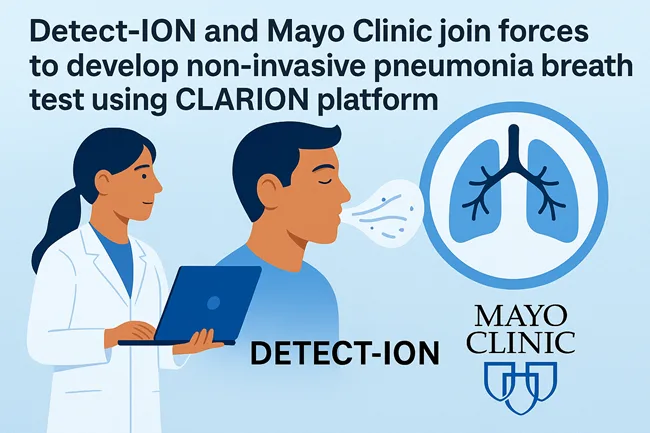
Detect-ION’s partnership with Mayo Clinic, focused on identifying unique volatile organic compound biomarkers in exhaled breath, aims to resolve this ambiguity. If successful, the project could represent a material advance over conventional diagnostics by enabling physicians to detect pathogens early, determine the invasiveness of the infection, and monitor treatment response using a single breath sample.
What makes the CLARION platform different from other breath-based approaches
At the heart of the initiative is Detect-ION’s CLARION technology, a point-of-care diagnostic platform that integrates a miniaturized gas chromatograph with a chip-scale mass spectrometer. Unlike traditional gas chromatography-mass spectrometry systems that are bulky and confined to centralized laboratories, CLARION is designed for bedside use and delivers lab-grade chemical analysis in under five minutes. Its primary strength lies in detecting trace volatile organic compounds in exhaled breath with high sensitivity and specificity.
What sets CLARION apart is its origin in government-funded defense programs. Initially developed as a dual-use technology with funding from the Intelligence Advanced Research Projects Activity, the Defense Advanced Research Projects Agency, the Defense Threat Reduction Agency, and the Defense Innovation Unit, the system was designed for trace chemical detection in high-risk environments. Detect-ION has since adapted and extended the platform for clinical diagnostics, with potential applications spanning tuberculosis, malaria, lung cancer, and now pneumonia.
This heritage gives CLARION a technological advantage, but it also presents challenges. Translating a platform built for military-grade chemical sensing into a clinically validated diagnostic tool requires rigorous biomarker discovery, regulatory alignment, and manufacturing readiness. The involvement of Mayo Clinic provides a level of institutional credibility that could help bridge this transition by anchoring early research within a top-tier medical system.
Why biomarker specificity is critical to unlocking diagnostic value
The first phase of the collaboration focuses on identifying volatile biomarkers in exhaled breath that correlate with invasive Pseudomonas aeruginosa infections. This will be done using high-resolution mass spectrometry techniques that allow researchers to differentiate between pathogenic infections and harmless bacterial colonization.
The ability to make this distinction is a major unmet need in respiratory care. Current diagnostic workflows often require clinicians to decide treatment protocols without knowing whether detected bacteria are actually causing disease. This uncertainty not only leads to overprescription of antibiotics but also exposes patients to avoidable drug toxicity, allergic reactions, and hospital-acquired complications.
By isolating a clinically relevant biomarker profile, the Detect-ION and Mayo Clinic team aims to create a diagnostic test that not only detects the presence of the pathogen but also assesses disease severity and tracks response to therapy. This could make CLARION a useful tool not only for initial diagnosis but for ongoing monitoring, especially in outpatient or immunocompromised populations where repeat bronchoscopies are infeasible.
What could change in antimicrobial stewardship and hospital resource allocation
If CLARION’s pneumonia application is validated through this collaboration, the implications for antimicrobial stewardship programs could be substantial. Clinicians currently face pressure to act quickly in suspected pneumonia cases, often initiating empirical antibiotic regimens before receiving confirmatory results. This practice, while necessary, accelerates the emergence of drug-resistant strains and imposes additional costs on the healthcare system.
A reliable, five-minute breath test would allow more targeted prescribing, enabling clinicians to withhold or refine antibiotic treatment based on specific, real-time pathogen data. This could also reduce the need for invasive procedures such as bronchoscopy, thereby freeing up critical hospital resources and lowering patient risk.
From a payer perspective, reducing unnecessary antibiotic use, shortening hospital stays, and preventing readmissions could translate into measurable cost savings. In the United States alone, pneumonia is estimated to account for over $17 billion in annual direct healthcare costs. Any technology that addresses this economic burden without compromising clinical outcomes is likely to attract interest from both public health agencies and value-based care administrators.
Where regulatory hurdles and adoption risks remain
Despite its promising technology, Detect-ION still faces a steep regulatory pathway. Breath diagnostics, particularly those relying on volatile organic compound signatures, remain a nascent category within the U.S. Food and Drug Administration’s device oversight framework. While the agency has cleared breath-based tests for conditions like Helicobacter pylori infection and certain metabolic disorders, few have navigated the more complex terrain of infectious disease diagnostics.
CLARION’s success will depend on demonstrating that its breath-based VOC patterns are not only reproducible across populations but also superior in clinical accuracy to current gold standards. Mayo Clinic’s support may help streamline early-stage validation, but Detect-ION will still need to generate large-scale, multi-center data to satisfy regulatory expectations and build payer confidence.
Another major hurdle is workflow integration. For a breath test to be adopted in clinical practice, it must align with existing diagnostic pathways and electronic health record systems while providing immediate clinical utility. This means ease of use, clear interpretation, and fast turnaround must be coupled with minimal training requirements for frontline providers.
Additionally, environmental variability and patient-specific factors such as diet, medication use, or comorbid conditions could interfere with breath biomarker readings. Ensuring consistent performance across different settings and patient types will be essential for clinical acceptance.
Why the platform’s broader potential could be shaped by this pilot use case
Detect-ION appears to be positioning CLARION not just as a single-use diagnostic, but as a modular platform for real-time breath-based analysis across multiple infectious and non-infectious diseases. This strategic flexibility mirrors a growing trend in diagnostic device development, where the core sensor remains constant but software-defined biomarker panels determine use case.
By initially targeting Pseudomonas aeruginosa, a pathogen that poses high clinical risk and lacks a reliable diagnostic standard, Detect-ION is choosing a high-impact but manageable entry point. If the technology proves successful in this application, it may pave the way for broader diagnostic use in tuberculosis, chronic obstructive pulmonary disease exacerbations, or even early lung cancer detection.
Public health and global medicine communities are also likely to watch closely. In low-resource settings where lab access is limited, the ability to conduct breath tests using a portable device could transform infectious disease screening, particularly for tuberculosis and malaria. CLARION’s military-grade design and speed also make it a candidate for deployment in field hospitals and disaster response zones.
What emerges from this Mayo Clinic collaboration could ultimately serve as the clinical proof-of-concept needed to expand CLARION’s use cases and unlock cross-sector partnerships in global health, biodefense, and commercial diagnostics.

Detect-ION, Mayo Clinic join forces to develop non-invasive pneumonia breath test added by Srinath B on
View all posts by Srinath B →