
KUBTEC Scientific has launched the XCELL TomoRad x-ray irradiator, a preclinical image-guided radiotherapy system designed to make targeted radiation studies more accessible for cancer research laboratories. Introduced at the annual meeting of the American Association for Cancer Research, the device uses tomosynthesis-based 3D imaging to support faster, lower-dose and more workflow-friendly small-animal irradiation research.
Why KUBTEC Scientific’s XCELL TomoRad launch matters for preclinical cancer radiotherapy access
The significance of the XCELL TomoRad launch is not that another x-ray irradiator has entered the preclinical research market. The more important issue is whether KUBTEC Scientific can reduce a long-standing access gap in image-guided radiotherapy research, where laboratories that want to model clinically relevant radiation dosing often face capital cost, infrastructure and usability barriers that push them toward broader, less targeted irradiation methods.
That distinction matters because radiation oncology research increasingly depends on the ability to reproduce clinically meaningful treatment conditions in animal models. Broad-field irradiation can still be useful, but it does not always reflect the precision, fractionation and targeting expectations now common in modern oncology. A system that combines image guidance, treatment planning and relatively simpler installation could allow more academic and translational laboratories to study tumor response, normal tissue toxicity, combination therapy timing and radiation biology under conditions closer to clinical practice.
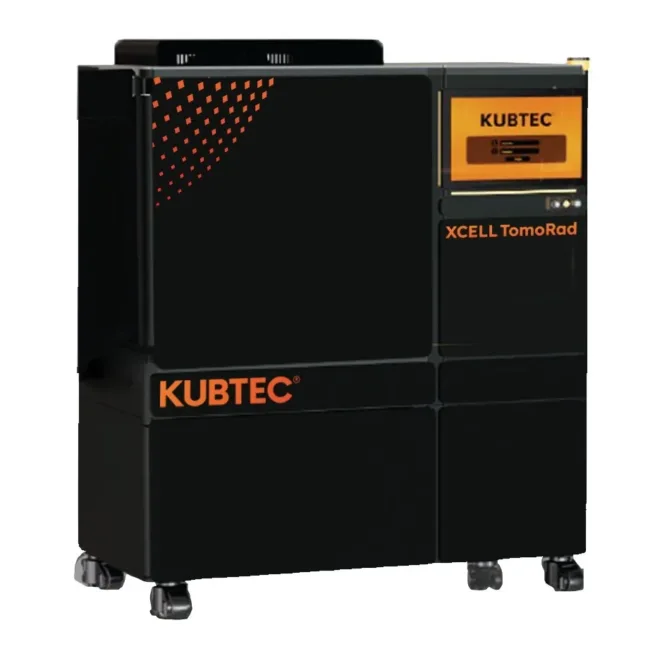
The unresolved question is whether access alone is enough to change research behavior. Laboratories do not adopt new preclinical equipment simply because it is easier to install or less expensive than higher-end alternatives. They need confidence in targeting accuracy, reproducibility, dosimetry validation, animal handling workflow and compatibility with established protocols. KUBTEC Scientific’s opportunity lies in lowering the barrier to entry, but the device will still have to prove that accessibility does not come at the expense of experimental rigor.
How tomosynthesis could reshape the trade-off between imaging speed and targeting precision
XCELL TomoRad’s core technical shift is its use of tomosynthesis, a 3D imaging method that reconstructs the target from multiple x-ray images acquired at different angles and allows viewing in 1mm slices. For preclinical cancer research, that approach is positioned as an alternative to microCT-based image guidance, with KUBTEC Scientific emphasizing lower sample radiation exposure, faster imaging and reconstruction, faster dosing and lower cost.
The commercial logic is clear. MicroCT-based platforms can provide high-resolution anatomical information, but they can also introduce workflow complexity, imaging dose concerns and longer acquisition or reconstruction times. In small-animal studies, those trade-offs are not academic details. Longer workflows can extend anesthesia time, increase animal stress and complicate throughput for laboratories running multi-arm oncology experiments. A faster imaging and irradiation workflow could be especially useful where researchers need repeated dosing, longitudinal assessment or larger cohorts.
However, tomosynthesis also raises the central scientific question that buyers will have to examine closely. A faster 3D imaging approach must still be good enough for the specific anatomical and tumor-localization tasks researchers care about. Some studies may prioritize speed and dose reduction, while others may require higher anatomical detail or more sophisticated image segmentation. The likely adoption pattern may therefore depend less on whether tomosynthesis is universally superior and more on whether it is sufficiently precise for common preclinical radiotherapy use cases at a better workflow and cost profile.
What the device changes for laboratories that could not justify microCT-based IGRT platforms
The most compelling market angle for XCELL TomoRad is democratization of preclinical image-guided radiotherapy. Before systems such as this, many laboratories interested in targeted radiation studies faced a difficult choice between investing in expensive and complex IGRT-capable platforms or using less targeted irradiation methods that may be easier to access but less clinically aligned.
That creates a meaningful gap in translational oncology. If only well-funded institutions can conduct image-guided small-animal radiotherapy studies, then the range of labs able to test radiation combinations, immuno-oncology interactions, radiosensitizers or tumor microenvironment hypotheses becomes narrower. KUBTEC Scientific is effectively positioning XCELL TomoRad as an intermediate category, offering image guidance and treatment planning without the same installation and complexity burden associated with higher-end systems.
The risk is that intermediate categories are judged harshly by both ends of the market. Premium users may ask whether the system provides enough imaging depth and planning sophistication compared with established microCT-based platforms. Cost-sensitive users may still view any IGRT-capable system as a major capital purchase requiring funding, training and validation. The device’s success will likely depend on whether KUBTEC Scientific can show that it expands the addressable market rather than merely shifting existing demand from one class of preclinical irradiator to another.
Why Advanced Treatment Planning software may be as important as the x-ray hardware
KUBTEC Scientific’s inclusion of Advanced Treatment Planning software as a standard feature is strategically important because preclinical radiotherapy is not just a hardware problem. Accurate, customizable and repeatable dosing depends on how well researchers can plan fields, define targets, reproduce positioning and document treatment conditions across cohorts.
For laboratories moving from broad irradiation toward targeted radiation, software can determine whether the transition feels manageable or intimidating. A well-integrated treatment planning environment could reduce training friction, support protocol consistency and make image-guided radiotherapy more usable for non-specialist teams. That matters in preclinical settings, where users may include cancer biologists, translational researchers and core facility staff rather than radiation physicists alone.
The limitation is that treatment planning software must earn trust through validation and usability. Researchers will want to know how dose calculations are handled, how workflows compare across tumor sites, how repeat treatments are aligned and how easily outputs can be documented for publications or regulatory-supportive research packages. In preclinical oncology, convenience is valuable, but credibility comes from reproducibility.
How faster dose delivery could influence small-animal radiotherapy workflow and animal welfare
XCELL TomoRad’s Mag Mode feature, described as an ultra-fast dose delivery method that positions the sample near the x-ray tube for higher dose delivery in a shorter time, targets another operational pain point in animal research. Faster treatment may help laboratories reduce time under anesthesia and improve throughput, both of which are important in studies involving repeated irradiation or larger animal cohorts.
The welfare and workflow implications are connected. Shorter procedures can reduce stress on animals, simplify scheduling for core facilities and make complex multi-arm studies more practical. In radiation biology, where timing relative to immunotherapy, chemotherapy, DNA damage response agents or imaging endpoints may matter, faster workflows could also improve experimental execution.
The unresolved issue is whether speed can be consistently paired with dosimetric control. Higher dose delivery rates and closer positioning can be useful, but laboratories will need clarity on dose uniformity, field shaping, repeatability and QA requirements. For preclinical systems, adoption often depends on whether a device can be trusted not only in demonstration settings but also across routine, multi-user research environments.
Why this is an enabling technology story rather than a direct clinical device story
KUBTEC Scientific’s messaging links the XCELL TomoRad to the broader goal of translating preclinical research into better clinical care, but the device should be understood primarily as an enabling research platform. Its near-term relevance is not direct patient treatment. Its importance lies in whether it improves the quality, accessibility and speed of preclinical radiation studies that may later inform clinical development.
That distinction is important for clinicians, regulators and industry observers. Better preclinical tools do not automatically produce better therapies, but they can improve the design of experiments that evaluate radiation combinations, dose schedules and tissue response. In oncology, where radiotherapy is increasingly being studied alongside systemic therapies and immunotherapies, more accessible image-guided preclinical platforms could expand the evidence base behind future clinical strategies.
The caution is that preclinical models remain imperfect. Small-animal radiotherapy studies can generate valuable mechanistic and translational insights, but differences in tumor biology, immune response, scale, fractionation and clinical complexity limit direct extrapolation. XCELL TomoRad may improve how researchers model targeted radiation, but it cannot remove the broader translational uncertainty that sits between animal studies and human oncology outcomes.
What clinicians, researchers and industry observers are likely to watch next
The next phase for XCELL TomoRad will likely revolve around independent validation, early adopter feedback and evidence of real workflow improvement. Researchers will look for data showing imaging accuracy, dosing reproducibility, treatment planning performance and practical comparisons with microCT-based systems in common cancer models. Core facilities may focus on installation burden, training time, service support and the ability to run studies efficiently across multiple users.
Industry observers will also watch whether KUBTEC Scientific can carve out a differentiated position within the preclinical irradiation market. The medical device manufacturer already operates across x-ray imaging and irradiation systems for research applications, which gives it a relevant installed-base narrative. The question is whether XCELL TomoRad becomes a niche addition for selected labs or a broader category-defining platform for more accessible image-guided preclinical radiotherapy.
The launch is therefore meaningful because it speaks to a practical constraint in cancer research rather than a flashy technological claim alone. Preclinical image-guided radiotherapy has long promised better alignment between laboratory studies and clinical radiotherapy practice. KUBTEC Scientific’s XCELL TomoRad now tests whether that promise can move beyond well-resourced centers and into a wider base of laboratories that need precision, speed and usability in the same system.


