DMOS Orthopaedic Centers has launched a new workers’ compensation referral portal for Iowa employers, claims adjusters and external partners, marking a digital workflow push aimed at reducing communication delays in occupational injury care and making orthopaedic case coordination easier to manage.
The Iowa-based orthopaedic provider said the new platform gives external partners a dedicated place to submit referrals, upload documents and track case status in real time. The move is designed to address a common friction point in workers’ compensation care: the gap between injury reporting, referral intake, medical documentation, treatment scheduling and status updates.
For employers, adjusters and nurse case managers, the value of a workers’ compensation portal is not just administrative convenience. Delays in referral processing can slow treatment, extend time away from work and create uncertainty around restrictions, recovery timelines and case documentation. In orthopaedic injury care, where many workplace injuries involve muscles, joints, bones, ligaments, nerves or repetitive strain, faster coordination can directly shape the path back to work.
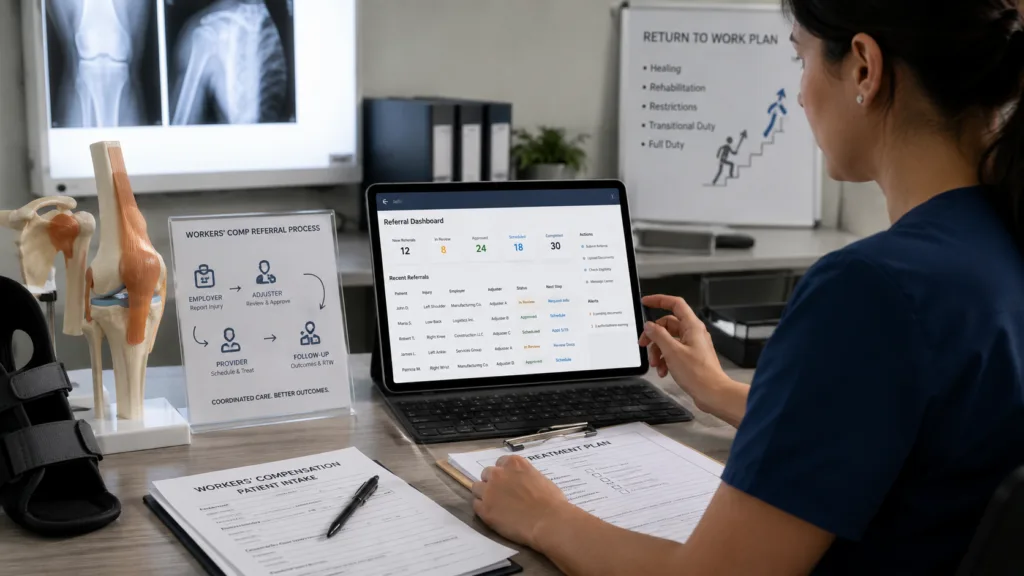
The announcement also reflects a wider healthcare operations trend. Specialty providers are increasingly using digital portals to simplify referral intake, reduce manual communication and give external stakeholders a clearer view of case progress. Workers’ compensation is particularly suited to this kind of workflow redesign because each case often involves multiple parties, including the injured worker, employer, insurer, adjuster, provider, therapist and sometimes legal representatives.
Why DMOS is targeting workers’ compensation workflow bottlenecks
Workers’ compensation care is more complex than a standard clinical visit. A patient needs treatment, but the employer needs status updates, the adjuster needs documentation, and the provider needs timely records, approvals and communication. If any part of that chain slows down, the entire case can become harder to manage.
DMOS Orthopaedic Centers already positions its workers’ compensation team around access, reporting and coordination. The organisation says its workers’ compensation services include same-day access through urgent injury clinics in Ankeny, Urbandale and West Des Moines, along with support for treatment coordination, paperwork and patient status reporting.
That makes the new referral portal a natural extension of its existing occupational injury-care model. Instead of relying heavily on phone calls, emails, faxes or fragmented document exchange, a portal can centralise the intake and tracking process. For claims adjusters, that could reduce follow-up friction. For employers, it could improve visibility. For DMOS, it could reduce staff time spent chasing information across multiple communication channels.
The practical importance is easy to miss. In workers’ compensation, administrative delay is not just paperwork pain. It can affect clinical timing, return-to-work planning and case costs. A faster referral pathway can help injured employees reach the right specialist earlier, while giving employers and adjusters the documentation needed to make decisions.
How a referral portal can change occupational injury-care coordination
A workers’ compensation referral portal can improve coordination in three main ways. First, it can standardise referral intake. When external partners submit information through structured fields and upload required documents in one place, providers can reduce missing information and avoid repeated back-and-forth communication.
Second, it can improve case visibility. Real-time status tracking allows adjusters and employers to see whether a referral has been received, whether documents are complete, and where the case sits in the process. That is particularly useful in injury-care settings where uncertainty often leads to repeated calls and duplicated work.
Third, it can support faster documentation flow. Workers’ compensation cases depend heavily on work status reports, treatment notes, restrictions, imaging results and therapy updates. DMOS has said its workers’ compensation team is dedicated to providing work status reports and forms within 24 business hours of an employee’s appointment. A digital portal can support that promise by making document handling more structured.
For injured workers, the benefits are indirect but important. A cleaner referral system can help reduce delays in appointments, approvals and communication. That can make the care experience less frustrating and may support faster return-to-work planning when medically appropriate.
Why orthopaedic providers are central to workers’ compensation care
Orthopaedic providers play a major role in workers’ compensation because many workplace injuries are musculoskeletal. These can include fractures, sprains, tendon injuries, back injuries, shoulder injuries, knee injuries, hand injuries and repetitive motion conditions such as carpal tunnel syndrome.
The clinical path can involve diagnosis, imaging, conservative treatment, physical therapy, hand therapy, injections, surgery or work restrictions. Each step has documentation requirements. Employers need to know whether an employee can return to work, whether modified duty is appropriate, and what restrictions apply. Adjusters need clear records to manage claims. Providers need accurate information to avoid gaps in care.
DMOS lists workers’ compensation services that include medical evaluations, second opinions, independent medical examinations, impairment ratings, causation determination, attorney or legal consults, imaging, physical medicine, physical therapy, hand therapy and surgery where appropriate. That breadth makes workflow coordination especially important.
A portal does not change the clinical complexity of orthopaedic workers’ compensation. But it can reduce administrative noise around that complexity. The cleaner the information flow, the easier it becomes for medical teams and case stakeholders to focus on treatment, recovery and return-to-work decisions.
What this says about healthcare digitisation beyond hospitals
The DMOS portal launch is a small but useful example of how healthcare digitisation is moving beyond large hospital systems and patient-facing apps. Much of healthcare still runs on operational friction: referrals, document uploads, status checks, authorisations, case notes and stakeholder communication.
Specialty practices are now under pressure to modernise those workflows because external partners expect faster visibility and fewer manual touchpoints. In workers’ compensation, that pressure is even stronger because cases are tied to employer costs, insurance claims and workforce productivity.
This is not the same as flashy artificial intelligence or high-end robotic surgery. But operational technology can still have a real impact. A well-designed referral portal can reduce leakage, improve response times and make case management more transparent. For a regional orthopaedic provider, that can become a competitive advantage.
The broader healthcare technology lesson is simple: not every valuable digital tool has to be a breakthrough diagnostic platform. Sometimes the most useful technology is the one that makes the next step easier for everyone involved.
What risks could limit the impact of the portal?
The first risk is adoption. A portal only works if employers, adjusters and other external partners actually use it. If stakeholders continue relying on older communication channels, the workflow may remain fragmented.
The second risk is usability. Healthcare portals can become counterproductive if they are hard to navigate, require too many steps or do not clearly show case status. External users need speed, not another login headache.
The third risk is data completeness. A digital portal can standardise intake, but it cannot guarantee that every referral arrives with the right information. DMOS will still need strong process design to ensure that missing records, incomplete documents or unclear referral details do not slow the system.
The fourth risk is integration. Workers’ compensation cases often involve records from employers, insurers, providers and therapists. A portal can improve visibility, but the real operational value depends on how well it fits with existing scheduling, medical records and case-management workflows.
Can the DMOS portal strengthen Iowa workers’ compensation care?
DMOS Orthopaedic Centers’ new workers’ compensation referral portal is not a blockbuster healthcare technology launch, but it addresses a real operational pain point. Occupational injury care depends on fast referrals, clear documentation and coordinated communication between multiple stakeholders. When that process breaks down, injured workers can face delays, employers face uncertainty and adjusters face more administrative burden.
The new platform gives DMOS a way to make workers’ compensation referrals more structured and transparent. If adoption is strong, the portal could reduce communication bottlenecks and support faster movement from injury reporting to specialist care and status documentation.
For the occupational health and orthopaedic care market, the launch highlights a practical shift. Digital transformation in healthcare is not only happening in high-profile areas such as artificial intelligence, robotics or remote monitoring. It is also happening in the less glamorous but deeply important workflows that decide how quickly patients get care, how easily employers receive updates and how efficiently claims move through the system.
That is why this story is worth watching. In workers’ compensation, speed and clarity are not administrative luxuries. They are part of the care pathway.

A workers’ comp portal may not sound flashy. For orthopaedic care delays, it could matter added by Pallavi Madhiraju on
View all posts by Pallavi Madhiraju →