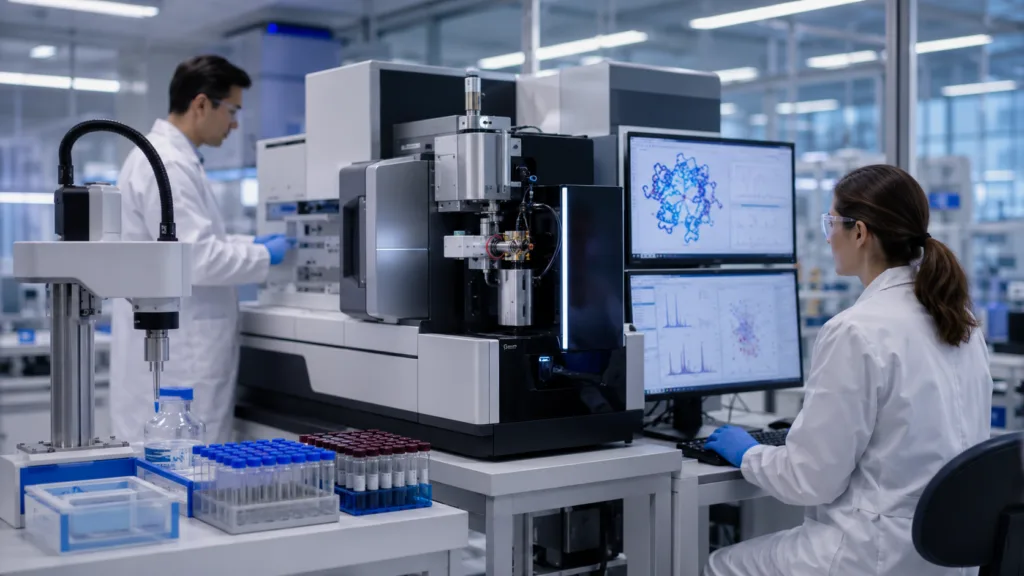
Thermo Fisher Scientific Inc. has unveiled the Thermo Scientific Orbitrap Tribrid Apex Mass Spectrometer and Thermo Scientific Orbitrap Excedion Mass Spectrometer at ASMS 2026, positioning the new platforms as next-generation tools for drug discovery, proteomics, multiomics and biopharmaceutical development. The announcement places mass spectrometry, AI-enabled analytics and scalable proteomics at the center of a broader industry push to convert complex biological data into decisions that can support new therapy development.
Why Thermo Fisher Scientific’s new Orbitrap platforms matter for earlier drug discovery decisions
The strategic point behind Thermo Fisher Scientific’s ASMS 2026 launch is not simply that two new instruments have entered the market. The more important signal is that analytical technology is being pushed earlier into the drug discovery chain, where target validation, disease mechanism mapping and biomarker confidence can influence whether a program advances, stalls or consumes capital without enough evidence.
The Thermo Scientific Orbitrap Tribrid Apex Mass Spectrometer is being positioned for complex biology across multiomics, structural biology, biopharma characterization and small-molecule analysis. That breadth matters because drug discovery teams increasingly need to interpret biology across layers, rather than treat genomics, proteomics and metabolomics as isolated streams of evidence. In oncology, neurodegeneration and other complex disease areas, the ability to resolve low-abundance signals and deeper proteoform information can help researchers understand disease pathways before a program reaches costly translational or clinical stages.
The limitation is that better instrumentation does not automatically solve the interpretation problem. More sensitive mass spectrometry can generate richer datasets, but richer datasets can also create more analytical burden. Laboratories will still need robust workflows, reproducible methods, skilled operators and software that can separate meaningful biological signals from technical noise. That is why Thermo Fisher Scientific’s emphasis on AI-enabled analytics is commercially relevant. The market is not only buying hardware performance. It is buying the promise that complex data can be converted into usable decisions without overwhelming scientific teams.
How AI-enabled mass spectrometry could change proteomics and multiomics research workflows
Thermo Fisher Scientific’s latest Orbitrap push reflects a broader shift in life sciences instrumentation, where the competitive battleground is moving from standalone performance specifications to connected scientific workflows. Mass spectrometry platforms are no longer judged only by sensitivity, speed or resolution. They are increasingly assessed on how well they support end-to-end research decisions, from discovery biology to candidate selection and development risk reduction.
The AI layer is especially important in proteomics and multiomics because these fields are expanding faster than many traditional analytical workflows can comfortably absorb. A platform that produces deeper biological coverage has more value when software can help researchers identify patterns, prioritize signals and move from exploratory analysis to testable hypotheses. Thermo Fisher Scientific’s recent software additions, including capabilities linked to AI, machine learning and proteoform analysis, suggest that the life sciences tools market is shifting toward integrated ecosystems rather than instrument-only upgrades.
However, AI-enabled analytics also introduces a trust question. Drug developers, academic labs and regulatory-facing teams will need confidence that algorithmic interpretation is transparent, reproducible and scientifically defensible. In early discovery, exploratory software can be useful even when uncertainty remains high. In later development, the tolerance for opaque outputs narrows sharply. Thermo Fisher Scientific’s challenge will be to make the AI layer valuable without turning it into a black box that complicates validation, documentation or regulatory confidence.
What the Orbitrap Tribrid Apex Mass Spectrometer enables in complex biology and proteoform research
The Thermo Scientific Orbitrap Tribrid Apex Mass Spectrometer is the more discovery-oriented part of the ASMS 2026 announcement. Thermo Fisher Scientific says the system offers five times greater sensitivity, up to 100% sequence coverage in a single experiment and results up to four times faster than previous-generation instruments. For researchers working with complex samples, those claims point to a practical goal: extracting more biological meaning from limited or difficult material without having to rely on multiple systems for different analytical questions.
This is particularly relevant for proteoform research, where the diversity of protein forms can provide information that gene-level analysis alone may miss. In translational research, understanding proteoforms can matter because disease biology is often shaped by post-translational modifications, protein variants and functional states that are not fully captured by genomics. Deeper sequence coverage may therefore help researchers better understand disease mechanisms, therapeutic targets and biological heterogeneity.
The unresolved question is how widely such performance can be translated into routine workflows. High-end mass spectrometry platforms often deliver their greatest value in expert environments with strong method development capabilities. Broader adoption depends on usability, sample throughput, training, informatics and total cost of ownership. For Thermo Fisher Scientific, the commercial opportunity is significant, but so is the need to ensure that the system can serve not only elite proteomics centers, but also a broader set of biopharma and translational research laboratories that need reliable, scalable outputs.
Why the Orbitrap Excedion Mass Spectrometer is aimed at reducing risk in drug development
The Thermo Scientific Orbitrap Excedion Mass Spectrometer is positioned closer to drug development and regulatory readiness. Thermo Fisher Scientific has framed the system around the need to detect more compounds in complex samples and support better decisions in safety, efficacy and dosing. That positioning is timely because drug pipelines are becoming analytically more demanding as modalities such as GLP-1 therapies, oligonucleotides and antibody-drug conjugates expand.
For pharmaceutical scientists, the value of detecting three to five times more compounds in complex samples is not just scientific curiosity. It can influence how early teams identify metabolites, impurities, molecular signals or safety-relevant patterns that could affect development decisions. In a capital-intensive pipeline, earlier detection of low-abundance or previously difficult-to-detect molecules can reduce downstream surprises. That is especially important for complex therapeutics, where analytical uncertainty can delay development, complicate comparability work or increase regulatory questions.
The risk is that “regulatory-ready” data is a high bar. Instrument capability is only one component of regulatory confidence. Method validation, documentation, laboratory controls, quality systems and reproducibility across sites remain critical. The Orbitrap Excedion Mass Spectrometer may strengthen the analytical foundation for development decisions, but adoption in regulated or near-regulated workflows will depend on whether laboratories can integrate the platform into validated processes without creating operational complexity.
How Thermo Fisher Scientific is linking Orbitrap systems with population-scale proteomics
Thermo Fisher Scientific’s broader strategy becomes clearer when the Orbitrap launches are viewed alongside the Olink proteomics platform. Olink gives the U.S.-based life sciences tools manufacturer a route into high-specificity protein analysis at population scale, while Orbitrap-based systems support deeper discovery workflows. Together, those capabilities point toward a discovery-to-validation model in which researchers can move from detailed biological interrogation to larger cohort confirmation.
That model is increasingly relevant as biobanks, real-world datasets and precision medicine initiatives become more important in therapeutic research. The PRECISE initiative in Asia, which is focused on biomarkers linked to aging and metabolic disease, illustrates why population-scale proteomics is becoming strategically valuable. Large and diverse datasets can help researchers move beyond narrow discovery cohorts and examine whether biological signals hold up across broader populations.
The challenge is that population-scale insight depends heavily on data quality, cohort design and biological interpretation. Large datasets can amplify discovery, but they can also amplify confounding factors if study design is weak or if analytical pipelines are inconsistent. Thermo Fisher Scientific’s opportunity is to connect deep mass spectrometry, scalable proteomics and AI analytics into a workflow that improves confidence across discovery and validation. The risk is that customers may still need significant internal expertise to turn those capabilities into reproducible translational conclusions.
What investors and industry observers may watch after Thermo Fisher Scientific’s ASMS 2026 launch
For investors, Thermo Fisher Scientific’s ASMS 2026 announcement reinforces the role of high-value analytical instruments and workflow ecosystems in supporting long-term growth. Thermo Fisher Scientific shares recently traded around $487.22, giving the company a market capitalization of about $181.7 billion. The modest positive move in the latest trading session suggests that investors are not treating the ASMS launch as a near-term financial shock, but the strategic value lies in reinforcing Thermo Fisher Scientific’s position in mass spectrometry, proteomics and biopharma research infrastructure.
The life sciences tools sector remains exposed to funding cycles, biopharma spending discipline and academic research budgets. Even strong technology launches can face adoption friction if customers delay capital equipment purchases or prioritize only mission-critical systems. That makes the platform story important. Thermo Fisher Scientific is not merely selling instruments into a cautious market. It is attempting to show that mass spectrometry, AI analytics and proteomics workflows can help customers reduce uncertainty in drug discovery and development.
Industry observers are likely to watch three practical questions next. The first is whether the new Orbitrap systems deliver measurable workflow gains in real-world laboratory settings beyond early adopter environments. The second is whether AI-enabled analytics can improve interpretation without weakening transparency or reproducibility. The third is whether Thermo Fisher Scientific can convert its combined Orbitrap and Olink assets into a differentiated ecosystem that competitors find difficult to match.
Why the ASMS 2026 launch shows where life sciences tools competition is heading
Thermo Fisher Scientific’s announcement at ASMS 2026 highlights a wider competitive shift in life sciences tools. The next phase of competition is less about individual instruments and more about decision infrastructure. Drug developers need platforms that help them understand biology, generate high-confidence evidence, manage complex modalities and support regulatory-facing decisions without slowing research teams.
That direction favors large life sciences tools providers with broad portfolios, installed bases, informatics capabilities and customer relationships across research and development. Thermo Fisher Scientific has scale advantages, but scale alone does not guarantee differentiation. Competitors in mass spectrometry, proteomics and analytical software will continue to challenge on performance, specialization, ease of use and cost. The real test will be whether Thermo Fisher Scientific can make its integrated workflow meaningfully easier, faster and more reliable for customers.
The ASMS 2026 launch therefore looks less like a standalone product update and more like a strategic signal. Thermo Fisher Scientific is betting that the future of drug discovery and development will require deeper biological measurement, faster analytical interpretation and stronger links between exploratory research and population-scale validation. If that bet holds, the Orbitrap Tribrid Apex Mass Spectrometer and Orbitrap Excedion Mass Spectrometer could strengthen the company’s role in the infrastructure layer of precision therapy development. If adoption proves slower, the technology may still be scientifically impressive, but its commercial impact will depend on how quickly laboratories can turn advanced capability into everyday productivity.