Elevation Spine’s Saber-C cervical fusion platform is moving beyond early commercial validation. Its next challenge is demonstrating whether workflow advantages translate into durable clinical, economic and safety benefits.
Elevation Spine has disclosed that its Saber-C Anterior Cervical Fusion System has surpassed 5,000 implantations, marking a commercial adoption milestone for the integrated-fixation device used in anterior cervical discectomy and fusion. The milestone follows recent United States regulatory expansions covering one or two adjacent cervical levels and newer titanium interbody options, while a next-generation update is expected later in 2026.
Why the 5,000-implant milestone signals commercial traction but not clinical proof
For an independent spinal implant manufacturer competing against larger companies with entrenched surgeon relationships, established distribution channels and broad product portfolios, reaching 5,000 implantations is commercially meaningful. It suggests that Saber-C has moved beyond a limited evaluation-stage product and has generated enough operating-room exposure to support surgeon training, instrument refinement, inventory planning and iterative product development.
The milestone may also strengthen Elevation Spine’s position when approaching hospital value-analysis committees, ambulatory surgery centres and prospective distribution partners. Purchasing groups generally want evidence that a new implant can be supplied reliably, supported during procedures and integrated into existing surgical workflows. A growing installed base reduces some of the perceived commercial risk associated with adopting technology from a smaller medical device manufacturer.
However, 5,000 implantations should not be interpreted as proof of superior clinical performance. The figure does not reveal how many individual patients, surgeons, hospitals or procedures are represented. A two-level procedure may involve more than one implant, meaning the number of implantations is not necessarily equal to the number of treated patients. Elevation Spine has also not disclosed fusion rates, revision rates, dysphagia outcomes, subsidence, neurological recovery or the proportion of cases performed using spikes rather than screws.
The milestone therefore demonstrates utilisation, not comparative effectiveness. It tells clinicians and industry observers that Saber-C is being used, but it does not establish whether the device produces better outcomes than traditional plate-and-cage constructs or competing zero-profile systems.
How Saber-C’s integrated fixation design could change workflow without eliminating trade-offs
Saber-C combines an interbody spacer, a zero-profile anterior cervical plate and fixation within a single platform. The system can accommodate either screws or in-line spikes, giving surgeons a choice of fixation strategy based on anatomy, surgical objectives and the accessibility of the treated cervical level.
Its principal design argument is procedural efficiency. Traditional anterior cervical discectomy and fusion may require placement of an interbody cage followed by preparation and attachment of a separate anterior plate. A low-profile integrated system can reduce the number of separate components handled during surgery and may limit the anterior prominence of the construct.
That distinction can be valuable at lower cervical levels, in patients with difficult anatomy and during adjacent-segment or revision procedures where previous hardware may restrict the available surgical corridor. The in-line deployment of fixation may also reduce the working angle needed for conventional screw insertion.
Yet procedural simplification is not the same as procedural superiority. Surgical time depends on surgeon experience, patient anatomy, the number of treated levels, decompression requirements and whether supplemental fixation is necessary. A technology that reduces one implantation step can still introduce a learning curve around device positioning, endplate preparation, fixation deployment and intraoperative confirmation.
The economic case also remains to be demonstrated. Hospitals will consider implant pricing, reusable and disposable instrumentation, operating-room time, inventory complexity and the financial consequences of any revision procedure. Elevation Spine must therefore show that workflow gains are reproducible across surgeons rather than concentrated among experienced early adopters.
What recent FDA clearances expand for Elevation Spine and what they do not establish
Saber-C’s regulatory evolution has broadened its addressable clinical use. The original 2019 clearance covered single-level cervical fusion for skeletally mature patients with degenerative disc disease from C2 to T1 following an appropriate period of non-operative treatment.
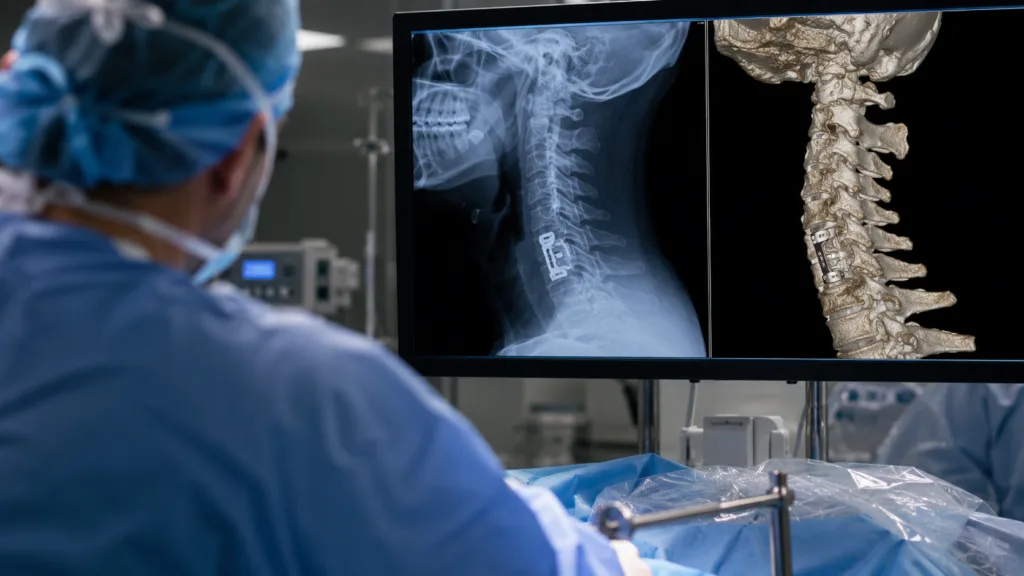
A subsequent clearance expanded the system to one or two adjacent levels and introduced additional sizes and design modifications. The 2026 clearance added solid titanium and porous, additively manufactured titanium spacer options, further widening the product configurations available to surgeons.
These additions matter commercially because two-level procedures represent a larger and more complex opportunity than a single-level indication alone. Greater size and material flexibility can also help the medical device manufacturer address variation in vertebral anatomy, bone quality, preferred graft strategy and surgeon technique.
The regulatory pathway, however, must be interpreted correctly. Saber-C is a Class II device cleared through the 510(k) substantial-equivalence process. The recent submissions relied primarily on comparisons with predicate devices and bench tests assessing factors such as compression, compression shear, torsion, expulsion, subsidence, screw pullout and plate push-off.
Those clearances establish that the reviewed configurations met the requirements for commercialisation. They do not represent prospective clinical trials proving that Saber-C improves patient outcomes, lowers revision rates or performs better than other cleared cervical fusion devices. The transition from regulatory clearance to evidence-based differentiation must come through appropriately designed clinical studies and transparent post-market data.
Why the spike and screw configurations create different adoption and risk profiles for surgeons
The distinction between Saber-C’s screw and spike configurations is central to understanding the platform. When the spacer, anterior cervical plate and screws are used together, the assembly can function as a stand-alone construct, with the integrated plate providing the necessary supplemental fixation.
The spike configuration carries a different labelling requirement. When the spacer and anterior plate are used with spikes, additional supplemental fixation, such as posterior cervical screw fixation, is required. This means the spike-based workflow should not be viewed as an interchangeable stand-alone alternative to the screw configuration.
That difference affects the clinical and commercial proposition. In-line spikes may provide easier access through a constrained anterior corridor, but the need for additional posterior fixation can increase procedural complexity in cases where the spike configuration is selected. The balance between easier anterior deployment and the broader fixation strategy will depend on the indication, anatomy and stability requirements of each procedure.
Fixation-specific surveillance will also remain important as utilisation expands. United States post-market records include a 2024 report involving apparent separation of a locking plate and migration of spike components, followed by revision surgery and conversion to screw fixation. A single adverse-event report cannot establish incidence, causality or an overall device-safety profile, particularly when the removed components were unavailable for evaluation.
Nevertheless, the event illustrates why aggregate implantation numbers need to be accompanied by configuration-level outcomes. Surgeons will want to understand whether complications differ between spike and screw use, whether outcomes change across one-level and two-level procedures, and which patient or anatomical characteristics increase the risk of migration, subsidence or loss of fixation.
How Saber-C compares with traditional plate-cage constructs and other zero-profile systems
Traditional anterior plate-and-cage constructs remain familiar to spine surgeons and can provide strong fixation, alignment control and broad procedural versatility. Their disadvantages can include additional exposure, greater hardware prominence and the possibility of irritation to nearby soft tissues.
Zero-profile anchored spacers were developed partly to address those concerns. Research across the broader device category has frequently found lower postoperative dysphagia rates and shorter operative times compared with conventional plate-cage constructs. Some studies have also reported reduced blood loss and less interference with adjacent-level anatomy.
The evidence is not uniformly favourable. Certain studies have identified higher subsidence rates with stand-alone or anchored zero-profile devices, particularly in multilevel procedures. Traditional plate constructs may also preserve cervical lordosis more effectively in some populations. Outcomes are influenced by implant design, endplate preparation, bone quality, graft choice, surgical level and patient selection.
Evidence generated with one zero-profile device cannot automatically be transferred to Saber-C. The platform’s integrated anterior plate, seven-point fixation architecture and optional in-line spikes distinguish it from systems relying entirely on integrated screws or anchoring blades. Those differences create a credible reason for device-specific research, but they do not remove the need for comparative evidence.
The peer-reviewed literature focused specifically on Saber-C remains primarily technique-oriented. The available work describes surgical indications, implantation steps and theoretical workflow advantages but does not establish comparative fusion, dysphagia, subsidence or revision outcomes. That evidence gap becomes more visible as the device moves from early adoption into broader commercial use.
What Elevation Spine must prove as Saber-C moves from early adoption toward broader scale
The next phase should be centred on measurable outcomes rather than another utilisation milestone. A registered observational study is intended to collect clinical and radiographic information from approximately 200 Saber-C patients. Such a registry could provide useful evidence on fusion, pain, disability, neurological function, dysphagia, subsidence and reoperation when the device is used in routine practice.
Registry data would become more persuasive if results are reported separately for one-level and two-level procedures, spike and screw fixation, primary and revision surgery, and patients with differing bone quality. Without those distinctions, favourable aggregate outcomes could conceal clinically relevant differences between configurations or patient groups.
Longer follow-up will be equally important. Early procedural success does not fully address pseudoarthrosis, adjacent-segment degeneration, implant migration or delayed revision. Elevation Spine will need data extending beyond the initial postoperative period to support claims of durable fixation and sustained clinical value.
Commercial scaling introduces additional challenges. The medical device manufacturer must expand production while maintaining consistency across machined titanium, titanium-coated polyether ether ketone and additively manufactured titanium components. Sterilisation control, lot traceability, instrument availability and reliable distribution become more demanding as the number of hospitals and surgeons increases.
Training must also scale with the product. Early adopters are often technically experienced and highly engaged with the manufacturer. Broader adoption introduces users with different levels of familiarity, making standardised surgical education, case selection and complication reporting increasingly important.
What clinicians and industry observers will watch before the next-generation launch
Elevation Spine’s planned next-generation Saber-C update could increase the platform’s momentum, particularly if it improves instrumentation, fixation options, implant sizes or material selection. The commercial impact will depend on whether the update solves clearly identified surgical problems rather than merely adding another product configuration.
Clinicians will look for evidence that design changes are based on systematically collected operating-room feedback and post-market outcomes. They will also examine whether the next-generation system changes the labelling distinction between spike and screw fixation, improves deployment confirmation or reduces the risk of migration and subsidence.
Hospital buyers are likely to focus on a different set of questions. They will want to know whether Saber-C reduces procedure time, simplifies inventory, supports movement of suitable cases into ambulatory surgery centres and produces complication rates comparable with established systems. A premium implant price will be easier to defend if it generates measurable efficiency or reduces downstream costs.
The platform may therefore be approaching an important inflection point. Five thousand implantations provide Elevation Spine with a credible commercial foundation, while expanded regulatory clearances create room for growth. The unresolved issue is whether the medical device manufacturer can convert utilisation into transparent evidence showing which patients benefit, which configuration performs best and whether the platform creates value beyond a streamlined implantation technique.
Key implications of Elevation Spine’s 5,000 Saber-C milestone for wider adoption
Saber-C has achieved enough procedural use to be regarded as an established emerging platform rather than an experimental commercial entrant. Its integrated plate, spacer and fixation strategy offers a differentiated approach to zero-profile anterior cervical fusion, while recent clearances have expanded its materials and two-level opportunity. Yet the milestone does not answer the questions that will determine long-term adoption. Device-specific clinical outcomes, configuration-level safety data, comparative performance, manufacturing scalability and economic value remain the decisive tests. Elevation Spine has demonstrated that surgeons are willing to use Saber-C. The next challenge is proving why more surgeons and hospitals should adopt it.