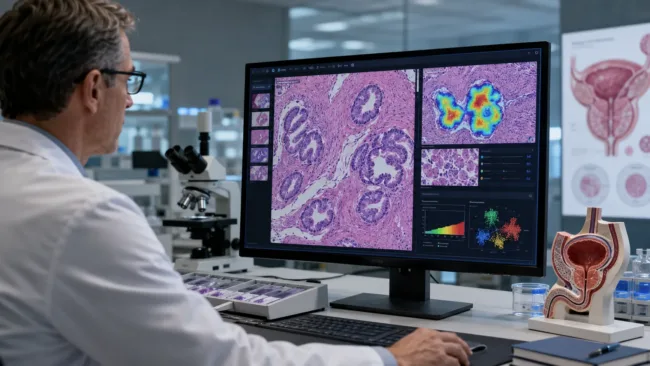
Geneva Private Equity has launched NXXIM, a new AI-powered enterprise medical imaging platform designed to unify radiology, pathology, genomics, and electronic health record data into a single, real-time diagnostic environment. The investment-backed venture will pilot its platform in clinical settings in 2026, aiming to streamline fragmented workflows and reduce time-to-diagnosis for large health systems.
What sets NXXIM apart from current enterprise imaging platforms?
NXXIM enters a competitive field already populated by long-established players such as GE HealthCare, Philips, and Sectra, as well as fast-moving AI vendors like Aidoc and Viz.ai. However, what differentiates NXXIM is not the use of artificial intelligence itself, but its architecture. It is positioning itself as an AI-native imaging platform, claiming to be purpose-built to handle multi-source diagnostic data with real-time orchestration.
Unlike traditional picture archiving and communication systems that were designed around static image storage and retrieval, NXXIM proposes a platform that merges structured data such as lab results and pathology reports with unstructured imaging files and genomic profiles. The result is a single diagnostic workspace intended to offer clinicians not just images, but the full clinical context surrounding them. This design choice shifts the center of gravity from image interpretation to multimodal diagnostic reasoning.
Industry observers tracking this segment suggest that NXXIM is attempting to leapfrog legacy upgrades by making data harmonization a baseline feature. If successful, this could allow radiologists and oncologists to act on complex diagnostic signals in parallel rather than sequentially. That could be particularly relevant for cancer care, where imaging, biopsy, and molecular profiling often arrive in silos and on different timelines.
Why the term “AI-native” implies more than just another upgrade
Artificial intelligence is no longer a novelty in diagnostic imaging. From stroke detection to mammography triage, numerous applications have proven clinical value in targeted use cases. What remains elusive is seamless integration into the broader diagnostic pipeline. NXXIM’s claim to be AI-native implies that its platform is not merely overlaying algorithms on top of legacy architecture but is instead designed to function as a real-time orchestration layer where AI inference is integral to its core function.
Such a system may enable contextual alerts and predictive diagnostics rather than relying solely on post-processed interpretations. For example, AI models within NXXIM could flag inconsistencies between pathology and radiology inputs or identify missing upstream diagnostics needed for a confident treatment decision. This level of sophistication, however, depends on real-time data standardization and deep interoperability, both of which are often weak links in hospital IT systems.
AI-native design also raises the bar for explainability and trust. Models must not only be accurate but auditable, particularly in high-stakes diagnostic scenarios. Observers familiar with prior AI rollouts in hospitals warn that even the most promising tools can fail if they overwhelm clinicians with alerts or lack transparent logic for their recommendations. NXXIM’s effectiveness will likely be judged not only by its technical capabilities but by how well it integrates into daily clinical flow.
What adoption challenges NXXIM is likely to face
For all its promise, the platform’s adoption trajectory will hinge on three critical dimensions: regulatory readiness, enterprise integration, and clinician trust.
On the regulatory front, software that influences diagnostic or treatment decisions falls under increasing scrutiny from agencies such as the United States Food and Drug Administration. The agency has already laid the groundwork for regulating continuously learning AI systems through its Software as a Medical Device framework. If NXXIM includes decision support or triage capabilities, it may be required to submit for premarket review or develop a plan for ongoing performance validation.
Deployment friction is another likely hurdle. Large health systems operate with a mix of PACS, RIS, LIS, and custom EHR integrations. Introducing a platform like NXXIM risks clashing with existing infrastructure unless its orchestration layer is proven to be vendor-agnostic and easy to implement. Geneva Private Equity’s positioning of NXXIM as non-disruptive to existing systems appears designed to lower this barrier, but whether the platform can deliver on that promise remains to be seen.
Clinician adoption represents the third and perhaps most unpredictable challenge. Radiologists and other specialists have expressed fatigue with over-engineered dashboards and alert fatigue from AI tools that lack workflow awareness. For NXXIM to gain traction, it must enhance—not complicate—diagnostic confidence. That will require intuitive design, customizable interfaces, and clear evidence that the platform helps reduce ambiguity, not increase it.
What Geneva PE’s strategy signals about medtech investor sentiment
The launch of NXXIM marks a return to infrastructure-level bets in health technology, a space that had lost investor interest during the earlier wave of AI hype. Geneva Private Equity’s involvement suggests renewed conviction that the intersection of AI, imaging, and data integration remains fertile ground, particularly as hospitals seek to modernize without replacing entire systems.
Unlike point solutions that target narrow diagnostic use cases, NXXIM appears to be targeting the foundational layer of enterprise imaging. This is significant because it reframes AI not as a clinical app, but as a systems-level utility—akin to how cloud computing evolved from discrete storage solutions to strategic infrastructure.
This move mirrors investor interest in platforms such as Flywheel.io and Blackford Analysis, which are increasingly being valued not for individual AI algorithms, but for their ability to host and operationalize a wide array of models and data types. NXXIM’s emphasis on real-time orchestration, rather than post-hoc image analysis, aligns with this broader trend toward intelligent infrastructure.
However, early-stage imaging platforms have historically faced long sales cycles, high deployment costs, and a tendency to underestimate the institutional inertia of large health systems. Geneva PE’s ability to position NXXIM as a value-adding overlay rather than a rip-and-replace solution may determine whether the platform survives beyond initial pilots.
What institutions and regulators will monitor ahead of 2026 pilots
With pilot deployments scheduled for 2026, attention will likely focus on three areas. First, the platform’s ability to scale across health systems with varying degrees of IT sophistication. While cloud-native design can enable centralized deployments, hospital environments are rarely uniform. Seamless integration across multiple systems will be key.
Second, regulatory watchers will examine how the platform approaches algorithm transparency, auditability, and clinical validation. With the global regulatory landscape evolving rapidly—particularly around AI explainability and real-world performance—NXXIM may need to build its compliance framework in parallel with product deployment.
Finally, the platform’s clinical impact will be closely scrutinized. If NXXIM can demonstrate that it meaningfully reduces time-to-diagnosis, minimizes diagnostic error, or improves interdisciplinary collaboration, it could find itself as a category-defining entrant. If it struggles to deliver measurable outcomes, it may be seen as another over-promised solution in a field already crowded with AI vendors.
What this means for enterprise imaging and diagnostic AI more broadly
The launch of NXXIM underscores a deeper evolution underway in diagnostic imaging. As data complexity grows—particularly with the rise of multi-omics, precision pathology, and real-time monitoring—the pressure on radiology and oncology workflows to synthesize this data in context is only increasing. NXXIM’s AI-native approach is one attempt to meet this challenge, but it is also a signal that enterprise imaging is no longer just about pixels. It is about context, orchestration, and decision-making environments that clinicians can trust.
Whether Geneva Private Equity’s bet pays off will depend less on novelty and more on execution. If NXXIM can prove its platform enhances outcomes without adding friction, it could shift the competitive landscape in imaging IT from storage-first systems to intelligence-first orchestration.