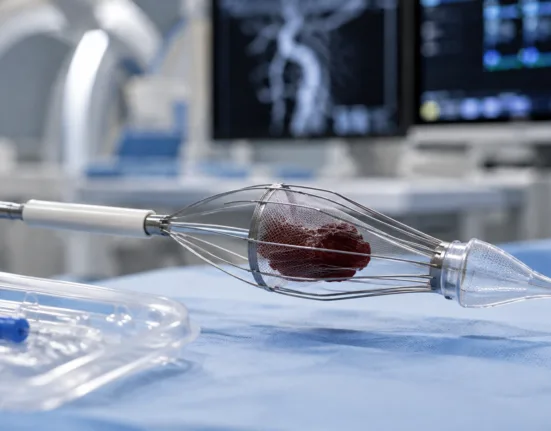
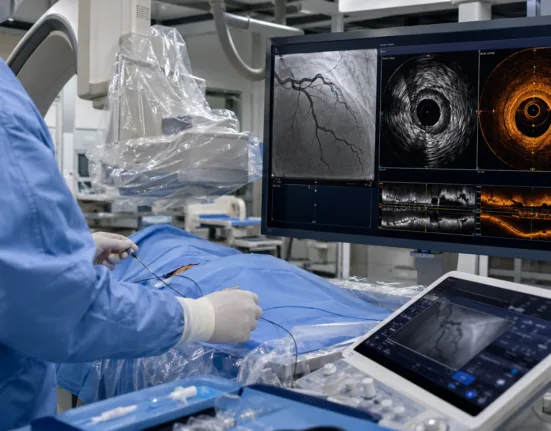
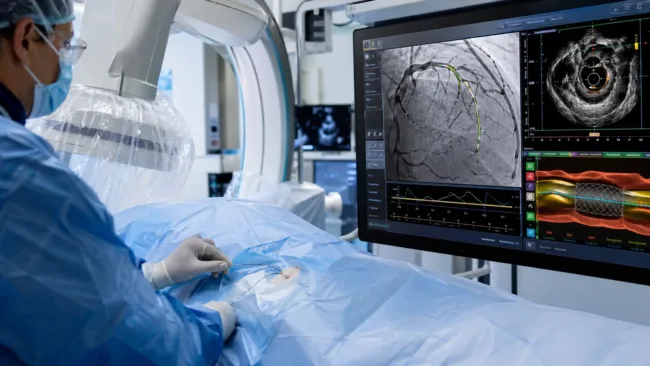
Vesalio has received 510(k) clearance from the U.S. Food and Drug Administration for enVast, its stent-based coronary clot retrieval system, making it the first device of its kind approved for mechanical thrombectomy in the cardiac circulation. The approval authorizes enVast for U.S. commercialization, following prior regulatory clearance and use in European markets. The device is designed to address large thrombus burden in patients undergoing primary percutaneous coronary intervention, a complication associated with poorer outcomes and higher procedural risk.
Why enVast signals a design shift in coronary thrombectomy
The introduction of enVast introduces a mechanical retrieval approach to coronary thrombus management that is fundamentally different from aspiration-first techniques. Rather than using suction to dislodge and evacuate clots, enVast relies on a stent-based capture architecture that physically engages and removes thrombi from the vessel wall. The Drop Zone technology at the core of Vesalio’s platform allows for the secure capture of thrombi with varying density and morphology, including soft, embolization-prone clots and dense fibrin-rich obstructions that typically resist aspiration.
This approach could offer procedural advantages in high thrombus load scenarios, which remain a major challenge in emergency PCI. Rapid and effective thrombus clearance is critical for myocardial reperfusion, particularly in ST-elevation myocardial infarction cases where distal embolization can compromise outcomes. While aspiration has remained the default approach in the catheterization lab, its limitations are well documented in complex LTB presentations. Mechanical stent-based capture, if demonstrated to be safe and reliable in coronary vasculature, could redefine how interventional cardiologists treat this subset of patients.
What makes LTB an unmet challenge despite PCI advances
Large thrombus burden continues to be under-addressed in current PCI protocols, even as other aspects of coronary intervention, such as drug-eluting stents and antithrombotic regimens, have evolved substantially. In practice, the presence of LTB often requires device improvisation or multiple adjunctive techniques to avoid slow-flow or no-reflow phenomena. This prolongs procedure times, increases the risk of embolization, and adds to operator fatigue during already time-critical interventions.
Interventional cardiologists managing these patients often rely on aspiration catheters, many of which are not specifically engineered to manage clot morphology variability. Soft thrombi may fragment and embolize during suction, while more organized clots can evade complete extraction. Industry observers believe that enVast may help close this gap by offering a coronary-specific design that does not force trade-offs between flexibility and clot engagement.
The system’s ability to capture and extract thrombus while conforming to the tortuous anatomy of coronary arteries could position it as a next-generation alternative for patients where traditional aspiration may be insufficient. If this is validated in U.S. clinical practice, enVast could offer a new pathway to optimize revascularization outcomes in high-risk PCI populations.
Vesalio’s long-game: building a multi-territory thrombectomy ecosystem
Vesalio’s commercial ambition extends beyond a single product approval. enVast is part of a broader strategy to deliver a comprehensive thrombectomy suite across neurovascular, coronary, and peripheral indications. The company has already secured FDA clearances for its NeVa and pVasc platforms targeting stroke and peripheral vascular occlusions respectively. Last month, Vesalio received additional U.S. regulatory approvals for aspiration-based devices that will complement its mechanical retrieval systems, further strengthening its portfolio.
This platform strategy is designed to give physicians the flexibility to choose between or combine aspiration and mechanical options, depending on the clinical scenario and clot type. The company’s Drop Zone and microfiltration technologies underpin this cross-anatomy approach, suggesting that Vesalio aims to establish a unified retrieval ecosystem rather than segmented product lines.
From a strategic positioning standpoint, Vesalio is taking a differentiated approach from larger firms that dominate specific vascular territories. Whereas Penumbra and Medtronic are entrenched in neurovascular aspiration, and Terumo holds share in coronary aspiration catheters, Vesalio is focusing on integration. It is offering modular tools that can span stroke, myocardial infarction, and limb ischemia without requiring clinicians to shift platforms or retrain for different device architectures.
Why FDA clearance is only the first step for enVast adoption
Despite its regulatory clearance, enVast will face several hurdles before it sees meaningful penetration in the U.S. PCI market. The first barrier is procedural conservatism. Interventional cardiologists tend to favor devices with which they are most familiar, particularly in emergent scenarios like STEMI, where rapid decision-making is essential. Even though enVast was designed to minimize complexity, physicians accustomed to aspiration workflows may be hesitant to adopt a novel stent-based system without robust U.S.-based safety data.
The lack of a dedicated reimbursement pathway could also slow uptake. Currently, stent retrievers used in neurovascular applications benefit from specific procedural codes. enVast, as a new entrant in the coronary space, will likely be billed under existing adjunct thrombectomy codes within the PCI bundle. Until long-term health economics data is available, payers may be reluctant to endorse widespread use, and hospitals may be hesitant to onboard a device without clear procedural or cost advantages.
To mitigate these adoption risks, Vesalio will need to focus on peer education, rapid training pathways, and real-world data collection. Early operator experiences shared through academic forums or society meetings could serve as catalysts for broader market curiosity. The company’s prior European deployment offers an early validation base, but U.S. proceduralists will likely demand local outcomes before considering integration into PCI protocols.
What physicians and regulators will likely monitor next
The success of enVast will rest on a combination of clinical feedback, procedural efficiency data, and complication profile outcomes. Physicians will want to know whether the device can reliably extract thrombus in a single pass, how it performs in curved anatomy, and whether its use increases procedural time compared to aspiration. In addition, the risk of vessel dissection or distal embolization during retrieval will be closely tracked.
Regulators may also look to post-market surveillance data to determine whether the approval of enVast shifts practice trends or influences adjunct device usage during PCI. If Drop Zone technology consistently reduces thrombus fragmentation and no-reflow, it could influence future device approval criteria or even practice guidelines.
Market analysts will watch for evidence that enVast shortens procedure time, lowers contrast use, or reduces the need for bailout techniques such as rheolytic thrombectomy or intracoronary thrombolytics. These metrics will be essential in quantifying value for payers and hospital procurement teams, especially as pressure increases on device companies to demonstrate cost-effectiveness in addition to performance.
Can Vesalio scale production and maintain momentum across indications?
Vesalio remains a private company, which gives it flexibility in product development but also exposes it to scaling risks. As it enters the coronary market, the company must simultaneously maintain supply reliability for its existing NeVa stroke system and pVasc peripheral devices. Any production bottlenecks or delays in field force expansion could hinder its ability to meet growing demand if enVast gains traction.
Unlike neurovascular thrombectomy, where volumes are relatively centralized in comprehensive stroke centers, coronary PCI procedures are distributed across thousands of hospitals in the U.S. This will require Vesalio to expand its commercial infrastructure rapidly, while also offering clinical support during initial cases to minimize misuse and optimize outcomes.
If the company can successfully execute this commercial scale-up without sacrificing device quality or physician support, it could emerge as a serious challenger in a thrombectomy market that is projected to reach multi-billion dollar annual revenue across vascular territories.
Strategic outlook: where enVast fits in the evolving thrombectomy landscape
enVast may not displace aspiration as the first-line tool for all PCI cases. However, its utility in LTB situations positions it to become a go-to option in a subset of complex interventions. As more hospitals adopt risk stratification frameworks for thrombus management, devices like enVast that offer procedural control and higher success rates in organized clots may secure a dedicated place in the cath lab toolkit.
The question for Vesalio is whether it can use this foothold to drive broader adoption of its platform strategy. If interventional cardiologists find value in transitioning between aspiration and mechanical retrieval depending on the case, Vesalio’s portfolio may have long-term staying power. But if enVast is perceived as a niche device for rare complications, its impact may be limited.
Ultimately, the clinical and commercial success of enVast will depend on proof of concept in the field. If it consistently reduces complications, improves flow restoration, and earns physician trust, Vesalio could shift the coronary thrombectomy conversation from aspiration-only to a more hybrid approach. The next 12 to 24 months will reveal whether this FDA clearance is the start of a paradigm shift or simply a tactical expansion for a focused device innovator.