CRISPR transformed genetic medicine by making it possible to change human DNA with programmable precision, and the arrival of approved ex-vivo gene editing established that permanent genomic modification can become a regulated therapeutic product. RNA-editing developers are deliberately pursuing a different proposition. Instead of correcting the underlying DNA sequence, they alter RNA transcripts produced from that gene, potentially restoring production of a functional protein while leaving the patient’s genome unchanged. Because RNA molecules are temporary and continuously replaced, the edit is intrinsically reversible: when treatment stops and the edited transcripts disappear, the original genetic sequence remains exactly where it was.
That reversibility can sound like a disadvantage compared with a one-time cure, but it may become one of RNA editing’s most important safety features. A permanent DNA change can potentially provide lifetime benefit but cannot simply be withdrawn if an unexpected consequence emerges years later. An RNA-editing oligonucleotide can theoretically be dose-adjusted, discontinued or redesigned, making the modality behave partly like a conventional chronic medicine while still modifying genetic information at the transcript level. Human development is now sufficiently advanced that several ADAR-directed programmes have entered clinical testing, including Wave Life Sciences’ WVE-006 and AIRNA’s AIR-001 in alpha-1 antitrypsin deficiency.
How can one RNA letter be changed without altering DNA?
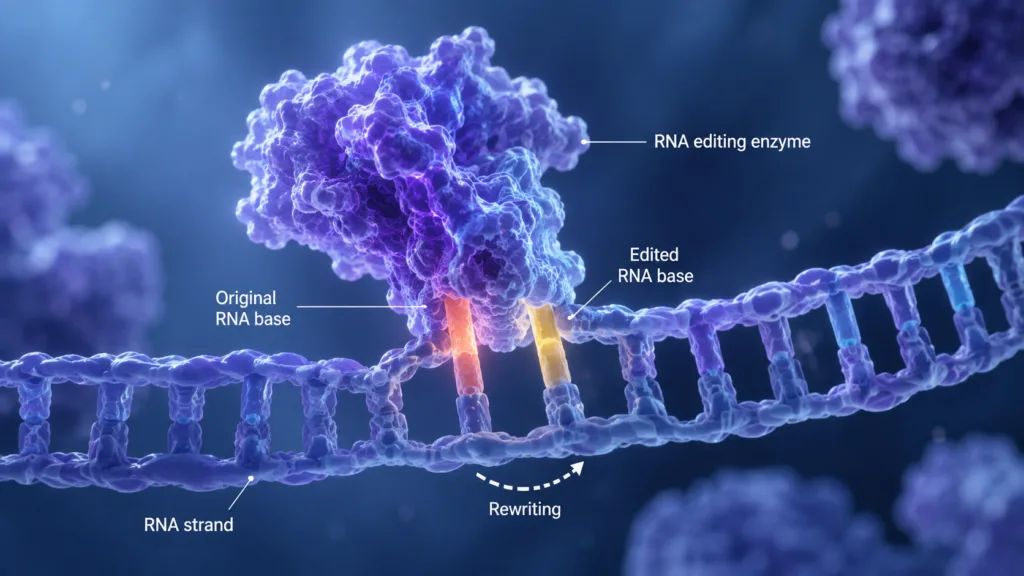
One of the principal therapeutic approaches exploits adenosine deaminase acting on RNA, or ADAR, enzymes already present in human cells. ADAR naturally converts adenosine into inosine within double-stranded RNA structures, and cellular machinery generally interprets inosine as guanosine during translation. A therapeutic guide RNA can therefore be designed to pair with a target transcript and position a specific adenosine within an RNA structure that recruits endogenous ADAR activity.
The molecular consequence can be equivalent to an A-to-G correction at the RNA level. If a genetic mutation creates a defective codon that can be corrected through this chemistry, edited transcripts can generate functional protein even though the original DNA mutation remains unchanged.
The elegance lies in recruiting an enzyme the cell already possesses rather than necessarily delivering a large foreign editing protein. Some platforms use engineered ADAR proteins, while others rely entirely on endogenous ADAR and deliver only chemically modified oligonucleotides that instruct the native enzyme where to edit. Each approach creates different trade-offs in delivery, efficiency, immunogenicity and off-target editing.
Why is alpha-1 antitrypsin deficiency becoming such an important proving ground?
Severe alpha-1 antitrypsin deficiency provides an unusually compelling genetic test case because the common Z mutation creates two disease problems simultaneously. Misfolded Z-AAT accumulates in hepatocytes and can damage the liver, while insufficient functional AAT reaches the bloodstream and lungs, reducing protection against neutrophil elastase and contributing to progressive emphysema.
A successful RNA editor could theoretically change the mutant transcript so hepatocytes produce normal or normal-like functional AAT instead. That creates the possibility of addressing both sides of the disease: reduce production of the harmful misfolded protein in the liver while restoring circulating protein capable of protecting the lung.
Wave Life Sciences’ WVE-006 is a GalNAc-conjugated RNA-editing oligonucleotide designed to recruit endogenous ADAR to the SERPINA1 transcript in hepatocytes. The company has reported clinical editing and production of functional M-AAT in its RestorAATion-2 programme and is discussing a potential accelerated-approval pathway with FDA. AIRNA’s AIR-001 entered a global Phase 1 trial in April 2026, showing that AATD is now supporting multiple human tests of RNA-editing architectures rather than a single proof-of-concept experiment.
What did the first generation of human RNA editing teach developers about delivery?
Korro Bio’s experience provides an important counterweight to the field’s enthusiasm. Its first-generation KRRO-110 AATD programme used an LNP-delivered RNA-editing oligonucleotide and entered the REWRITE clinical study, but the company terminated the programme after the approach did not generate the projected level of functional protein following a single administration. Korro subsequently shifted toward GalNAc-conjugated delivery for liver targets.
That outcome illustrates a recurring lesson across genetic medicine: the editing chemistry can work perfectly in a laboratory and still fail as a drug if not enough therapeutic material reaches the relevant cells at a useful exposure. RNA editing is therefore partly a delivery industry just as in-vivo DNA editing is.
GalNAc has become particularly important for liver-directed RNA medicines because the ligand binds the asialoglycoprotein receptor highly expressed on hepatocytes, enabling efficient uptake after subcutaneous administration. This delivery route has already been validated extensively by siRNA therapeutics, allowing RNA-editing companies to reuse a mature biological transport mechanism rather than invent one simultaneously with a new editing modality.
Why might repeated RNA editing be safer than permanent DNA correction?
Reversibility provides one theoretical advantage. If a patient develops an unexpected toxicity related to the edited protein, further dosing can be stopped and the proportion of edited transcripts should decline as RNA turns over. A permanent genomic edit remains in affected cells and their descendants.
RNA editing also avoids intentionally creating a permanent double-strand DNA break, one of the important safety considerations associated with conventional CRISPR nuclease approaches. This does not make RNA editing risk free. ADAR can potentially modify unintended adenosines within the target transcript or elsewhere, and guide structures can generate so-called bystander editing at nearby sites. Researchers are therefore redesigning guide RNAs to improve precision and broaden the range of sequences that can be edited without creating unacceptable collateral changes.
Repeated treatment introduces its own risks, including chronic exposure to the oligonucleotide, delivery chemistry and any unintended RNA changes occurring with every dose. The safety comparison between RNA and DNA editing therefore cannot be reduced to reversible equals safe and permanent equals dangerous; it depends on disease severity, tissue, delivery route and the consequences of both intended and unintended edits.
Why can RNA editing correct only certain mutations directly?
ADAR naturally performs A-to-I editing, which is interpreted mainly as A-to-G. This means straightforward correction is limited to mutations whose desired nucleotide change is compatible with that chemistry or can be exploited through related transcript-level mechanisms.
APOBEC-family enzymes perform cytidine-to-uridine editing and can expand the available sequence changes, while engineered systems are being designed to widen targeting flexibility further. Even so, RNA editing does not yet provide a simple universal editor capable of replacing any arbitrary nucleotide with any other nucleotide in a patient.
Sequence context matters as well. ADAR has preferences regarding surrounding nucleotides and double-stranded RNA structure, and guide design can strongly influence both efficiency and bystander editing. Recent structural work has demonstrated that relatively subtle changes to ADAR-recruiting RNA architecture can broaden target range and improve precision, illustrating how much performance depends on guide engineering rather than merely selecting the right genetic mutation.
Why could editing RNA be attractive for common diseases as well as rare mutations?
The technology does not have to restore a damaged gene. RNA editing can potentially change the amino-acid sequence of a normal protein deliberately to create a version with therapeutically favorable function. Korro’s KRRO-121 hyperammonemia programme illustrates this concept: rather than correcting an inherited mutation, the company is developing an RNA-editing oligonucleotide intended to create a useful protein variant by rewriting the transcript.
That expands RNA editing from genetic repair toward programmable protein engineering inside the patient. Instead of manufacturing a recombinant protein externally or delivering a gene encoding a modified protein, developers could theoretically instruct the patient’s own cells to produce a therapeutically optimized variant temporarily.
If that model works, the addressable market becomes much larger than rare monogenic disease. Metabolic, cardiovascular and neurological conditions could eventually become targets when changing one amino acid in an existing protein creates a pharmacologically valuable state.
Will RNA editing compete with gene editing or occupy a different therapeutic niche?
The technologies will probably coexist. A severe childhood genetic disease where lifetime correction can be achieved safely in accessible stem cells may strongly favor permanent DNA editing. A liver disease in which chronic subcutaneous treatment is already familiar and the consequences of a permanent edit remain uncertain may be an attractive RNA-editing setting.
The decision could become analogous to choosing between surgery and chronic pharmacotherapy: one approach offers potentially durable correction with a larger upfront intervention, while the other provides controllability and reversibility at the cost of repeated treatment.
The central question is therefore not whether RNA editing is better than CRISPR. It is whether temporary transcript correction creates a clinically useful middle ground between conventional RNA medicines that silence genes and permanent DNA therapies that rewrite them.
Human trials have finally moved that question out of preclinical biology. The next few years will show whether measurable RNA editing can generate enough correctly functioning protein, for long enough and with sufficient precision, to make reversibility an advantage patients actually benefit from rather than simply a scientifically elegant feature.