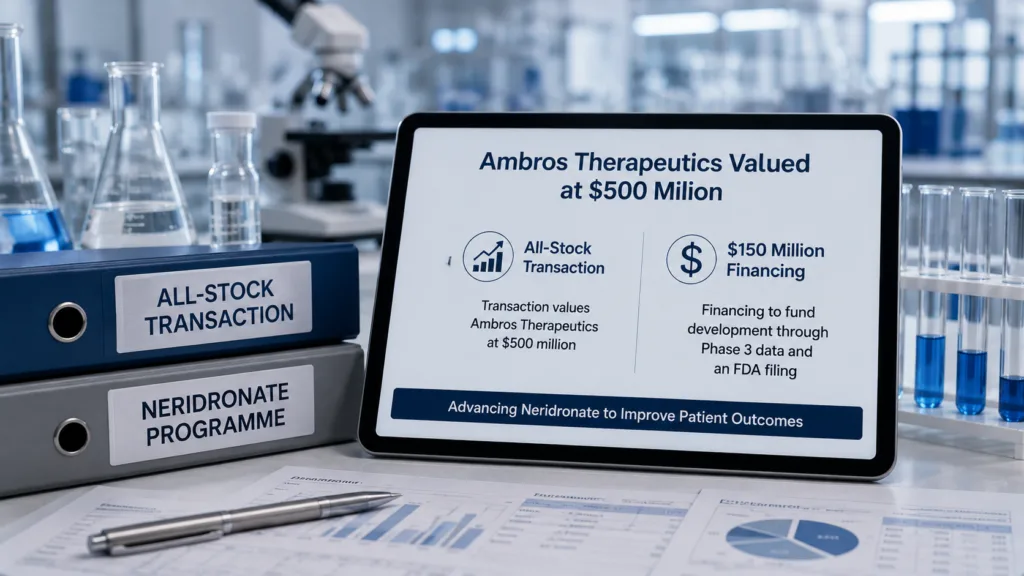
Werewolf Therapeutics, Inc. and Ambros Therapeutics, Inc. have agreed to an all-stock merger that will effectively transform Werewolf from an immuno-oncology developer into a late-stage rare-disease company centered on neridronate, an established bisphosphonate now being tested in a US pivotal Phase 3 study for complex regional pain syndrome type 1. The transaction is accompanied by an oversubscribed $150 million private placement that the companies expect will finance the combined business through CRPS-RISE topline results in 2028, a planned US Food and Drug Administration New Drug Application and early commercial preparations, with projected cash runway extending into the first half of 2029.
The economics make clear which business is becoming the operating center of the combined company. The merger assigns an implied pre-financing value of $500 million to Ambros Therapeutics and $47.5 million to Werewolf Therapeutics. Before adjustments for Werewolf’s closing net cash, existing Ambros shareholders are expected to own approximately 71.7% of the combined company, investors in the new private placement about 21.5% and pre-merger Werewolf shareholders, excluding PIPE participants, only around 6.8%.
After closing, the company is expected to operate as Ambros Therapeutics from San Diego and trade on Nasdaq under the proposed ticker AMBX. The transaction is targeted to close by the first quarter of 2027, subject to shareholder approvals, effectiveness of a Form S-4 registration statement, Nasdaq listing approval for the new shares and other customary conditions.
Why is a late-stage pain programme effectively taking over Werewolf Therapeutics?
Werewolf entered 2026 with a very different scientific identity. Its PREDATOR platform was designed to generate conditionally activated cytokine therapies intended to stimulate immune responses preferentially within tumors, with WTX-124 and WTX-330 targeting the interleukin-2 and interleukin-12 pathways respectively. The Ambros transaction means the publicly traded vehicle will instead place its principal resources behind a bisphosphonate being developed for a debilitating pain disorder, while Werewolf shareholders receive contingent value rights tied to potential future proceeds from dispositions of the legacy programmes.
This is therefore closer to a strategic reset than a conventional merger combining complementary pipelines. Existing Werewolf shareholders are retaining a relatively small direct ownership position in the new company, while the CVR structure preserves a separate economic pathway if the old assets are subsequently licensed, sold or otherwise monetized.
Ambros brings the asset that determines the new company’s near-term value proposition. Neridronate, also identified in the US development programme as AMBTX-01, is already approved in Italy for several bone-related conditions including CRPS-1 and has reportedly been administered to approximately 600,000 patients across its approved indications. In the United States, however, it remains investigational and no medicine is currently FDA approved specifically for CRPS-1.
The merger therefore pairs a public-market infrastructure with a molecule that has unusually extensive human exposure but still requires a successful US registrational study. That is a different risk profile from an early biotech programme whose safety and pharmacology are being tested for the first time.
What exactly is CRPS-RISE testing with neridronate?
CRPS-RISE, registered as NCT07210515, is a multicenter, randomized, triple-blind, placebo-controlled Phase 3 study expected to enroll approximately 270 adults with complex regional pain syndrome type 1. Participants are randomized one-to-one to receive intravenous neridronate or placebo, with four 100 mg infusions administered over 10 days for a total neridronate dose of 400 mg.
The primary endpoint is change in pain intensity from baseline to week 12 on an 11-point Numerical Rating Scale. Secondary measures examine other dimensions of pain and patient-reported outcomes, while the programme also includes longer-term follow-up and an opportunity for qualifying participants with persistent active disease to receive neridronate after completing the blinded trial.
Importantly, Ambros is not recruiting an unrestricted CRPS-1 population. CRPS-RISE focuses on patients within six months of disease onset who have the so-called warm phenotype and a positive triple-phase bone scan. Patients must also meet Budapest clinical diagnostic criteria and have a known precipitating event such as a fracture, sprain or contusion.
This enrichment strategy could prove central to the programme. CRPS is clinically heterogeneous, and Ambros believes earlier evidence indicates neridronate produces its clearest treatment effect in patients whose disease remains in an inflammatory warm phase with bone-scan abnormalities consistent with the drug’s proposed biological activity.
The strategy may improve the probability of demonstrating efficacy, but it could also narrow the eventual commercial population if FDA labeling closely follows the trial inclusion criteria. A positive study therefore would not automatically establish that neridronate is effective in chronic cold-phase CRPS, patients with negative bone scans or every individual meeting broader CRPS diagnostic criteria.
Why does Ambros believe one Phase 3 study could support an FDA filing?
Ambros says discussions with FDA established that a single successful pivotal study could potentially support a US approval application. Neridronate has also received Breakthrough Therapy, Fast Track and Orphan Drug designations for CRPS, reflecting the seriousness of the disorder and absence of an FDA-approved pharmacological treatment specifically indicated for the condition.
A one-study pathway does not mean FDA has agreed in advance to approve the medicine. The agency would still have to evaluate whether CRPS-RISE demonstrates a persuasive treatment effect, whether safety remains acceptable and whether the broader clinical, chemistry, manufacturing and controls package supports marketing.
Ambros does have prior randomized evidence on which to build. A multicenter double-blind trial published in Rheumatology enrolled 82 patients with CRPS-I affecting a hand or foot and randomized them to the same basic regimen of four 100 mg intravenous neridronate infusions over 10 days or placebo. Pain improved more substantially with neridronate, with the active-treatment group showing a 46.5 mm decrease on the study’s visual analogue scale during the reported interval compared with a 22.6 mm decrease for placebo, with a P value below 0.0001.
The investigators also reported improvements in other pain and quality-of-life measures, while patients originally assigned to placebo subsequently experienced similar improvements after crossing to open-label neridronate. The study is an important efficacy signal, but it was conducted more than a decade ago in a relatively small Italian population and does not remove the need for the specifically FDA-aligned US pivotal programme.
CRPS-RISE effectively attempts to reproduce the earlier clinical signal under a more tightly selected precision-medicine framework and a contemporary registrational design.
Why is the $150 million financing as important as the merger itself?
The concurrent private placement is expected to provide $150 million in gross proceeds through common stock and pre-funded warrants, with RA Capital Management and Janus Henderson Investors co-leading a syndicate that also includes several healthcare-focused institutional investors. The financing is scheduled to close alongside the merger.
For Ambros, the importance is straightforward. Late-stage randomized trials are expensive, and a biotech that reaches pivotal development without sufficient capital can find itself forced to finance repeatedly before the most important data arrive. The companies expect the combined resources to carry operations through the 2028 CRPS-RISE topline result, the intended NDA submission and commercialization preparations, with runway into the first half of 2029.
That makes this more than a transaction designed simply to obtain a Nasdaq listing. The financing attempts to remove a substantial part of the capital-overhang risk between the merger and the pivotal readout.
The trade-off is dilution. Private-placement investors are expected to own roughly one-fifth of the combined company immediately after closing, while Ambros shareholders retain the dominant position and historical Werewolf shareholders receive a much smaller direct stake.
From the combined company’s perspective, however, the structure creates something late-stage biotech investors often value highly: enough capital to reach the principal clinical catalyst without assuming another major financing must occur first.
How large is the opportunity if CRPS-RISE succeeds?
Ambros estimates that approximately 65,000 people are newly diagnosed with CRPS-1 in the United States each year. The condition can follow fractures, sprains, surgery or other injuries and is characterized by persistent pain that may be disproportionate to the initial injury, along with swelling, hypersensitivity, temperature or color changes and impaired movement.
The absence of a specifically FDA-approved pharmacological therapy creates a clear unmet need, but the addressable market should not simply be equated with annual incidence. CRPS-RISE selects a biologically and temporally narrower subgroup, and any eventual prescribing population will depend on the approved label, diagnostic practices, requirements around triple-phase bone scanning and whether physicians can identify suitable patients early enough.
Neridronate’s treatment schedule could nevertheless be commercially attractive if efficacy proves durable. Rather than requiring chronic daily therapy, CRPS-RISE uses one four-infusion course delivered over 10 days. Earlier Italian evidence suggested benefits could persist substantially beyond the infusion period, although the US Phase 3 study needs to establish how reproducible that durability is in its selected population.
Ambros also says its intellectual-property and orphan-exclusivity position could potentially support US market protection through 2045. Actual exclusivity will depend on issued intellectual property, regulatory outcomes and the scope and enforceability of relevant claims rather than the company’s projection alone.
What is the central risk after the merger closes?
The combined company will effectively become a Phase 3 binary around neridronate.
The medicine has several attributes that reduce traditional early-development uncertainty: extensive historical exposure, Italian approval, randomized efficacy evidence and an FDA-aligned pivotal design. However, none guarantees that CRPS-RISE will reproduce the magnitude of earlier pain reduction in a 270-person US trial.
Patient selection introduces both opportunity and risk. Enriching for warm-phase, bone-scan-positive CRPS may increase the treatment signal, but it means recruitment requires more than simply finding patients with chronic pain. Investigators must identify individuals relatively soon after disease onset, confirm diagnosis and establish the imaging characteristics required by the protocol.
The primary endpoint is also patient-reported pain intensity, an inherently variable measurement that can produce substantial placebo responses in analgesic trials. Triple blinding and rigorous eligibility criteria are therefore important protections, but the statistical result will still depend on demonstrating a clinically persuasive separation at week 12.
Werewolf Therapeutics is effectively trading its existing corporate direction for that wager. Ambros Therapeutics is gaining access to Nasdaq and enough new capital to pursue the wager without an obvious near-term funding gap.
If CRPS-RISE succeeds, the combined company could approach FDA with an asset that has decades of pharmacological history but no US commercial presence in a disease without an approved medicine. If the trial fails, the company’s post-merger concentration around neridronate will make the consequence correspondingly large.
That is what makes the transaction unusual. This is not merely one biotechnology company buying another. It is a public-market reset built around the proposition that a well-established European bisphosphonate can be converted into the first FDA-approved medicine for a carefully defined US CRPS-1 population.