The European Commission’s recent approval of €47 million in German state aid for Vetter Pharma’s new aseptic filling facility in Saarlouis marks more than a regional win. It signals a structural shift in how Europe views contract manufacturing organizations, or CDMOs—not merely as outsourcing vendors, but as core pillars of supply chain resilience, regional economic redevelopment, and industrial diversification. The Vetter Pharma project, built on the former Ford auto site, offers a concrete case study of this transformation.
As global demand for sterile injectables and biologics intensifies, EU policymakers appear increasingly aligned on the need to anchor critical manufacturing capacity within the bloc. State aid approvals for pharma infrastructure, once rare, are now gaining traction under the Union’s evolving regional aid map. Analysts tracking these developments say the confluence of industrial decline in sectors like automotive and the pharmaceutical sector’s capacity bottlenecks has created a perfect policy overlap—one where CDMOs like Vetter Pharma are becoming instruments of both economic and healthcare strategy.
Why the EU is funding pharma contractors in legacy industrial regions
The €47 million grant for Vetter Pharma, approved under Article 107(3)(c) of the Treaty on the Functioning of the European Union, is intended to revitalize Saarlouis, a region hard-hit by Ford’s withdrawal. The new facility will specialize in aseptic filling of injectable drugs—transferring sterile medicines into vials and syringes—and is expected to create at least 1,200 direct jobs.
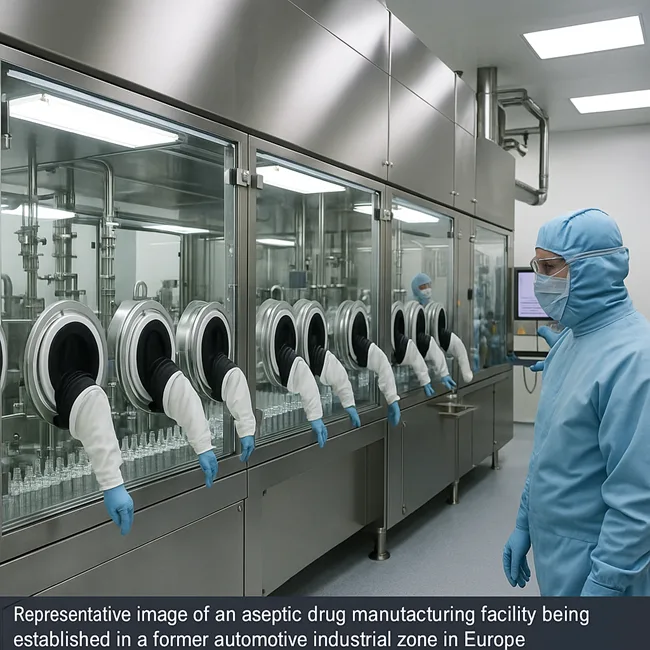
But beyond job creation, the project reflects Brussels’ shifting stance on health security. Aseptic filling was exposed as a European vulnerability during the COVID-19 pandemic, when EU states struggled to localize fill-finish steps for vaccines and biologics. By co-funding sterile manufacturing nodes in previously industrialized zones, the EU aims to create a distributed, contract-based pharmaceutical infrastructure that can respond faster to global shocks.
Institutional observers note that the Commission’s 2022 Regional Aid Guidelines explicitly widened the strategic use of aid—encouraging support for projects that promote “health sovereignty,” job resilience, and supply chain localization. With advanced therapies like mRNA, monoclonal antibodies, and biosimilars reshaping product pipelines, the need for decentralized sterile infrastructure has only grown.
Are contract manufacturing firms becoming the new pharma infrastructure builders?
Contract development and manufacturing organizations have long operated behind the scenes, quietly producing finished dosage forms, packaging, and injectables for branded pharmaceutical firms. But the profile of CDMOs is now rising, as both public funders and global pharma clients rely on them to absorb surging capacity needs.
In Europe, firms like Vetter Pharma, Recipharm, Siegfried, Delpharm, and Fareva are increasingly seen not just as service providers but as strategic infrastructure partners. Analysts point out that most EU-based CDMOs now run GMP-certified facilities with modular expansion capabilities, workforce training hubs, and client IP security frameworks—making them ideal partners for large-scale therapeutic rollouts.
What makes Vetter Pharma’s Saarlouis plant notable is its public-private hybrid model: state-backed site redevelopment paired with a commercially relevant manufacturing focus. This format could become the default in a European CDMO landscape increasingly shaped by public health mandates, fiscal incentives, and regional industrial policy.
How regional aid maps and pharmaceutical strategy are converging across Europe
The European Commission’s regional aid map has historically targeted industrial laggards in Eastern Europe, Southern Italy, and parts of the Balkans. But recent updates, including amendments approved in October 2023 and September 2024, show a sharper focus on post-industrial regions in Germany, France, and the Benelux countries.
Vetter Pharma’s Saarlouis site fits this mold exactly. The closure of the Ford plant left a large brownfield footprint and a displaced skilled workforce. The regional government of Saarland, along with federal German authorities, positioned the site for advanced manufacturing redevelopment, ultimately leading to the €47 million aid notification.
According to Commission assessments, the aid was justified because the project would not have gone forward in Saarlouis without it—meeting the incentive effect test. The plant will not distort EU competition, and its location qualifies under the regional aid map. Analysts say these criteria are now more flexibly applied to pharmaceutical infrastructure, especially when it contributes to EU-wide goals like affordable medicines and pandemic preparedness.
Could aseptic fill-finish capacity become Europe’s next critical infrastructure priority?
The push for localized sterile injectable capacity is more than a jobs program. Fill-finish capacity is increasingly seen as a bottleneck in the pharmaceutical supply chain, particularly for vaccines, biologics, and oncology injectables. The capital intensity, cleanroom requirements, and technical labor involved in aseptic filling make it a natural fit for state co-investment.
During the COVID-19 pandemic, delays in fill-finish led to shipping lags, cold-chain failures, and dose wastage. As a result, the EU’s Pharmaceutical Strategy for Europe now lists localized fill-finish as a strategic capability. CDMOs with proven sterile expertise, like Vetter Pharma and Recipharm, are prime candidates for future investment waves.
Saarlouis is likely only the beginning. Sector watchers expect additional sterile infrastructure announcements in Hungary, Poland, Southern France, and Northern Spain. Each of these regions aligns with EU redevelopment criteria and hosts universities or industrial parks suitable for life sciences pivoting.
What does the workforce transition from auto to pharma look like in regions like Saarlouis?
One of the most underreported stories in Europe’s CDMO rise is its role in industrial workforce realignment. With auto plant closures accelerating in the shift to electric vehicles, thousands of skilled workers are being displaced. Pharmaceutical production, particularly in sterile operations, offers an adjacent skills pathway—with training in technical maintenance, process controls, and quality assurance.
German economic development agencies have already launched retraining programs for former automotive workers in Saarland, some of which are tied directly to Vetter Pharma’s hiring pipeline. By mid-2026, the company expects to onboard its first wave of local recruits for the Saarlouis site, with operations commencing in 2027.
Analysts believe this trend could set a precedent. As Germany phases out combustion engine subsidies and coal mining, pharma and biotech may emerge as the next big employer in previously industrial regions. CDMO-led expansions, thanks to their modularity and compliance orientation, are particularly well-suited to integrating workers with manufacturing backgrounds.
Will other EU CDMOs follow Vetter Pharma’s public-private expansion model?
While Vetter Pharma is privately held, its approach could influence publicly listed peers like Siegfried Holding AG, Recipharm (via EQT), and Lonza Group AG. Many of these firms are actively expanding sterile capacity and exploring joint financing models involving local governments, EU funds, or public development banks.
The success of the Saarlouis model will likely be measured on three fronts: employment absorption, fill-finish output reliability, and pharmaceutical client uptake. If Vetter Pharma delivers across these axes, the hybrid grant model could become a template replicated in other post-industrial zones.
Investors are also watching. While most CDMOs maintain long-term contracts that shield them from quarterly volatility, large public contracts or grant-backed infrastructure deals can improve revenue visibility and increase political capital. If institutional sentiment continues to favor onshoring and pharmaceutical self-reliance, CDMOs may become the default vehicle for that transition.
Outlook: Will CDMOs become the backbone of a decentralized EU pharmaceutical future?
The broader takeaway from Vetter Pharma’s €47 million aid approval is that CDMOs are no longer peripheral actors in Europe’s pharmaceutical strategy. They are emerging as key players in a decentralized, resilient, and regionally inclusive manufacturing model.
With regional aid maps being updated to favor pharma infrastructure, workforce retraining programs aligning with sterile production, and client demand growing for injectables and biologics, the conditions are ripe for CDMOs to scale.
Europe’s future pharmaceutical backbone may not be a handful of megafactories owned by legacy brands, but a lattice of CDMO-run facilities, strategically located in places like Saarlouis—once known for cars, now producing critical medicines.