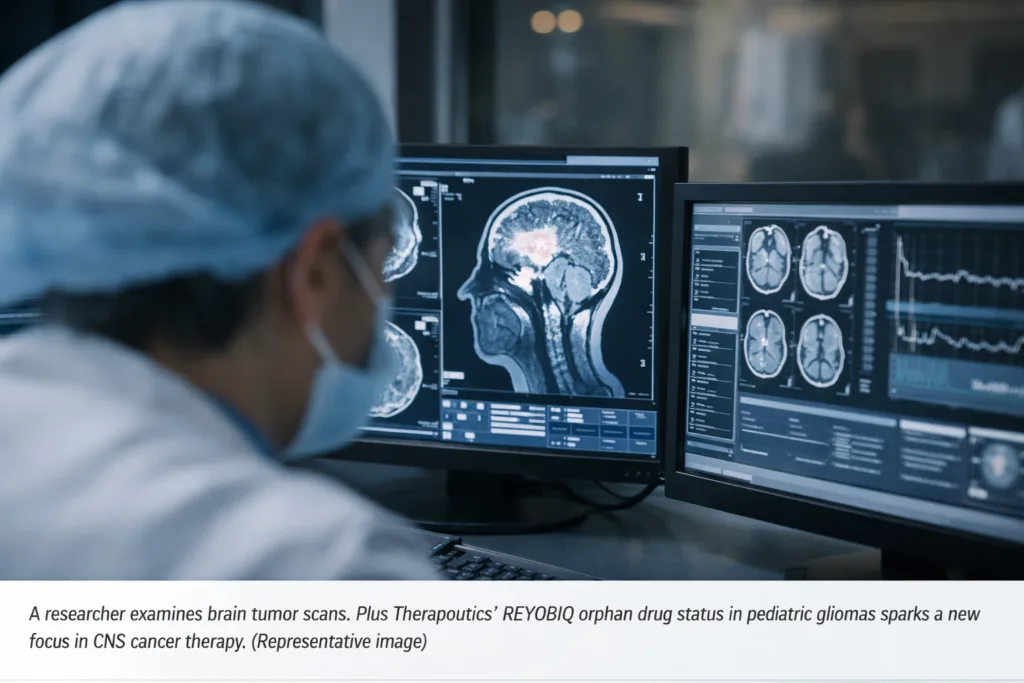
Plus Therapeutics, Inc. has secured United States Food and Drug Administration orphan drug designation for REYOBIQ, also known as rhenium Re186 obisbemeda, in pediatric malignant gliomas, adding a regulatory advantage to one of the more unusual radiotherapeutic programs in central nervous system oncology. The designation is notable not only because it covers a rare and difficult pediatric setting, but because the scope was granted more broadly than originally requested and also encompasses pediatric ependymoma, giving the Houston-based developer a wider strategic runway than a narrower high-grade glioma-only label might have offered.
Why orphan drug designation matters here even though it does not answer the clinical question yet
What makes this announcement matter is that it does not represent a clinical breakthrough in itself, but it does improve the odds that the program can stay alive long enough to generate the evidence needed in a notoriously unforgiving disease area. FDA orphan drug designation can provide incentives such as tax credits for qualified clinical testing, exemptions from certain user fees, and the potential for seven years of market exclusivity if the product eventually wins approval for the designated indication. For a small clinical-stage company operating in hard-to-fund neuro-oncology niches, those incentives are not cosmetic. They can influence financing strategy, partnerability, and the internal prioritization of scarce development capital.
That distinction matters because pediatric malignant glioma remains one of the least forgiving segments in pediatric oncology. Childhood high-grade gliomas continue to carry poor prognoses, while pediatric ependymoma also remains a difficult disease area marked by recurrence risk and limited durable treatment options. In other words, the unmet need here is not rhetorical. It is structural, persistent, and clinically severe.
What the broader FDA scope reveals about Plus Therapeutics’ regulatory positioning in rare CNS tumors
What is genuinely new here, then, is less about the existence of REYOBIQ and more about how regulators appear willing to frame its possible addressable opportunity. According to the company’s announcement, the FDA granted orphan designation for malignant glioma more broadly than Plus Therapeutics initially sought, effectively stretching the regulatory umbrella to include pediatric ependymoma. That broader-than-requested scope is strategically important because pediatric brain tumor development rarely follows a neat, single-subtype commercial script. Trial recruitment is difficult, patient populations are small, and companies that can support adjacent rare CNS indications under one broader strategic thesis may have a better chance of building continuity across programs.
Why REYOBIQ’s delivery model could stand out in a crowded but uneven neuro-oncology field
The scientific proposition behind REYOBIQ is also worth attention because it sits outside the more crowded lanes of targeted biologics, cellular therapy, and small-molecule precision oncology. Plus Therapeutics describes the product as a directly administered radiotherapeutic designed to deliver high-dose beta radiation to tumor sites within the central nervous system while limiting exposure to surrounding healthy tissue. In theory, that approach addresses one of neuro-oncology’s oldest frustrations: many systemic therapies struggle to achieve therapeutic concentrations in the brain or cerebrospinal fluid, while conventional radiation and surgery carry obvious anatomical and developmental constraints in children. If a localized radiotherapeutic can achieve meaningful tumor control with an acceptable safety profile, it could occupy a clinically useful middle ground between standard local therapy and systemic escalation.
What clinicians and regulators will still need to see before this becomes more than a regulatory win
Still, the distance between theoretical elegance and pediatric neuro-oncology adoption is vast. The main limitation of the current news flow is that orphan drug designation says nothing about efficacy magnitude, durability of response, optimal patient selection, or long-term neurotoxicity. Pediatric brain tumor specialists and regulatory watchers are likely to focus much more heavily on the eventual quality of the ReSPECT-PBC dataset than on the designation itself. That includes whether the company can enroll consistently, whether recurrent and refractory populations are sufficiently well defined, whether imaging and progression criteria are robust, and whether localized radiation delivery can show benefit without creating unacceptable procedural burden or delayed toxicity in a developing brain.
How the pediatric program changes the development story from theory to execution risk
That is where the broader company context becomes important. Plus Therapeutics had already announced FDA clearance of its investigational new drug application for REYOBIQ in pediatric patients with high-grade glioma and ependymoma, and the company has said the ReSPECT-PBC Phase 1/2 study is intended to enroll children with recurrent, refractory, or progressive disease. That means the program is no longer just a theoretical pediatric extension of adult CNS work. It has moved into a stage where execution risk becomes the central question.
Why this designation may strengthen the platform narrative across multiple CNS tumor settings
There is also a subtle but important portfolio implication. Plus Therapeutics is not developing REYOBIQ only for pediatric malignant glioma. The same platform is being advanced in recurrent glioblastoma and leptomeningeal metastases through the ReSPECT-GBM and ReSPECT-LM studies, respectively. The pediatric orphan designation therefore strengthens a broader corporate claim that the product may have utility across multiple CNS tumor settings rather than a single narrow use case. That kind of cross-indication logic can be attractive to investors and potential partners because it suggests a platform-like oncology strategy rather than a one-asset, one-indication gamble.
What could still go wrong even if the regulatory narrative now looks more supportive
Even so, platform narratives in oncology often overpromise before clinical data force a reality check. Pediatric CNS cancers are particularly hard proving grounds because endpoints can be messy, comparator standards are imperfect, and patient numbers are low enough that even promising signals may remain difficult to interpret. Industry observers tracking rare pediatric oncology programs generally look for three things before taking a platform seriously: early evidence that the therapy can be delivered reproducibly across sites, proof that response or disease-control signals are not merely anecdotal, and a regulatory path that does not depend on heroic assumptions about single-arm datasets. REYOBIQ has taken a step forward on the third of those questions, but the first two remain unresolved.
Commercially, orphan status helps but does not solve the larger challenge. Even if REYOBIQ eventually shows efficacy, adoption in pediatric neuro-oncology would still depend on specialized treatment-center readiness, handling requirements for radiotherapeutics, reimbursement clarity, and clinician comfort with central nervous system-directed administration logistics. This is not a product that can be easily inserted into routine community oncology workflows. It is a specialized hospital-based intervention that may require a tightly coordinated operational model. That increases complexity even as it may strengthen differentiation.
What the market and the field are likely to watch next after this orphan designation headline
The most important thing to watch next is not the designation headline itself but whether Plus Therapeutics can translate regulatory encouragement into credible pediatric development momentum. Clinicians and regulators will want to see how quickly the pediatric study enrolls, whether safety remains manageable in a fragile population, and whether any early signs of disease control justify more serious attention. In rare pediatric brain tumors, the market often rewards a good regulatory narrative first and asks harder questions later. In this case, those harder questions are still the ones that matter most.