Innovent Biologics, Inc. disclosed preclinical data for IBI3055, a tri-specific T cell engager targeting CD19, BCMA, and CD3, at the 2026 Immune Resetting: B-Cell Mediated & Beyond Summit in Boston. The candidate is being positioned for B cell- or plasma cell-mediated autoimmune diseases, with Innovent Biologics reporting deep depletion of B cells and plasma cells, lower immunoglobulin levels, and favorable tolerability in transgenic mouse and non-human primate studies.
Why IBI3055 matters as autoimmune drug development shifts from suppression to immune reset
The reason this matters is that autoimmune drug development has entered a new phase in which simple suppression is no longer the only ambition. The term “immune reset” has moved from an academic idea to a live commercial and clinical strategy, driven largely by striking early results from CD19-directed CAR-T programs and, more recently, by emerging use of T-cell engagers in severe refractory autoimmune disease. That shift raises the bar for every new entrant. A preclinical asset is no longer judged only on whether it can deplete pathogenic cells. It is judged on whether it can do so deeply enough, selectively enough, and durably enough to compete with the growing promise of one-time or finite-course immune reprogramming approaches.
What is genuinely new in IBI3055 compared with earlier B-cell depletion approaches
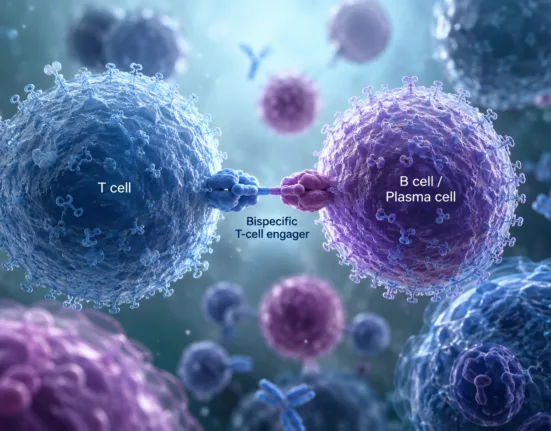
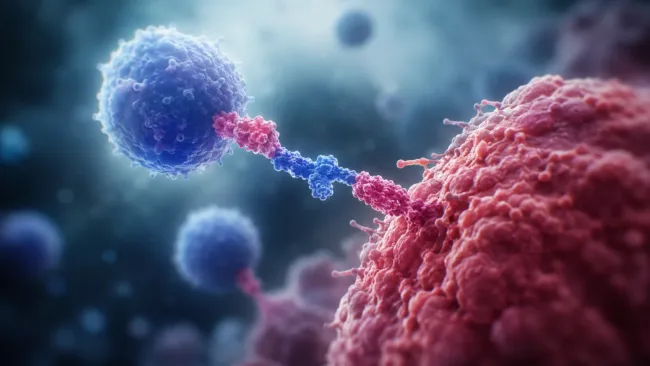
What appears genuinely new in IBI3055 is not simply that it is another CD3-based immune engager. The more distinctive claim is the simultaneous reach across CD19-positive B cells and BCMA-positive plasma cells, combined with a masking strategy intended to restrain nonspecific CD3 activation until the molecule is in the right biologic context. In autoimmune disease, that dual-cell logic is strategically attractive because B cells and longer-lived antibody-producing plasma cells do not play identical roles. CD19-directed depletion can reduce autoreactive B-cell pools, but plasma cells can continue to sustain pathogenic antibody production. BCMA-directed approaches, by contrast, reach further into the plasma-cell compartment. A tri-specific design that tries to cover both while controlling T-cell activation is therefore attempting to solve a real biologic problem rather than merely add engineering complexity for its own sake.
Why deep preclinical depletion alone may not be enough to prove immune-reset potential
That said, preclinical depth of depletion is only a starting point. The autoimmune field has learned quickly that profound immune-cell knockdown can look compelling in translational models yet still leave unanswered questions about durability, relapse biology, infection risk, immunoglobulin recovery, and the practical management of cytokine-mediated toxicity in humans. The promise of immune reset depends not only on cell elimination, but on what returns afterward and whether the reconstituted immune system is less autoreactive than before. That is one reason CAR-T has generated so much interest: some clinical reports suggest that B-cell reconstitution after depletion may occur in a qualitatively altered immune environment. A T-cell engager such as IBI3055 will need to show that it can produce similarly meaningful remissions, not just transient immunologic clearing.
How the competitive landscape is getting tougher for autoimmune T-cell engagers
The competitive backdrop is also becoming more crowded and more sophisticated. Clinical and translational evidence has already begun to accumulate around CD19 CAR-T, BCMA-directed approaches, and even bispecific T-cell engagers such as blinatumomab and teclistamab in heavily pretreated autoimmune settings. That means Innovent Biologics is not introducing a concept into a vacuum. It is entering a race in which clinicians and regulators are already comparing modalities on convenience, controllability, durability, inpatient burden, and toxicity management. The appeal of an off-the-shelf antibody-based engager is obvious. It could be easier to manufacture, faster to deploy, and potentially more scalable than autologous cell therapy. But convenience alone will not be enough if remission durability or tolerability proves inferior.
Why indication selection could determine whether IBI3055 becomes a meaningful clinical contender
From a clinical-development standpoint, the biggest unresolved issue is disease selection. Autoimmune disease is not one commercial category with one biological engine. The balance between autoreactive B cells, plasmablasts, long-lived plasma cells, T-cell dysregulation, and tissue-resident immune pathology differs sharply between systemic lupus erythematosus, myasthenia gravis, systemic sclerosis, inflammatory myopathies, autoimmune hemolytic anemia, and other refractory disorders. A dual CD19-BCMA strategy could be more compelling in antibody-driven diseases where plasma-cell persistence is a central reason therapies fail. It may be less decisive where non-humoral mechanisms dominate or where tissue-level fibrosis and irreversible organ damage make depletion alone an incomplete answer. Innovent Biologics will therefore need to be disciplined in choosing first-in-human indications where the biology most clearly rewards deep B-cell and plasma-cell elimination.
What safety and tolerability questions could define the commercial ceiling for IBI3055
Safety will likely define the ceiling of the program more than potency. Innovent Biologics is emphasizing CD3 masking as a design feature to reduce nonspecific T-cell activation, and that is understandable because CD3 engagement is where enthusiasm and anxiety meet in the T-cell engager category. In cancer, the field has spent years learning how step-up dosing, hospitalization, cytokine monitoring, and infection prophylaxis shape real-world usability. In autoimmune disease, the tolerance for severe immune toxicity may be even lower, especially if these agents move beyond salvage settings. Deep depletion of B cells and plasma cells also creates a separate safety burden around hypogammaglobulinemia, infection susceptibility, and the need for immunoglobulin replacement. The preclinical tolerability described so far is encouraging, but it is not yet the kind of evidence that resolves these clinical operating questions.
How regulators may judge autoimmune immune-reset platforms beyond early biologic activity
Regulatory watchers are also likely to focus on how much evidence is needed before the field treats immune-reset assets as category-shaping rather than niche rescue therapies. For now, many of the most eye-catching autoimmune data points remain early, compassionate-use based, or limited to severe refractory populations. That creates both opportunity and risk. It gives companies like Innovent Biologics room to differentiate with smart indication choice and cleaner clinical execution. But it also means that enthusiasm can outrun evidence very quickly. If IBI3055 advances, the market will want to know whether first-in-human studies are designed merely to demonstrate biological activity or to produce the kind of remission, steroid reduction, and durable treatment-free intervals that could change referral patterns and payer behavior.
What IBI3055 signals about Innovent Biologics’ broader autoimmune strategy and platform ambitions
There is also a strategic business angle here. Innovent Biologics has been expanding beyond oncology and is increasingly presenting itself as a broader innovation platform spanning oncology and general biomedicine, including autoimmune disease. A candidate like IBI3055 fits that narrative because it gives the company exposure to one of the fastest-rising themes in immunology without relying solely on checkpoint or inflammatory-cytokine logic. In other words, this is not just a molecule story. It is part of a portfolio signal about where the company wants to compete internationally as autoimmune immune-resetting becomes a higher-value development category.
Why promising preclinical autoimmune assets now face a much higher proof threshold
The main risk is that the field is moving so fast that “interesting preclinical” may have a short shelf life. By the time IBI3055 reaches human testing, the benchmark may no longer be proof of dual-compartment depletion. It may be evidence of durable, drug-free remission with acceptable infection burden and an outpatient-friendly safety profile. That is a much harder standard. For now, the preclinical package suggests that Innovent Biologics understands the biological problem the field is trying to solve. What remains unknown is whether the tri-specific format can translate that insight into a clinically and commercially credible autoimmune therapy rather than another elegant molecule that performs best in model systems.