H2 Global Group said its portfolio company VR LIFE is moving toward United States expansion for VR Vitalis Pro, an MDR-certified rehabilitation device already deployed across more than 40 healthcare facilities, while the Czech technology group also disclosed progress on a separate hydrogen-based medical device platform through its subsidiary H2 Medical Technologies. Publicly available company materials support the existence of VR Vitalis Pro as a certified rehabilitation device and indicate that H2 Medical Technologies is pursuing a regulatory path for a molecular hydrogen-based device, but many of the valuation and market-size claims attached to the announcement remain primarily company-sourced.
Why VR LIFE’s clinical footprint matters more than the financing headline in European rehabilitation technology
What makes the story relevant is not the financing headline by itself, but the broader signal it sends about how small European MedTech groups are trying to build value. H2 Global Group appears to be pursuing a two-track model: backing a clinically used digital rehabilitation platform through VR LIFE while also attempting to create proprietary device intellectual property around molecular hydrogen through H2 Medical Technologies. That kind of structure can look attractive on paper because it blends near-term commercial exposure with longer-duration platform bets. It can also create confusion, because investors and industry observers must separate what is already validated in clinics from what is still sitting in the early regulatory and evidence-building phase.
The more tangible part of the story is VR Vitalis Pro. VR LIFE’s own product positioning indicates that VR Vitalis Pro is a certified medical device designed for rehabilitation departments, with positioning around virtual reality-assisted therapy in professional care settings. The company also says the product is intended to improve care delivery and lower operating costs for facilities, which suggests it is being marketed less as a consumer wellness tool and more as a structured clinical workflow product. That distinction matters because the rehabilitation technology market has become crowded with digital tools that promise engagement but struggle to prove durable utility in real provider environments. A device already embedded in clinical settings has a different commercial profile from a pilot-stage digital therapeutic that is still looking for its first reference site.
Why deployment across healthcare facilities still falls short of broad market validation
Even so, adoption across dozens of facilities should not be confused with broad-scale market validation. A rehabilitation device can gain early traction because it is novel, visually engaging, or relatively easy to introduce into selected centers. The harder question is whether those deployments translate into repeatable utilization, measurable patient benefit, reimbursement support, and procurement durability. Clinicians tracking the rehabilitation technology field usually look beyond the existence of installations and ask whether the platform improves adherence, staffing efficiency, outcomes, or patient throughput compared with existing physiotherapy workflows. Without transparent multicenter outcomes data, it remains difficult to judge whether VR Vitalis Pro is a scalable category contender or simply an interesting regional success story.
What a United States regulatory push could reveal about the true commercial readiness of VR Vitalis Pro
That is where the United States angle becomes important. The announcement frames Food and Drug Administration preparation as the next major inflection point. Strategically, that makes sense. European certification can establish credibility and open institutional doors, but entry into the United States remains a far more significant commercial test for many MedTech platforms. The United States rehabilitation market is larger, more fragmented, more reimbursement-sensitive, and typically less forgiving of devices whose clinical and economic benefits are not clearly documented. Moving from an MDR-certified footprint in Europe to FDA-cleared or FDA-authorized positioning in the United States is not just an administrative exercise. It often forces companies to sharpen device classification strategy, evidence generation plans, labeling boundaries, and provider value propositions.
Why virtual reality rehabilitation now faces a tougher proof burden than novelty alone can solve
The bigger analytical question is whether virtual reality rehabilitation still has enough novelty to attract attention on its own. In 2026, that answer is less obvious than it might have been a few years ago. Virtual reality in rehabilitation is no longer a futuristic concept. It is a known modality, and that means customers are becoming more demanding. Hospitals and rehabilitation networks are less likely to be impressed by immersive therapy alone. They want workflow integration, patient stratification logic, clinician usability, and evidence that the system can fit into real operational constraints. In other words, the bar has shifted from “this is innovative” to “this improves care or economics.” Any company entering a broader market with a virtual reality rehabilitation product now has to compete on discipline, not just imagination.
What H2 Medical Technologies’ hydrogen platform changes and why the evidence bar remains high
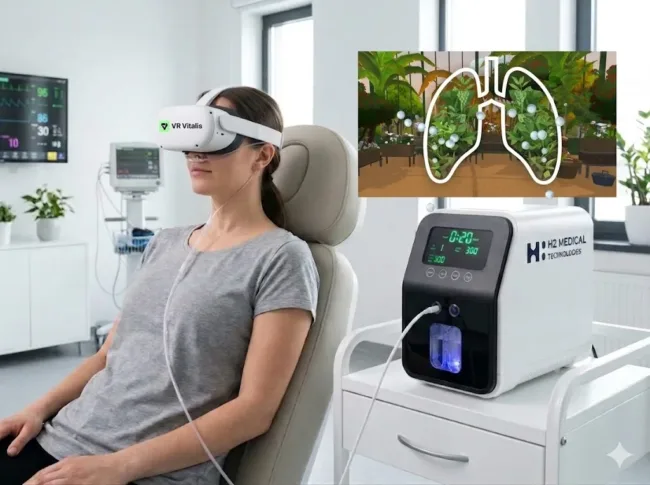
The H2 Medical Technologies side of the story is more speculative, and that is where the release becomes most investor-facing. H2 Medical Technologies says it is developing a patent-pending platform that combines molecular hydrogen with virtual reality for pulmonary rehabilitation, and public company materials indicate that a SÚKL-approved clinical study and registration effort tied to molecular hydrogen devices are underway. That is enough to say the program exists and has entered a more formal development phase. It is not enough to conclude that the platform is close to meaningful regulatory or commercial inflection.
Why is that distinction so important? Because molecular hydrogen remains an area where scientific interest, consumer enthusiasm, and evidentiary rigor do not always move together. There may be legitimate exploratory potential in hydrogen-linked therapeutic concepts, especially in inflammation, neurodegeneration, or rehabilitation-related support contexts, but regulatory watchers tend to demand very clear answers on mechanism, endpoint relevance, device claims, and reproducibility. A company can be scientifically intriguing and still be far from commercially derisked. The phrase “world’s first” may catch investor attention, but first-in-category status only matters if regulators accept the device framework and if clinical studies generate data that clinicians take seriously.
Why trial design, endpoint visibility, and evidence depth will decide whether the platform gains credibility
That brings the story back to trial design and evidence standards. The release refers to clinically validated healthcare innovation, yet the public information available so far does not provide the kind of detailed endpoint architecture, comparator framing, or peer-reviewed outcome package that would let outside observers independently assess strength of evidence. In rehabilitation and neurodegenerative support technologies, design quality matters immensely. Was the study randomized? Was there a sham or active control? Were endpoints functional, cognitive, pulmonary, or quality-of-life based? How durable was the effect? Were there subgroup differences? Without that level of visibility, outside stakeholders are effectively being asked to infer quality from regulatory movement and deployment numbers. That is rarely enough for serious clinical adoption.
Why private valuation language does not yet equal independently verified MedTech market value
The investor framing of the release also deserves caution. H2 Global Group’s claim that the implied value of its original investment in VR LIFE more than doubled and that the group now carries a pre-money valuation of about $67 million may be directionally useful as internal signaling, but such figures do not automatically represent independently realized market value. Private valuations can be shaped by round structure, rights, strategic scarcity, and narrative. They are not the same thing as broad market validation. The stated ambition of reaching a transaction value between $500 million and $1.5 billion within three years should therefore be read as an aspiration rather than a forecast supported by independent market consensus. The public sources surfaced here mainly repeat company disclosures rather than third-party financial verification.
What this case reveals about the European MedTech playbook for scaling into larger healthcare markets
Still, the release does point to a real strategic theme in European MedTech. Smaller regional innovators are increasingly trying to prove value in Europe first, where regulatory and clinical pathways may in some cases offer a more accessible first proving ground, before using that base to pursue United States expansion or strategic partnerships. That playbook can work, especially for companies that combine targeted clinical use cases with capital efficiency. But it also creates a familiar bottleneck. European validation may open doors, yet the real value inflection usually depends on stronger evidence generation, reimbursement traction, and successful translation into larger commercial markets.
What clinicians, regulators, and investors are likely to watch next as the story develops
For clinicians and health system buyers, the next watchpoint is straightforward. They will want to see whether VR LIFE can publish more robust real-world or controlled evidence showing where VR Vitalis Pro changes rehabilitation delivery in measurable ways. They will also want clarity on which patient populations benefit most and whether the product produces operational gains that justify procurement. For regulators, the next watchpoint is whether H2 Medical Technologies can convert early regulatory progress into a coherent and credible medical device dossier with claims narrow enough to be defensible and meaningful enough to matter. For investors, the real test is whether H2 Global Group can turn a collection of promising narratives into verifiable milestones that reduce execution risk.
In that sense, this is not yet a story about a proven breakout MedTech platform. It is a story about an emerging European healthcare technology ecosystem attempting to move from interesting clinical footholds and early device concepts toward institutional credibility. VR LIFE gives the group something more concrete to point to. H2 Medical Technologies gives it optionality and a higher-upside narrative. But neither piece removes the central challenge. In MedTech, value is rarely created by storytelling alone. It is created when evidence, regulation, clinical behavior, and commercial adoption line up at the same time. That alignment may still be coming. It is not yet fully visible.