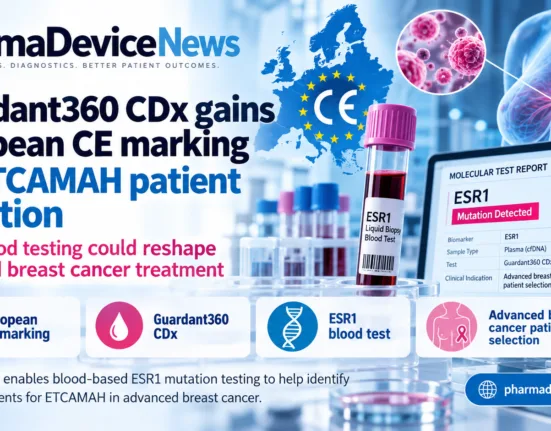
Guardant Health Inc. has entered a multi-year strategic collaboration agreement with Merck to jointly develop and commercialize companion diagnostics for oncology therapies, using Guardant’s Infinity Smart liquid biopsy platform. The partnership will integrate Guardant’s blood- and tissue-based molecular profiling tools into Merck’s global clinical trial infrastructure, aiming to accelerate biomarker-driven therapy development across the United States, Europe, the United Kingdom, and Asia-Pacific regions.
Why this deal positions Guardant as a foundational diagnostics partner for pharma-driven precision oncology
The Guardant–Merck collaboration represents a significant milestone in the convergence of diagnostics and drug development. At a time when the oncology drug pipeline is increasingly tethered to biomarker stratification, Guardant’s positioning as a preferred diagnostic enabler could shape how companion diagnostics are integrated into trials from Phase I through commercialization. While Guardant Health has long marketed its Guardant360 CDx as a flagship liquid biopsy test for advanced cancers, the Infinity Smart platform expands its footprint by offering whole-genome-like resolution from a blood draw, tailored for early-stage trials and biomarker discovery.
What is materially different in this collaboration compared to typical diagnostics–pharma tie-ups is the breadth of engagement. Guardant will not just provide assays but co-develop new diagnostics in tandem with Merck’s oncology programs, with global co-commercialization rights. This signals a broader strategy by both firms to synchronize diagnostic and therapeutic pathways from the outset—a model often discussed but rarely implemented at such scale.
For Merck, known outside the United States and Canada as MSD, the agreement underscores its intent to embed biomarker science deeper into its clinical development engine. By integrating Guardant’s platform, Merck gains access to a liquid biopsy ecosystem that could shorten time to enrollment, de-risk stratified trials, and enable pan-cancer biomarker strategies across solid tumors.
What this reveals about pharma’s shifting strategy in liquid biopsy partnerships
The diagnostics–pharma interface has long been constrained by delayed biomarker selection, siloed development timelines, and inconsistent assay availability across geographies. This collaboration suggests Merck is pre-empting those challenges by locking in a diagnostics partner early and at scale. It follows a broader industry trend toward vertical integration or deep partnership alignment across precision oncology programs.
Notably, Guardant is not the only player building platform-based co-development relationships. Foundation Medicine, Tempus, and Exact Sciences are all seeking similar roles in early trial enrollment and companion diagnostic co-design. However, Guardant’s Infinity Smart distinguishes itself with its ability to provide high-depth, low-volume genomic coverage suitable for dynamic biomarker identification—key for Merck’s expanding immuno-oncology and targeted therapy assets.
This deal also likely cements Guardant as one of Merck’s go-to platforms for liquid biopsy in lieu of more transactional partnerships or lab-developed test (LDT) strategies. With companion diagnostic approvals now tied closely to FDA standards and growing expectations from global regulators for analytical validity, a multi-year co-commercialization agreement offers regulatory alignment advantages that standalone diagnostics developers often lack.
How trial efficiency, regulatory harmonization, and biomarker clarity could benefit
One of the most immediate advantages of this agreement is likely to be seen in clinical trial acceleration. Liquid biopsy assays such as those from Guardant reduce the need for invasive tissue collection, enabling faster enrollment and potentially increasing the pool of eligible participants for biomarker-driven studies. This is particularly valuable for Merck, which is investing heavily in next-generation oncology agents with narrow biomarker-defined populations.
From a regulatory perspective, the co-development model improves the odds of synchronized therapeutic and companion diagnostic approvals—a hurdle that has historically delayed market access. Co-commercialization in key regions including the European Union and Asia-Pacific also suggests that both companies are anticipating the need to meet divergent regulatory expectations while maintaining assay consistency, a challenge Guardant has previously addressed with its Guardant360 CDx’s FDA approval and CE marking.
However, success will depend on the degree to which Guardant can scale its assay validation processes across jurisdictions. Regulatory watchers suggest that while Infinity Smart shows promise as a research-use platform, its translation into formal companion diagnostics will require robust clinical evidence packages and cross-lab reproducibility demonstrations. These hurdles may be mitigated if Merck integrates Infinity Smart early into its Phase II/III trials, allowing validation alongside efficacy endpoints.
What challenges remain for liquid biopsy platforms aiming for global CDx scale
While the announcement signals strategic alignment, execution risks remain high. The challenge of co-developing and co-commercializing diagnostics across international borders—each with their own reimbursement frameworks, clinical practice norms, and laboratory infrastructure—can dilute impact unless tightly coordinated.
One key uncertainty is whether the Infinity Smart platform will gain regulatory traction beyond investigational use. It is not yet FDA-approved as a companion diagnostic, and although Guardant has a track record of navigating regulatory hurdles with Guardant360 and Shield, the analytical standards for multi-gene liquid biopsy platforms remain in flux. Stakeholders in oncology diagnostics are closely monitoring how payers and regulators differentiate between broad genomic profiling tools and those tied directly to therapy selection.
Industry observers also point to manufacturing scalability and logistical complexity. The use of liquid biopsy in clinical trials demands not only assay sensitivity and specificity but also rapid turnaround times, sample stability across geographies, and harmonized interpretation pipelines. Guardant will likely need to scale up its bioinformatics and sample processing infrastructure globally to meet Merck’s trial timelines and commercial rollout goals.
Why this deal may influence how other diagnostics–pharma alliances are structured
The Guardant–Merck agreement could become a new template for diagnostics–pharma alliances, especially in oncology, where biomarker development is no longer optional but fundamental. Rather than waiting for mid-to-late phase trials to select a diagnostic partner, pharmaceutical companies may increasingly initiate diagnostics co-development from the earliest trial phases.
This also challenges the industry’s legacy model of using broad LDTs in early research and narrowing down to a companion diagnostic late in development. The future may favor partnerships that bring the diagnostics firm into trial design, endpoint definition, and global market planning from day one.
While this collaboration remains in its early stages, its multi-region scope, shared commercialization ambition, and integration of a next-generation liquid biopsy platform suggest that both companies are placing long-term bets on a more synchronized therapeutic-diagnostic paradigm in oncology.