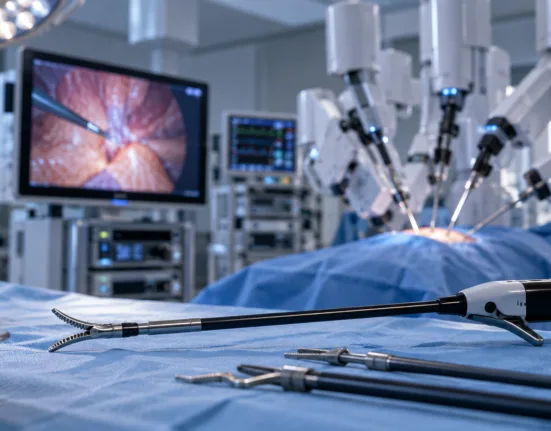
Johnson & Johnson has secured US Food and Drug Administration 510(k) clearance for MONARCH QUEST 3, the latest software generation for its robotically assisted bronchoscopy platform, adding artificial intelligence-powered nodule segmentation, improved registration and navigation, a new three-dimensional Compass interface and wider compatibility with cone-beam computed tomography systems. Announced on August 17, 2026, the update is designed to address one of the most difficult technical problems in robotic lung biopsy: the fact that a pulmonary nodule’s real position during bronchoscopy may no longer precisely match where it appeared on the computed tomography scan used to plan the procedure. The clearance represents the fourth major MONARCH software launch in roughly 18 months and reinforces Johnson & Johnson’s strategy of expanding the clinical utility of an installed robotic platform through repeated software and imaging upgrades rather than relying only on new hardware generations.
The regulatory terminology matters because MONARCH QUEST 3 received FDA 510(k) clearance rather than a new Premarket Approval or an approval specifically establishing improved lung cancer diagnostic outcomes. The authorized MONARCH indication remains bronchoscopic visualization of and access to patient airways for diagnostic and therapeutic procedures, while the new software is intended to make planning, navigation and targeting more precise and manageable during those procedures. Johnson & Johnson says MONARCH QUEST 3 builds on the platform’s existing continuous visualization, robotic control and stable reach by helping clinicians compensate for anatomical shifts that develop after the original CT scan, but the company has not disclosed a randomized clinical trial demonstrating that QUEST 3 itself produces a defined increase in diagnostic yield compared with the previous software generation.
Why is CT-to-body divergence such a difficult problem during robotic bronchoscopy?
Robotic bronchoscopy typically begins with a pre-procedure CT scan that provides the anatomical information used to construct a virtual route through progressively smaller airways toward a suspicious pulmonary nodule. The problem is that the lung is not a rigid organ, and anatomy can change between the diagnostic scan and the actual biopsy because of differences in breathing, anesthesia, ventilation, positioning and the mechanical effects of the bronchoscopy procedure itself. A robotic catheter may therefore appear perfectly aligned with a lesion on the preoperative navigation map even though the real target has shifted sufficiently for a biopsy needle to pass beside rather than through it, a phenomenon commonly described as CT-to-body divergence. Johnson & Johnson has made reduction of this navigation discrepancy a central focus of the QUEST software family, with the latest update adding more sophisticated registration and imaging tools intended to keep the virtual map closer to what the physician encounters in the patient.
The clinical importance becomes greater as pulmonologists attempt to biopsy smaller nodules in the peripheral lung, where the target may be only millimeters from the planned pathway and the available airway becomes increasingly narrow. Johnson & Johnson’s earlier prospective TARGET study followed 679 patients across 21 sites in the United States, Canada and Hong Kong and reported that physicians using MONARCH reached the intended lesion in 98.7% of cases, while investigator-reported diagnostic yield was 83.2%. Those results provide substantial clinical evidence supporting the underlying MONARCH platform, but TARGET was a single-arm study and preceded QUEST 3, so its 83.2% diagnostic yield should not be presented as a performance claim for the newly cleared software. The more relevant point is that high navigation success does not automatically guarantee a diagnostic tissue sample, leaving room for software, imaging and biopsy-tool improvements even after the bronchoscope has successfully reached the general target region.
QUEST 3 attempts to narrow that final gap by maintaining continuous registration and real-time tracking of the bronchoscope tip relative to anatomy while also making it easier to incorporate imaging acquired during the procedure. That shift from relying heavily on a static preoperative CT toward combining navigation with intraprocedural confirmation reflects a broader evolution in robotic bronchoscopy, where determining whether the instrument has actually reached the lesion can be as important as finding a route through the airway. The practical ambition is not merely to make the robot easier to steer, but to improve confidence that the tissue collected by the biopsy instrument comes from the suspicious nodule rather than adjacent lung.
What does AI-powered nodule segmentation change before the biopsy begins?
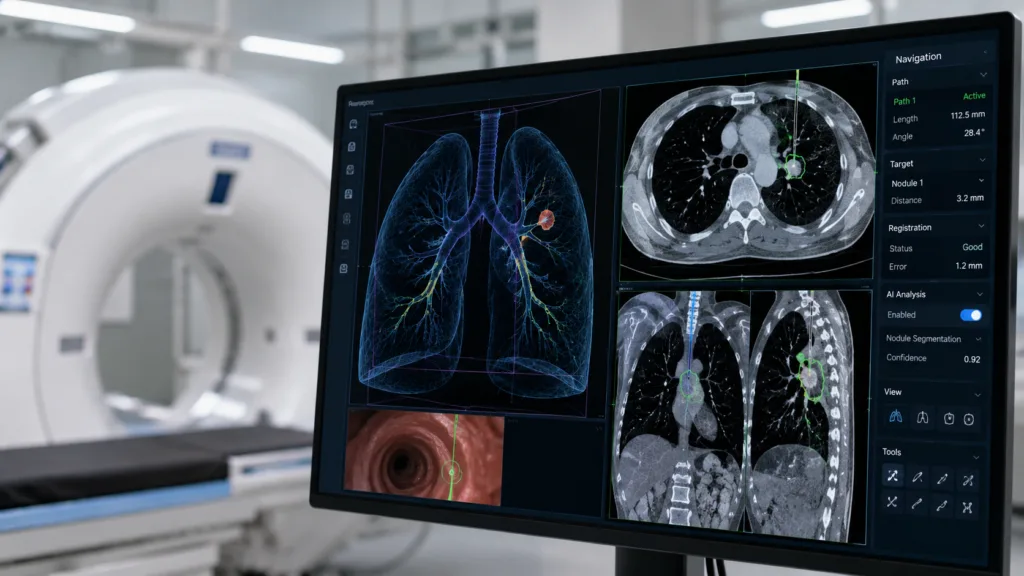
One of MONARCH QUEST 3’s most visible additions is AI-powered nodule segmentation, which Johnson & Johnson says can automatically generate more accurate nodule boundaries with a single click during pre-procedural planning. Segmentation converts a pulmonary nodule from a relatively simple point of interest on a CT image into a defined three-dimensional target whose size, contour and relationship with surrounding airways can be incorporated into the planned route. That can matter when lesions are irregularly shaped, positioned near airway branches or sufficiently small that modest differences in target boundaries could influence where the physician wants the bronchoscope and biopsy instrument to approach. The software therefore uses artificial intelligence as a planning and spatial-definition tool rather than as an autonomous system determining whether a nodule is malignant.
This distinction is important as artificial intelligence becomes increasingly embedded inside medical devices without necessarily replacing physician judgment. MONARCH QUEST 3 does not diagnose lung cancer from a CT scan, select treatment or independently perform a biopsy; instead, its algorithms support the physician by organizing anatomical information and improving the digital model used during navigation. The eventual cancer diagnosis still depends on obtaining adequate tissue and having that sample evaluated through appropriate pathological and molecular testing. In that sense, the AI element is commercially important precisely because it addresses a narrower but frequent workflow problem rather than attempting to automate the entire diagnostic process.
Johnson & Johnson has also introduced a new 3D Compass overlay intended to improve visual orientation between the robotic joystick and the actual direction of the bronchoscope tip inside the patient. Navigating a flexible robot through repeated airway branches is spatially complicated because movement made through the control interface must be translated into motion deep within three-dimensional anatomy, and the physician may need to redirect the scope repeatedly while maintaining a stable position near the target. By giving operators a clearer visual representation of tip orientation relative to the patient, the Compass could reduce some of that cognitive burden while making fine positional adjustments easier as the physician approaches a lesion. Johnson & Johnson describes the feature as an aid to scope-tip orientation rather than an autonomous navigation function, meaning procedural control remains with the clinician.
Could broader cone-beam CT integration improve lung nodule targeting?
MONARCH QUEST 3 also broadens compatibility with commonly used mobile and fixed cone-beam CT systems, potentially allowing hospitals to combine the robotic platform with imaging equipment they already own rather than requiring one tightly prescribed imaging configuration. Cone-beam CT can acquire three-dimensional anatomical information during the bronchoscopy itself, providing a more current view of where the nodule and biopsy instruments sit after anesthesia and procedural changes have altered the lung from its preoperative state. This can help physicians assess tool-to-lesion relationships and compensate for CT-to-body divergence, making intraprocedural imaging one of the most important complementary technologies emerging around robotic bronchoscopy. Johnson & Johnson says QUEST 3’s wider compatibility is intended to let clinicians use existing advanced imaging infrastructure while improving targeting confidence.
The available clinical evidence, however, shows why broader CBCT access should not automatically be translated into a claim of higher diagnostic yield. A 2026 Mayo Clinic retrospective study compared 179 MONARCH procedures performed without mobile cone-beam CT with 152 procedures using MONARCH plus mobile CBCT and found diagnostic yields of 70.9% and 71.7%, respectively, a difference that was not statistically significant. Complication rates were likewise not significantly different, while median procedure duration decreased from 77 minutes to 69 minutes with mobile CBCT. At the same time, radiation dose increased substantially, from 7.4 mGy in the MONARCH-only group to 285.9 mGy in the MONARCH-plus-mobile-CBCT group, illustrating that additional imaging can introduce meaningful trade-offs even when it improves the physician’s ability to visualize the target during the procedure.
That study should not be treated as a definitive judgment on QUEST 3 because the procedures occurred between 2019 and 2023, before the newly cleared software existed, and the research was retrospective and conducted at a single center. It does, however, provide useful context for the commercial argument around broader imaging integration: hospitals need to evaluate whether additional CBCT imaging improves workflow, tool confirmation or difficult-case management enough to justify radiation exposure, capital costs and procedural complexity. QUEST 3 could change that calculation if better software integration allows physicians to use intraprocedural imaging more efficiently or selectively, but that remains a clinical and operational question that should be evaluated with newer evidence rather than assumed from the clearance itself.
How much evidence already supports the underlying MONARCH platform?
The TARGET study remains one of Johnson & Johnson’s most important pieces of evidence because it represents a large prospective multicenter evaluation of robotically assisted bronchoscopy rather than a small feasibility series from highly specialized early adopters. The 679 patients were followed for at least one year, with the study evaluating safety, navigation success and diagnostic yield across a broad variety of lung nodules. Investigators reported lesion reach in 98.7% of procedures and an investigator-defined diagnostic yield of 83.2%, while Johnson & Johnson said the safety profile was comparable with non-robotic bronchoscopy approaches. The company has continued analyzing subsets from TARGET to understand factors affecting yield, including lesion characteristics, bronchus sign and patient characteristics, reinforcing the point that successful robotic navigation is only one component of obtaining an actionable diagnosis.
The 83.2% figure also needs the same evidence discipline applied to other diagnostic-device studies. Diagnostic yield was investigator reported, and definitions of yield can vary materially across bronchoscopy studies depending on how nondiagnostic pathology, atypical cells and subsequent follow-up are classified. Cross-trial comparisons between MONARCH and competing robotic systems can therefore be misleading when patient populations, lesion size, imaging support and yield definitions are different. For hospitals evaluating the technology, the more meaningful evidence will increasingly come from standardized prospective studies examining not only whether a lesion is reached, but whether the first procedure produces sufficient tissue for a definitive diagnosis and the molecular testing increasingly required to select lung cancer therapy.
That tissue-quality issue may become even more consequential as precision oncology expands. A biopsy that establishes malignancy but produces too little material for genomic or biomarker testing can still lead to another procedure or delay treatment selection, meaning diagnostic robotics ultimately needs to be judged against a broader patient pathway than simple navigation success. QUEST 3’s improvements do not directly solve every tissue-acquisition problem, but more reliable targeting could increase the probability that biopsy tools sample the intended portion of the lesion repeatedly rather than operating around its margins. That is where software improvements could become clinically meaningful even if the underlying robotic hardware remains largely unchanged.
Why is MONARCH becoming as much a software platform as a bronchoscopy robot?
Johnson & Johnson has now launched four major MONARCH software updates in approximately 18 months, showing how surgical robotics is increasingly adopting a technology model in which a hospital’s installed hardware can acquire additional capabilities through software rather than becoming obsolete when the next physical system appears. QUEST 3 combines AI-assisted planning, registration improvements, 3D orientation and broader imaging integration while retaining the same core MONARCH concept of a flexible robotically controlled bronchoscope with continuous visualization. This can improve the economics of an installed system because hospitals may gain new functionality without replacing the complete robotic capital platform, while Johnson & Johnson can continue differentiating MONARCH through a faster development cycle than would be possible if every advancement required redesigning the robot itself.
The release also incorporates Polyphonic for MONARCH, Johnson & Johnson’s open digital ecosystem, which allows teams to review procedural-volume information and use a centralized video library to revisit cases and support collaboration and training. That addition pushes the platform beyond the immediate bronchoscopy procedure and into procedural analytics and education, areas that could become increasingly important as hospitals build robotic bronchoscopy programmes and attempt to standardize performance among multiple clinicians. Software-generated data can potentially help institutions identify workflow variation and learning needs, although Johnson & Johnson has not established that Polyphonic itself improves clinical outcomes. The strategic value is that MONARCH becomes part robot, part navigation platform and part digital operating environment rather than a piece of equipment used only during the minutes when the bronchoscope is physically inside the patient.
That evolution also increases competitive pressure in robotic bronchoscopy, where Johnson & Johnson faces other established and emerging systems pursuing peripheral lung lesions through different combinations of shape-sensing, electromagnetic navigation, integrated imaging and robotics. Hardware reach alone is unlikely to remain enough for long-term differentiation because hospitals increasingly compare diagnostic yield, ease of workflow, imaging requirements, procedure time, disposables, training and the ability of software to improve with future updates. Johnson & Johnson’s decision to make QUEST 3 compatible with a broader range of mobile and fixed CBCT systems is particularly relevant in that environment because hospitals that have already invested in advanced imaging may prefer a robotic platform capable of working with existing infrastructure rather than forcing another major capital purchase.
What will determine whether MONARCH QUEST 3 materially changes robotic lung biopsy?
The most important evidence after launch will be whether the new software improves clinically relevant performance under real-world conditions rather than simply making the interface more sophisticated. Studies will need to examine whether AI segmentation and better registration reduce navigation error, whether the 3D Compass shortens difficult procedures or accelerates operator learning, and whether broader CBCT integration increases tool-in-lesion confirmation without creating excessive imaging burden. Ultimately, the strongest endpoint would be a consistent improvement in definitive diagnostic yield, particularly for small peripheral nodules where conventional bronchoscopic approaches have historically faced the greatest difficulty. Such evidence would allow QUEST 3 to move from a technically attractive software upgrade to a clinically differentiated generation of the MONARCH platform.
For now, FDA clearance confirms that Johnson & Johnson can market the updated software within MONARCH’s authorized bronchoscopy framework, but it does not establish that QUEST 3 diagnoses cancer more accurately than earlier software or competing robotic systems. The significance lies in how directly the update addresses known weaknesses in image-guided lung biopsy: targets move relative to planning scans, physicians need better spatial orientation near small lesions and intraprocedural imaging is becoming increasingly important for confirming where a biopsy instrument actually sits. By bringing AI-based segmentation, improved registration, real-time scope tracking and broader cone-beam CT compatibility into one release, Johnson & Johnson is making the software layer a larger part of MONARCH’s clinical proposition.
The next phase is therefore an evidence test rather than another regulatory one. MONARCH already has prospective multicenter data showing high lesion-reach rates and meaningful diagnostic yield, while newer studies illustrate that simply adding advanced imaging does not automatically improve every outcome and can introduce trade-offs such as radiation exposure. QUEST 3 gives physicians more sophisticated tools to manage those variables, but whether those tools translate into fewer nondiagnostic biopsies, faster procedures or better patient pathways will determine how consequential this fourth software launch actually becomes.