
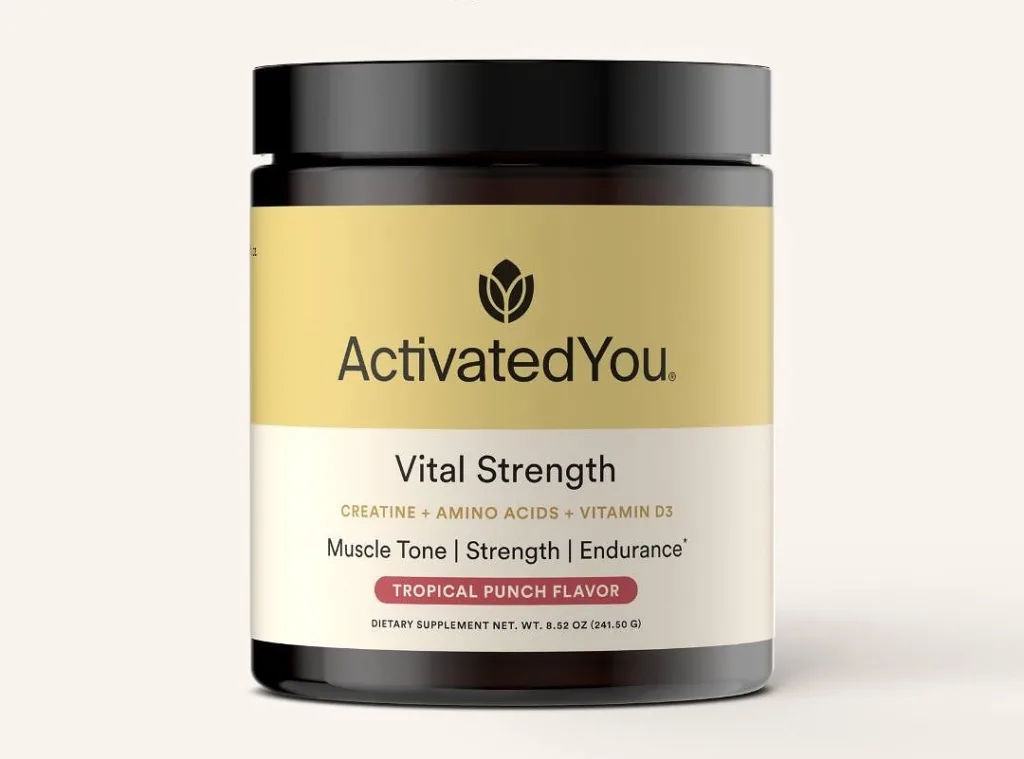
ActivatedYou, the wellness supplement brand founded by actor and health advocate Maggie Q with functional medicine physician Frank Lipman, launched Vital Strength on July 24, 2026, marking its entry into the increasingly competitive creatine and performance nutrition category. The daily powder combines creatine monohydrate, branched-chain amino acids, vitamin D3, glycine and proline and is being positioned for lean muscle support, exercise recovery, endurance and physical resilience.
The launch broadens ActivatedYou beyond the digestive health, weight management and beauty-oriented products that have shaped much of its consumer identity. Vital Strength gives the direct-to-consumer company an opportunity to participate in the rapid mainstreaming of creatine, which has moved beyond bodybuilding audiences and is increasingly marketed to women, middle-aged consumers and people focused on maintaining strength as they age.
Yet the formula requires ingredient-by-ingredient interpretation. Its 5-gram creatine monohydrate dose is closely aligned with amounts commonly evaluated in strength and resistance-training studies. The scientific case surrounding its smaller amino acid components is less straightforward, while the vitamin D3 contribution is likely to depend substantially on the user’s baseline vitamin D status.
ActivatedYou has not disclosed a product-specific clinical study demonstrating that the completed Vital Strength formula produces the advertised combination of muscle tone, recovery, endurance and total-body resilience. The commercial proposition therefore rests on the established literature surrounding individual ingredients, the appropriateness of their doses and the brand’s ability to communicate structure and function benefits without presenting the supplement as a clinically proven treatment.
Why does Vital Strength move ActivatedYou beyond its established digestive health and beauty portfolio?
ActivatedYou has built its identity around whole-body wellness products such as Morning Complete, Advanced Restorative Probiotic, Essential Skin Food and Lean + Active. Vital Strength moves the company into a different consumer purchase occasion by targeting exercise performance, muscle maintenance and recovery rather than digestive comfort, appearance or general metabolic support.
That expansion is commercially logical because creatine has become one of the few sports nutrition ingredients capable of attracting experienced gym users and newer wellness consumers at the same time. Consumers who previously associated creatine primarily with male bodybuilding are increasingly encountering products framed around healthy aging, women’s strength, mobility and long-term physical independence.
ActivatedYou is leaning into that broader positioning. Its launch materials describe Vital Strength as suitable for adults across fitness levels and place particular emphasis on age-related muscle and bone concerns. The formula is caffeine-free and stimulant-free, which separates it from conventional pre-workout powders and makes daily consistency, rather than an immediate energy sensation, the centre of the proposition.
This positioning could help the brand cross-sell Vital Strength to existing customers who already purchase daily wellness powders. It also creates a more demanding evidence environment. Consumers shopping for creatine can easily compare ingredient doses and price-per-serving across dozens of competing products, including inexpensive single-ingredient creatine monohydrate powders.
Vital Strength therefore needs to justify why buyers should select a multi-ingredient branded formulation instead of basic creatine. The answer will depend on whether its amino acids, vitamin D3 and broader wellness identity create enough perceived value to offset the simplicity and lower cost often associated with single-ingredient alternatives.
What does each scoop of ActivatedYou Vital Strength contain?
The official Supplement Facts panel lists a serving size of one 8.05-gram scoop, with 30 servings in each container. Every serving provides 5 grams of creatine monohydrate, a 1-gram blend of the branched-chain amino acids L-leucine, L-isoleucine and L-valine, 500 milligrams of glycine, 500 milligrams of proline and 50 micrograms of vitamin D3, equivalent to 2,000 international units.
The remaining ingredients include natural flavours, citric acid, malic acid, fruit and vegetable juice for colour, stevia-derived rebaudioside A, thaumatin and annatto seed extract. ActivatedYou says the formula contains no caffeine, artificial sweeteners, artificial colours or artificial flavours.
One commercial strength is the relative transparency of the label. The amount of creatine is individually disclosed, as are the total BCAA blend, glycine, proline and vitamin D3 doses. Consumers are not being asked to interpret a single large proprietary blend that conceals how much of each major ingredient is present.
However, the formula is not a protein powder and should not be evaluated as one. The combined amino acid content is modest compared with a conventional complete protein serving, and the BCAA blend contains only three of the nine essential amino acids. Vital Strength is better understood as a creatine-led supplement with supporting nutrients than as a substitute for adequate dietary protein.
That distinction matters because the launch materials compare the targeted nature of Vital Strength with the calorie and macronutrient content of protein shakes. Creatine and protein fulfil different nutritional roles, and consumers may use them together rather than treating one as an alternative to the other.
How closely does the 5-gram creatine dose align with research on strength and lean tissue?
Creatine monohydrate is the most scientifically established component of Vital Strength. Its central role in replenishing phosphocreatine supports the rapid production of adenosine triphosphate during repeated high-intensity muscular efforts, providing a credible physiological basis for its use alongside resistance exercise.
Research does not suggest that creatine simply creates lean muscle without an appropriate training stimulus. Its most consistent benefits are observed when supplementation is combined with resistance training, allowing users to perform or adapt to repeated high-intensity exercise more effectively.
A 2024 systematic review and meta-analysis of adults younger than 50 found that creatine supplementation combined with resistance training produced greater increases in lean body mass than resistance training alone. Another analysis reported additional upper-body and lower-body strength gains among younger adults receiving creatine during controlled resistance-training programmes.
Evidence in older adults also supports a potentially useful role when creatine accompanies structured resistance training. Meta-analyses have found improvements in lean tissue and selected measures of upper-body and lower-body strength, although outcomes vary across studies, training programmes, durations and participant groups.
Vital Strength’s 5-gram daily dose sits within an evidence-relevant range and is likely to be the product’s clearest point of scientific differentiation from loosely formulated wellness powders. The dose also allows ActivatedYou to market a meaningful quantity without requiring a loading phase or multiple daily servings.
The limitation is that evidence for creatine monohydrate cannot automatically validate every claim made for the finished formulation. Improvements in training performance, strength or lean tissue under controlled study conditions do not independently prove faster recovery, injury prevention, stronger bones or visible muscle definition in every user.
Why does the 1-gram BCAA blend create the biggest evidence question for recovery claims?
ActivatedYou presents the BCAA blend as a recovery component intended to support muscle repair and reduce exercise-related breakdown. Leucine, isoleucine and valine are essential amino acids involved in muscle metabolism, and leucine has a recognised role in signalling pathways associated with muscle protein synthesis.
The central question is dose. Vital Strength supplies 1 gram of total BCAAs, but the individual quantities and leucine-to-isoleucine-to-valine ratio are not disclosed on the public Supplement Facts panel.
A systematic review examining BCAA use around high-intensity exercise identified 2 to 10 grams per day as the range most commonly associated with improved markers of post-exercise recovery and muscle function. Vital Strength’s total blend is below that range, making it difficult to assume that findings from higher-dose BCAA studies will translate directly to this formulation.
The broader BCAA evidence is also mixed. Meta-analyses have reported reductions in muscle soreness and certain biochemical markers of muscle damage, but improvements in actual muscle performance recovery have been less consistent. One review found that BCAAs reduced soreness and several indirect damage markers without producing significant performance improvements 24 or 48 hours after strenuous exercise.
This does not mean the BCAA component has no value. It means ActivatedYou’s strongest recovery claims would benefit from product-specific evidence showing that the selected blend, at the disclosed dose and when combined with the other ingredients, produces a measurable benefit beyond creatine alone.
Glycine and proline add another formulation narrative because both are amino acids associated with structural proteins, including collagen. Each is present at 500 milligrams, but the company has not presented clinical evidence showing that those amounts materially affect exercise recovery, muscle resilience or connective tissue outcomes within the completed product.
What does the vitamin D3 dose contribute to the muscle and bone positioning?
Vital Strength provides 50 micrograms, or 2,000 international units, of vitamin D3 per serving. That represents 250% of the United States Daily Value, although it remains below the adult tolerable upper intake level of 100 micrograms, or 4,000 international units, identified by the National Institutes of Health.
Vitamin D is important for normal bone metabolism and muscle function, and inadequate vitamin D status can contribute to weakness. That gives ActivatedYou a reasonable basis for including the nutrient in a formula positioned around physical resilience.
The evidence does not support treating vitamin D3 as a universal performance enhancer, however. Studies examining supplementation and muscle strength have produced inconsistent findings, with benefits more plausible among people who begin with deficient or inadequate vitamin D status. Trials involving vitamin D-replete adults have frequently shown little or no additional strength benefit.
For ActivatedYou, the most defensible commercial message is that vitamin D3 supports normal musculoskeletal function rather than that the ingredient will independently produce greater strength or prevent injury. The product also enters a market in which consumers may already obtain vitamin D from multivitamins, fortified foods or separate supplements, making total daily intake an important part of responsible product communication.
How does United States supplement regulation shape ActivatedYou’s marketing claims?
Vital Strength is a dietary supplement, not a drug approved to treat muscle loss, osteoporosis, sarcopenia or any other medical condition. That regulatory distinction is particularly important because the launch language refers to aging, bone density, neuromuscular function, recovery and physical resilience.
The United States Food and Drug Administration permits dietary supplements to carry structure and function claims describing how an ingredient supports the normal structure or function of the body. These claims are not approved by the agency before marketing, although companies are responsible for ensuring that they are truthful, appropriately substantiated and accompanied by the required disclaimer.
Manufacturers using eligible structure and function claims must notify the regulator no later than 30 days after first marketing the product with those claims. The standard disclaimer explains that the statements have not been evaluated by the United States Food and Drug Administration and that the product is not intended to diagnose, treat, cure or prevent disease. ActivatedYou includes this disclaimer in the Vital Strength launch materials.
The absence of premarket approval places greater responsibility on formulation transparency, claim substantiation and quality assurance. The launch announcement does not disclose a finished-product clinical trial, comparative study or published assessment of Vital Strength itself. It also does not describe third-party certification for ingredient identity, purity or sport-related banned substances.
Those omissions do not establish a quality problem. They identify potential opportunities for ActivatedYou to strengthen differentiation in a crowded market through independent testing, manufacturing disclosures or product-specific research.
Can ActivatedYou create a defensible position in the crowded creatine supplement market?
The commercial opportunity rests partly on brand architecture. ActivatedYou is not trying to compete solely as a sports nutrition company. It is presenting creatine within a broader lifestyle narrative centred on women, healthy aging, daily wellness and maintaining physical capability.
Maggie Q gives the launch consumer recognition and a fitness-oriented identity, while Frank Lipman contributes medical and integrative wellness positioning. That combination could help the company reach shoppers who might feel underserved or intimidated by conventional bodybuilding brands.
The risk is that creatine monohydrate is highly commoditised. Consumers can purchase clinically familiar 3-gram or 5-gram servings from numerous established sports nutrition companies. Celebrity association may generate initial attention, but repeat purchases will depend on taste, tolerability, pricing, convenience and whether users believe the supporting ingredients add meaningful value.
Vital Strength’s clean-label presentation, absence of stimulants and once-daily format are sensible commercial choices. Its 5-gram creatine dose gives the product an evidence-aligned core. The comparatively small BCAA blend, lack of product-specific outcome data and broad language around total-body resilience leave more work for the company’s substantiation and consumer education strategy.
The most revealing milestones will not be launch-day publicity. They will be sustained customer retention, credible reviews over longer periods, transparent quality disclosures and evidence showing whether the combined formula improves outcomes beyond those expected from standard creatine monohydrate used with resistance training.
Vital Strength gives ActivatedYou a plausible route into muscle-support and healthy-aging nutrition, but the formula’s scientific hierarchy is clear. Creatine provides the strongest foundation, vitamin D3 adds a defensible nutritional support layer, and the amino acid blend remains the part of the proposition most in need of dose-specific and finished-product evidence.