Fate Therapeutics has treated the first patient in RECLAIM-LN, moving its off-the-shelf FT819 CAR T-cell therapy into a Phase 2 study that could potentially support registration in refractory moderate-to-severe lupus nephritis. The first participant received the treatment in an outpatient setting and was discharged the same day, providing an early demonstration of the accessibility model Fate Therapeutics hopes will differentiate FT819 from patient-specific CAR T-cell therapies that can require complex manufacturing and treatment at specialized centers. The open-label trial is expected to enroll approximately 53 patients and assess complete renal response at 26 weeks as its primary endpoint. Fate Therapeutics aims to complete enrollment during the first half of 2028.
The clinical milestone moves FT819 beyond an exploratory autoimmune program and into a much more consequential test of whether engineered, induced pluripotent stem cell-derived CAR T cells can produce sufficiently deep renal responses for a potential regulatory pathway. Fate Therapeutics says RECLAIM-LN was developed through interactions with the United States Food and Drug Administration under FT819’s Regenerative Medicine Advanced Therapy designation, while the company is also participating in the regulator’s Chemistry, Manufacturing and Controls Development and Readiness Pilot program. Those interactions are particularly relevant because manufacturing consistency and product availability are central to the commercial argument for an off-the-shelf CAR T therapy.
RECLAIM-LN will test whether a single FT819 dose can produce complete renal responses
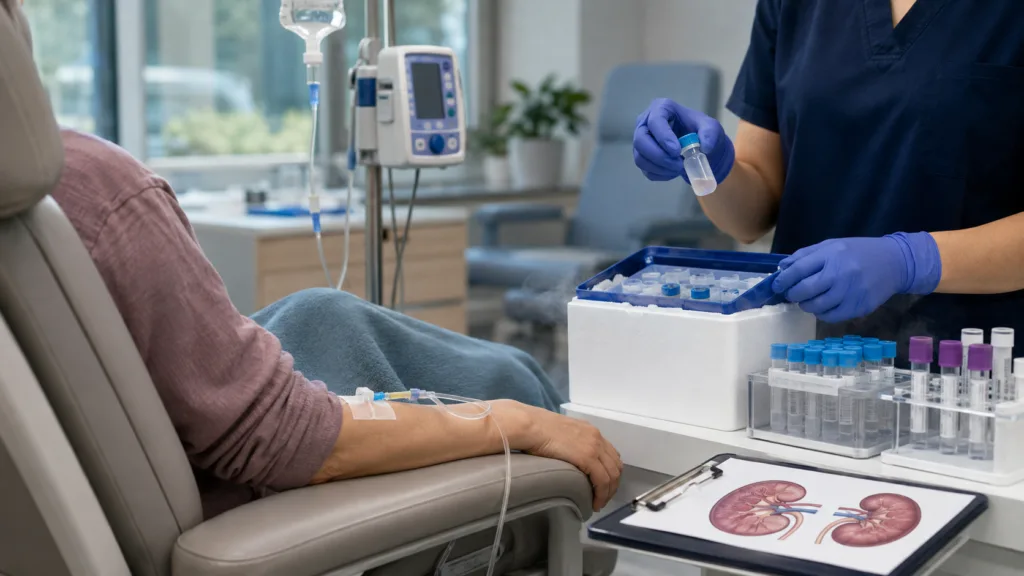
RECLAIM-LN is enrolling patients with refractory moderate-to-severe systemic lupus erythematosus involving lupus nephritis, one of the most serious manifestations of the autoimmune disease. Patients will receive a single dose of 900 million FT819 cells following bendamustine conditioning, with complete renal response at week 26 serving as the primary efficacy measure. The study is single arm rather than randomized, meaning interpretation will depend heavily on the magnitude, consistency and durability of responses relative to expected outcomes in this difficult-to-treat population.
Fate Therapeutics estimates that approximately 100,000 people in the United States have refractory moderate-to-severe lupus nephritis and says only around 10% to 20% of this population would be expected to achieve complete renal response with currently available approaches. That estimate forms an important part of the rationale for using a single-arm design, although regulators will ultimately determine whether the observed response rate, duration and safety profile provide sufficiently persuasive evidence for registration.
The company selected bendamustine after earlier Phase 1 experience suggested that less-intensive conditioning could support meaningful activity while avoiding the conventional combination of fludarabine and cyclophosphamide used in many CAR T-cell programs. Fate Therapeutics has said patients and investigators in the earlier study viewed the more intensive regimen as less desirable because of its additional treatment burden and potential adverse effects. RECLAIM-LN therefore represents a simultaneous test of the CAR T product and a simplified treatment pathway intended to make cellular therapy more practical outside traditional transplant-style settings.
Earlier lupus data support the Phase 2 move but remain preliminary and uncontrolled
The RECLAIM-LN strategy is supported by Phase 1 findings from FT819-102, which had treated 21 patients with systemic lupus erythematosus as of May 14, 2026. Sixteen received FT819 following less-intensive conditioning, and Fate Therapeutics reported no dose-limiting toxicities, no cytokine release syndrome above Grade 2, no immune effector cell-associated neurotoxicity syndrome and no graft-versus-host disease in that group.
Clinical measures also moved in a favorable direction. Fate Therapeutics reported sustained improvements across disease activity, urine protein-to-creatinine ratio, physician global assessment and fatigue measures, while bendamustine conditioning appeared to produce the deepest and most durable responses among the regimens evaluated. Among 10 evaluable patients taking background glucocorticoids, seven reduced their dose to five milligrams per day or less and five discontinued steroids completely.
Biological findings provided additional evidence that FT819 was affecting the intended B-cell compartment. The company reported reductions of approximately 74% to 96% in the most expanded baseline B-cell clones, with those dominant clones not reappearing through 12 months of follow-up, while protective vaccine antibody titers were preserved. These observations support the hypothesis that a deep immune reset might reduce autoimmune activity without completely eliminating previously acquired humoral immune protection, although the patient numbers remain too small to determine how consistently that profile will occur.
Earlier lupus nephritis experience was particularly encouraging but extremely limited. Fate Therapeutics previously reported renal responses among three patients with severe refractory lupus nephritis treated during Phase 1, including one participant who maintained complete renal response and drug-free remission through one year. The new 53-patient study must establish whether those individual outcomes represent a repeatable treatment effect rather than exceptional responses in a very small early-stage dataset.
Off-the-shelf manufacturing could determine whether CAR T expands beyond rare specialist use
FT819 differs fundamentally from autologous CAR T-cell products because it is manufactured from a clonally engineered induced pluripotent stem cell master bank rather than separately from each patient’s collected T cells. Fate Therapeutics can therefore produce larger standardized batches, cryopreserve finished doses and position inventory at distribution depots for shipment to clinical sites when patients require treatment.
The company has already manufactured and released the first pivotal-stage FT819 batch for RECLAIM-LN and placed product inventory in depots for on-demand distribution. Fate Therapeutics says the manufacturing strategy allows each batch to maintain a uniform composition that is difficult to achieve when every treatment begins with cells collected from a different patient or donor. The FDA has discussed the company’s potency strategy and other manufacturing-readiness elements through FT819’s RMAT and CMC pilot interactions.
That manufacturing architecture could become one of FT819’s most important advantages if clinical efficacy is confirmed. Autologous CAR T therapies require leukapheresis, individualized manufacturing and coordination between treatment centers and production facilities, while an inventory-based product could potentially shorten waiting periods and extend treatment into community hospitals and infusion centers. The first RECLAIM-LN patient’s outpatient administration with same-day discharge therefore provides an operational proof point, although one successful outpatient treatment cannot establish how routinely the model will work across the broader study population.
FT839 gives Fate a second autoimmune CAR T strategy as FT819 enters later-stage testing
Fate Therapeutics is simultaneously advancing FT839, a next-generation off-the-shelf CAR T-cell candidate designed to target both CD19 and CD38. The FDA cleared the FT839 Investigational New Drug application in July, allowing the company to proceed with the Phase 1/2 COMPLETE basket trial across autoimmune diseases. Fate Therapeutics engineered FT839 with 13 targeted genetic edits intended to support multi-antigen targeting, immune evasion, persistence and safety.
FT839 is also being developed without a requirement for conditioning chemotherapy, which could eventually produce an even simpler treatment model if clinical results support that strategy. The program is intended to target a broader collection of disease-driving immune cells, including B cells, plasma cells and activated immune populations, potentially extending Fate Therapeutics’ autoimmune platform beyond conditions dominated primarily by pathogenic B cells.
The two programs create a useful development progression. FT819 is moving into the potentially registrational RECLAIM-LN study with an established CD19-directed approach and less-intensive conditioning, while FT839 represents a more extensively engineered attempt to broaden immune-cell depletion and potentially eliminate conditioning. Success with FT819 would provide important clinical and manufacturing validation for the broader induced pluripotent stem cell platform even before FT839 reaches meaningful efficacy readouts.
Fate’s cash runway supports RECLAIM-LN while investors remain cautious on execution risk
Fate Therapeutics ended June with $153.8 million in cash, cash equivalents and investments, down approximately $21 million during the quarter, and management expects its operating runway to extend into 2028. Second-quarter research and development expenses were $24.4 million, total operating expenses reached $33.2 million and the company recorded a net loss of $30.2 million.
The runway should allow Fate Therapeutics to continue RECLAIM-LN and several other clinical programs through important milestones, but completing enrollment in the first half of 2028 means spending will continue for an extended period before the potentially registrational lupus nephritis program matures. Additional capital could eventually become necessary depending on enrollment timing, manufacturing investment and the pace at which FT839 and the oncology pipeline expand. This is an inference from the company’s reported liquidity, spending and development schedule rather than financing guidance beyond the stated runway.
Fate Therapeutics shares were trading near $2.68 during the August 13 session, down about 1.7% from the previous close, with a market capitalization of approximately $321 million. The muted reaction suggests investors viewed first-patient dosing as an important execution milestone but are waiting for enrollment progress and eventual renal-response evidence before assigning substantially greater value to RECLAIM-LN. That interpretation is an inference from the trading pattern rather than a confirmed explanation from individual shareholders.
FT819 has now entered the stage where the accessibility advantages of off-the-shelf CAR T must be matched by reproducible clinical efficacy. Same-day outpatient treatment and premanufactured pivotal inventory address two major practical limitations of cellular therapy, while the earlier lupus data provide enough evidence to justify the 53-patient study. RECLAIM-LN will determine whether those operational strengths can be paired with a complete renal response rate strong enough to support a potential regulatory filing in one of the most difficult manifestations of systemic lupus erythematosus.