RenovoRx has reported new peer-reviewed pharmacokinetic evidence suggesting that its Trans-Arterial Micro-Perfusion platform can alter how gemcitabine is distributed during treatment for locally advanced pancreatic cancer. A substudy from the ongoing Phase 3 TIGeR-PaC trial calculated an approximately 51% targeted extraction ratio for intra-arterially delivered gemcitabine, while systemic drug exposure was lower than with conventional intravenous administration.
The findings do not establish that the RenovoRx approach improves survival, but they provide an important mechanistic explanation for why targeted delivery could potentially increase local drug exposure without proportionally increasing chemotherapy circulating throughout the body. That distinction makes the latest publication considerably more clinically significant than another commercial update on RenovoCath adoption.
New TIGeR-PaC substudy examines what happens to gemcitabine after targeted delivery
The peer-reviewed analysis evaluated pharmacokinetic and pharmacodynamic data from 16 patients enrolled across six centers participating in TIGeR-PaC. Eleven patients received gemcitabine through RenovoRx’s Trans-Arterial Micro-Perfusion approach, while five received conventional intravenous gemcitabine at the same dose of 1,000 milligrams per square meter.
RenovoRx’s treatment method uses its RenovoCath double-balloon catheter to temporarily isolate an arterial segment near the pancreatic tumor. The platform is designed to increase pressure within the isolated vessel and promote movement of chemotherapy across the arterial wall into surrounding tissue, potentially allowing a greater proportion of the drug to reach the tumor environment before entering systemic circulation.
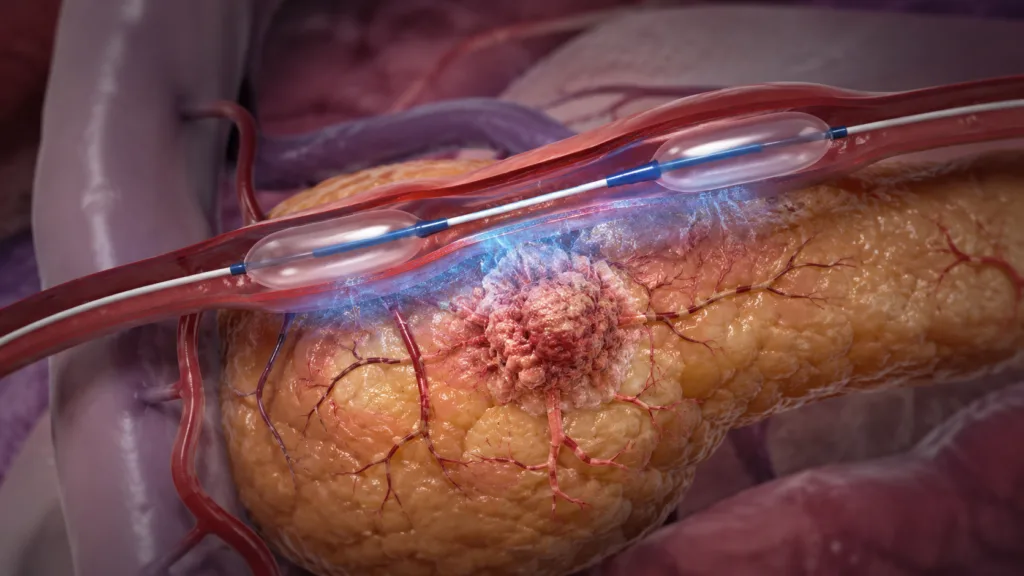
That mechanism is particularly relevant in pancreatic cancer because these tumors are frequently surrounded by dense stromal tissue and can have poor vascular penetration. Even when chemotherapy has activity against pancreatic cancer cells, systemic administration does not guarantee that a sufficiently high concentration reaches the tumor itself.
The new substudy attempts to quantify whether Trans-Arterial Micro-Perfusion meaningfully changes that distribution. Despite gemcitabine being infused at a higher concentration per minute through the targeted intra-arterial approach, peak concentrations measured in systemic circulation were lower than those observed after intravenous treatment. Median systemic gemcitabine exposure, measured by area under the concentration-time curve, reached 4.7 hour-micrograms per milliliter following intra-arterial administration compared with 8.8 after intravenous delivery.
Investigators calculated absolute bioavailability of approximately 0.489 for intra-arterial gemcitabine relative to intravenous treatment. From that figure, they estimated a targeted extraction ratio of 0.511, suggesting that roughly 51% of the drug was extracted within or near the targeted treatment region before reaching broader systemic circulation.
The 51% extraction finding supports TAMP’s mechanism but does not prove better survival
The 51% figure is likely to attract considerable attention because it offers a relatively intuitive measurement of what RenovoRx has been trying to demonstrate mechanistically. If approximately half of the delivered gemcitabine is removed from circulation around the targeted region, the result is consistent with the premise that more chemotherapy may interact with pancreatic tissue before being distributed throughout the body.
That does not mean 51% of the chemotherapy entered the tumor itself. The extraction calculation reflects drug removed from the local arterial circulation and may include uptake or metabolism within surrounding tissue as well as the tumor environment.
This distinction is critical when interpreting the study. Pharmacokinetic evidence can show that a delivery method changes where and how a drug travels through the body, but it cannot independently establish whether patients live longer, experience better disease control or have fewer serious treatment-related adverse events. Those clinical questions remain the responsibility of the broader Phase 3 TIGeR-PaC study.
The publication nevertheless provides important biological support for the trial. A targeted cancer-delivery platform must first demonstrate that it meaningfully changes drug distribution before investigators can reasonably expect that altered distribution to translate into improved outcomes. For RenovoRx, the new data move the TAMP hypothesis beyond engineering theory by providing direct pharmacokinetic evidence that intra-arterial gemcitabine behaves differently from the same drug administered intravenously.
Gemcitabine metabolite data offer another clue about localized drug processing
Investigators also examined concentrations of difluorodeoxyuridine, or dFdU, the primary inactive metabolite produced when gemcitabine is broken down in the body. Patients receiving targeted intra-arterial therapy showed higher circulating concentrations of the metabolite despite having lower systemic exposure to active gemcitabine.
Researchers interpreted that combination as being consistent with increased local processing of gemcitabine before the drug entered broader circulation. In other words, more active drug may have been converted into its inactive metabolite within the targeted region, producing lower levels of circulating gemcitabine but higher levels of dFdU.
The analysis also identified an exploratory relationship between dFdU exposure and changes in CA 19-9, a tumor marker commonly followed in pancreatic cancer. Higher metabolite exposure was associated with larger reductions in CA 19-9 following intra-arterial treatment, with investigators reporting a statistically significant negative correlation.
Some patients experienced CA 19-9 reductions of as much as approximately 40% following a single treatment. That finding is intriguing because it raises the possibility that circulating metabolite levels could eventually provide an indirect indication of how effectively gemcitabine was delivered into the targeted pancreatic region. However, the evidence remains preliminary and should be interpreted cautiously.
CA 19-9 is not a direct measure of survival, and not every pancreatic cancer patient has an elevated baseline level that can be meaningfully monitored. The correlation analysis also involved very few patients, substantially limiting the conclusions that can be drawn from the result.
TIGeR-PaC survival data remain the decisive test for RenovoRx
The most important question surrounding the RenovoRx platform therefore remains unchanged: can altering gemcitabine delivery improve patient outcomes? TIGeR-PaC is designed to answer that question in patients with locally advanced pancreatic cancer. The randomized Phase 3 study compares targeted intra-arterial gemcitabine delivered through the TAMP platform with conventional systemic intravenous gemcitabine plus nab-paclitaxel.
Overall survival is the primary endpoint, making the eventual trial result substantially more consequential than the pharmacokinetic substudy. RenovoRx completed enrollment in the Phase 3 study in August 2026. The final analysis is event-driven and will occur after the required number of patient deaths has been recorded, with the company previously indicating that 86 events are necessary for completion of the primary analysis.
As of an August update, 78 events had been recorded. RenovoRx has guided toward top-line TIGeR-PaC results during the second half of 2027, making the survival readout the major clinical catalyst now facing the program.
The new pharmacokinetic publication arguably raises the stakes for that result. Investors and clinicians now have evidence that the TAMP platform changes gemcitabine distribution, but the value of that change will ultimately depend on whether it produces a clinically meaningful survival benefit.
A positive Phase 3 result could validate not only the pancreatic cancer regimen but also the broader concept of targeted arterial micro-perfusion as a way to improve delivery of established cancer drugs. A negative survival result would create a very different interpretation. It could suggest that successfully concentrating chemotherapy near the tumor is insufficient to overcome the biological aggressiveness and treatment resistance of locally advanced pancreatic cancer.
RenovoCath provides the delivery mechanism, but Phase 3 survival remains the real test
RenovoCath remains central to the treatment approach because it is the catheter used to perform Trans-Arterial Micro-Perfusion. However, the importance of the August 25 development lies primarily in the clinical evidence generated with the platform rather than in another update about commercial device adoption.
RenovoRx has separately been building a commercial business around RenovoCath as a United States Food and Drug Administration-cleared medical device, and cancer-center adoption provides useful evidence that physicians are willing to use the technology. Those developments help establish the operational infrastructure surrounding TAMP, but they do not answer the clinical question confronting TIGeR-PaC.
The latest peer-reviewed study addresses a different issue. It provides evidence that the device-enabled treatment changes gemcitabine pharmacokinetics in a measurable way, offering a mechanistic bridge between the engineering design of the platform and the survival hypothesis being tested in Phase 3.
RenovoRx still faces substantial clinical risk because TIGeR-PaC must demonstrate that this altered drug distribution translates into meaningful patient benefit. Yet the 51% targeted extraction estimate provides a clearer explanation of what TAMP may be doing inside the body and gives clinicians and investors another piece of evidence to evaluate while awaiting the definitive survival data.