Anumana has received United States Food and Drug Administration 510(k) clearance for an electrocardiogram-based artificial intelligence algorithm designed to detect early signs of pulmonary hypertension from a standard 12-lead electrocardiogram. The clearance gives the cardiovascular AI company a first-mover position in a disease area where diagnosis is often delayed, and it extends Anumana’s regulatory footprint beyond its earlier cleared low ejection fraction algorithm.
Why Anumana’s FDA clearance matters because pulmonary hypertension is still diagnosed too late
The strategic significance of this clearance lies less in novelty for artificial intelligence itself and more in where Anumana is trying to insert AI into the care pathway. Pulmonary hypertension remains one of those conditions that can hide in plain sight. Symptoms such as shortness of breath and exercise intolerance overlap with far more common cardiopulmonary problems, which helps explain why diagnosis is often delayed and why specialist confirmation usually comes after disease has already advanced. Anumana is betting that the most routine cardiac test in medicine, the 12-lead electrocardiogram, can be turned into an earlier signal generator rather than remain a largely blunt instrument for this indication.
That is the real commercial and clinical pitch. If a standard electrocardiogram can flag suspicion earlier inside existing health system workflows, the algorithm could widen the top of the diagnostic funnel without demanding a new imaging platform, a new blood test infrastructure, or a specialist referral at the first step. That makes the Anumana product look more like a triage enabler than a diagnostic endpoint, which is important because pulmonary hypertension still requires confirmatory workup, with echocardiography used to estimate probability and right heart catheterization remaining the gold standard for definitive diagnosis and classification.
What this FDA-cleared ECG-AI algorithm changes in the pulmonary hypertension workup pathway
What is genuinely new here is not merely that an AI model can identify a hidden cardiac or pulmonary signal. The electrocardiogram-AI field has already shown regulatory traction in adjacent use cases, including low ejection fraction detection, atrial fibrillation risk prediction, and other cardiovascular screening applications. What changes with this clearance is the expansion of the routine electrocardiogram into pulmonary vascular disease detection, a more difficult category because pulmonary hypertension is heterogeneous, frequently underrecognized, and often discovered only after echocardiographic suspicion or invasive hemodynamic assessment.
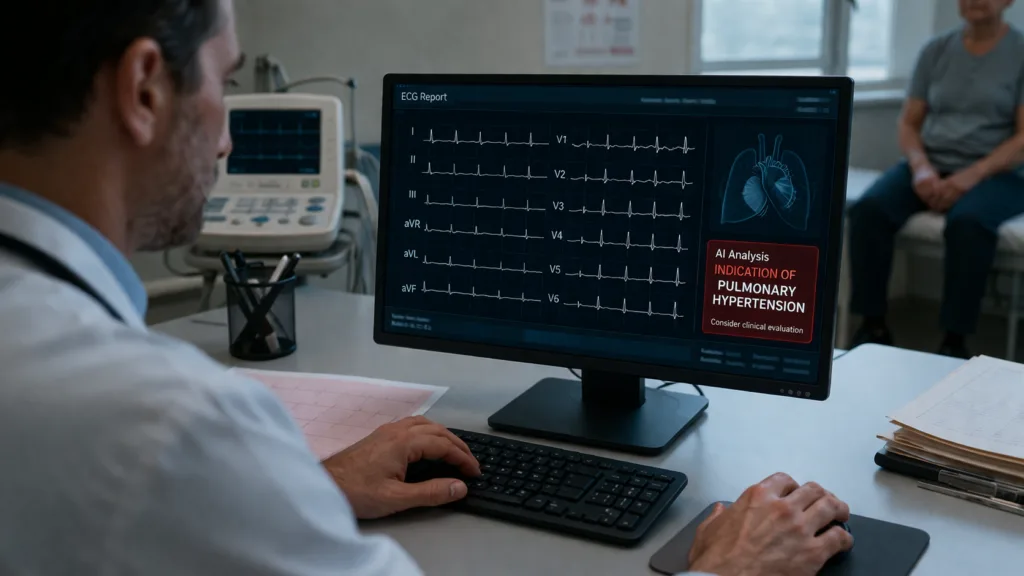
That matters because it potentially shifts where clinicians begin to suspect disease. In practice, many patients with unexplained dyspnea do receive electrocardiograms early, but those tracings may not by themselves trigger a pulmonary hypertension workup unless there are obvious abnormalities or a highly attuned clinician. Anumana’s argument is that artificial intelligence can extract weak signals that the human eye does not reliably recognize and then push clinicians toward follow-up echocardiography or specialist evaluation sooner. If that proposition holds in real-world deployment, the tool could function as a workflow amplifier for earlier case finding rather than as a replacement for specialist judgment.
How strong are the validation data behind Anumana’s ECG-AI pulmonary hypertension software
The validation story is credible enough to make the clearance meaningful, but not yet comprehensive enough to silence skepticism. Anumana says the algorithm was developed using more than 250,000 de-identified patient records from Mayo Clinic. It also cites an independent multicenter study involving 21,066 patients across five United States health systems in which the software detected pulmonary hypertension in adults presenting with dyspnea with 73% sensitivity and 74.4% specificity. Separately, the company says a real-world analysis found the model identified more than 85% of pulmonary arterial hypertension cases and 78% of chronic thromboembolic pulmonary hypertension cases in patients who had an electrocardiogram between symptom onset and diagnosis.
Those figures are good enough to support the case for enrichment of downstream testing, but they also expose the limits of the technology. Sensitivity and specificity in the low-to-mid 70s mean false positives and false negatives will remain part of the clinical reality in a broad dyspnea population. In other words, this is not a magic doorbell that rings only when pulmonary hypertension is present. Industry observers tracking software as a medical device adoption will likely see the current evidence as supportive for suspicion-raising, but not sufficient for stand-alone diagnostic confidence. That is particularly true in pulmonary hypertension, where disease subtype matters and hemodynamic confirmation changes treatment direction.
The more interesting signal may be the earlier-detection angle from prior published work. A 2024 peer-reviewed study and Mayo Clinic reporting indicated that the electrocardiogram-based algorithm achieved strong area-under-the-curve performance and retained detection capability months or even years before diagnosis in some datasets. That kind of temporal lead time is what gives the Anumana story strategic depth. If replicated in deployment, the algorithm could help identify patients earlier in the disease arc, when referral patterns and treatment pathways may still be altered. But published discrimination metrics from retrospective or multicenter validation do not automatically translate into behavior change inside real hospital operations.
Why regulatory clearance is important but still leaves unanswered adoption and workflow questions
The Food and Drug Administration clearance is clearly a milestone, yet it mainly answers the question of whether the product can be marketed, not whether it will be routinely used. The harder phase begins now. Hospitals must decide whether the algorithm fits into existing electrocardiogram management systems, whether clinicians trust the alert, and whether the output meaningfully changes referral decisions without producing alert fatigue. Anumana says the software integrates with electronic health record environments and runs inside the health system without external data transfer, which should help address privacy and implementation friction. Even so, health systems tend to be cautious about introducing another software layer into already crowded cardiovascular workflows.
Reimbursement is another important but nuanced point. Anumana says its FDA-cleared electrocardiogram-AI algorithms are eligible for reimbursement, and earlier reporting around its electrocardiogram-AI category noted Category III Current Procedural Terminology codes and 2025 Centers for Medicare and Medicaid Services outpatient payment recognition for AI-electrocardiogram services. That is directionally helpful because reimbursement often separates interesting artificial intelligence from usable artificial intelligence. Still, reimbursement eligibility is not the same thing as broad, frictionless economics across all sites of care. Coding uptake, payer behavior, documentation burden, and local return-on-investment assumptions can all affect deployment speed.
What clinicians regulators and digital health investors are likely to watch after this Anumana milestone
Clinicians tracking pulmonary hypertension will probably focus on three things next. First, they will want prospective evidence showing that the algorithm does more than detect statistical signal. The more consequential question is whether it shortens time to echocardiography, specialist referral, right heart catheterization, or treatment initiation in a way that improves outcomes. Second, they will want subgroup clarity. Pulmonary hypertension is not one disease, and performance across pulmonary arterial hypertension, chronic thromboembolic pulmonary hypertension, and other etiologic categories will matter. Third, they will want to know how the algorithm behaves in messy real-world populations outside curated academic datasets.
Regulatory watchers, meanwhile, may see this as another sign that electrocardiogram-AI is maturing from a compelling academic field into a regulated product category with commercial logic. Anumana already had clearance for its low ejection fraction algorithm, and the pulmonary hypertension clearance broadens the claim that routine electrocardiograms can support earlier cardiovascular risk detection at scale. For digital health investors, that creates a stronger platform narrative: not one algorithm for one niche task, but a repeatable regulatory and workflow model that could support multiple electrocardiogram-based indications.
Still, the risk of overreading the moment is real. Pulmonary hypertension diagnosis remains complex, specialist-centered, and dependent on confirmatory testing. A cleared triage algorithm may help health systems find more patients sooner, but it does not remove the downstream bottlenecks in echo capacity, referral logistics, or invasive hemodynamic confirmation. That is why this clearance looks meaningful without yet being transformative. It expands the clinical ambition of electrocardiogram-AI, but its real value will depend on whether hospitals use it to change behavior, not just to add one more dashboard output.