TaeWoong Medical USA has received U.S. Food and Drug Administration 510(k) clearance for the Niti-S SPAXUS Stent, a fully covered self-expanding metallic stent used in endoscopic ultrasound-guided transluminal drainage. The clearance expands the medical device manufacturer’s U.S. therapeutic EUS portfolio at a time when minimally invasive gastrointestinal procedures are moving deeper into complex drainage indications once managed through surgery or percutaneous intervention.
Why TaeWoong Medical USA’s SPAXUS clearance matters for therapeutic EUS adoption in the United States
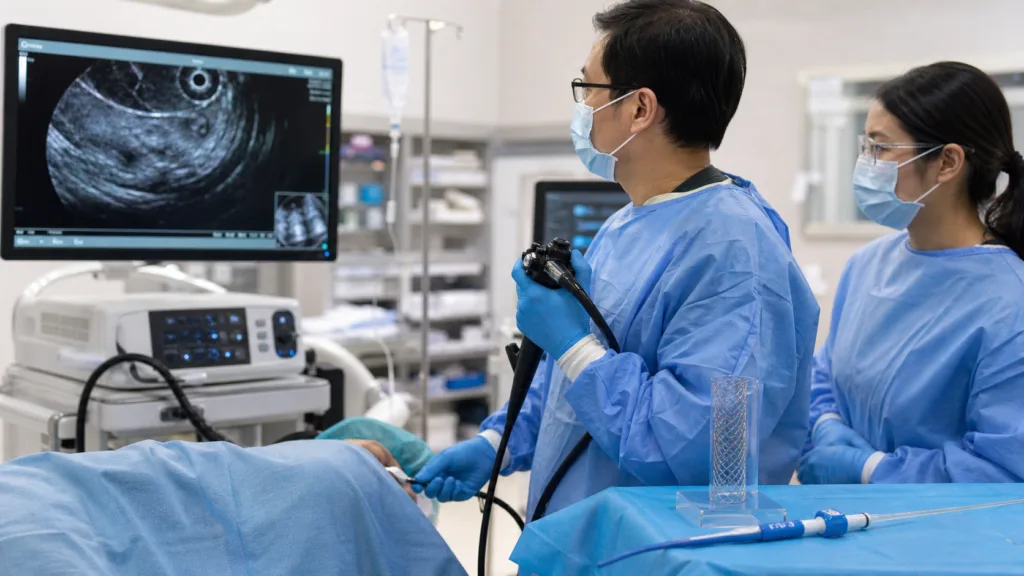
The practical significance of the SPAXUS clearance is not simply that another stent can now enter the U.S. market. It is that TaeWoong Medical USA is adding an FDA-cleared lumen-apposing option in a segment where device design, procedural familiarity, complication management, and hospital economics all matter. Therapeutic endoscopic ultrasound has gradually shifted from a specialist diagnostic technique into an interventional platform, allowing advanced endoscopists to create controlled internal drainage routes between the gastrointestinal tract and adjacent structures such as pancreatic fluid collections or the gallbladder.
For clinicians, the attraction is procedural consolidation. A well-selected endoscopic ultrasound-guided drainage case can avoid external drains, reduce the burden of open or laparoscopic surgery in fragile patients, and keep therapy within the endoscopy suite. That is especially relevant for pancreatic pseudocysts, walled-off necrosis, and gallbladder drainage in high-risk surgical candidates. However, adoption still depends on far more than clearance. Hospitals need advanced endoscopists with experience in EUS-guided access, fluoroscopic and endoscopic support, clear protocols for post-procedure follow-up, and readiness to manage bleeding, infection, migration, occlusion, perforation, or incomplete resolution.
That makes SPAXUS an incremental but strategically meaningful addition. It does not create the therapeutic EUS category, but it gives TaeWoong Medical USA a stronger U.S. foothold in a procedural field where choice of stent geometry, deployment behaviour, removability, and lumen apposition can influence physician preference.
How the Niti-S SPAXUS Stent design targets the core problems in transluminal drainage
SPAXUS is designed around a fully covered self-expanding metallic stent architecture with a bi-flange configuration. The commercial logic behind that design is clear: transluminal drainage is only as reliable as the stability of the newly created channel. If the stent migrates, leaks, embeds, occludes, or becomes difficult to remove, the theoretical benefit of minimally invasive drainage can quickly become a clinical management problem.
The bi-flange design is meant to support lumen apposition, helping hold two tissue walls in close proximity. In the context of pancreatic pseudocyst drainage or gallbladder drainage, that apposition matters because the procedure depends on maintaining a stable internal conduit between the gastrointestinal lumen and the target collection or organ. The silicone covering is intended to reduce leakage and tissue ingrowth, while also supporting later removability. These design attributes are commercially important because endoscopists often weigh not just technical success at placement, but the entire lifecycle of the device from deployment to resolution and removal.
The unresolved question is whether design familiarity and procedural performance will translate into consistent real-world confidence across U.S. centres. Lumen-apposing metal stents are not commodity devices in the same way as some standard endoscopic accessories. They sit inside a high-skill therapeutic workflow. Even small differences in delivery system handling, flange expansion, radiopacity, stent length, diameter availability, and removal characteristics can affect adoption. TaeWoong Medical USA will therefore need to convert FDA clearance into practical physician trust, especially among advanced endoscopy teams that may already have established preferences.
What the 510(k) pathway reveals about regulatory opportunity and clinical limits
The SPAXUS clearance came through the FDA 510(k) pathway, meaning the device was found substantially equivalent to legally marketed predicate devices. That is commercially valuable because it allows U.S. commercialization without the longer and more expensive premarket approval pathway. For a device category with existing regulatory precedent, this route provides clarity and speed.
However, the 510(k) pathway also shapes how the clearance should be interpreted. It is not the same as a broad new clinical breakthrough claim. It confirms that the device met the regulatory requirements for substantial equivalence within its intended use, not that it is superior to competing stents or appropriate for every patient with a pancreatic or gallbladder condition. The clinical decision remains case-specific, particularly in patients with anatomy, infection risk, necrotic burden, anticoagulation issues, or surgical complexity.
The FDA summary also indicates a defined implantation period for relevant pancreatic indications, with removal expected after confirmation of resolution. That matters because these devices are not intended to be forgotten implants. Follow-up timing, imaging, clinical monitoring, and removal planning remain central to safe use. For hospital systems, the device therefore sits within a service line rather than a single procedure. Commercial uptake may depend on whether centres can standardise the full pathway, not merely purchase the stent.
Why pancreatic pseudocyst and walled-off necrosis indications could drive early clinical interest
Pancreatic pseudocysts and walled-off necrosis are likely to be the most visible clinical settings for SPAXUS because they already sit at the centre of therapeutic EUS adoption. Symptomatic pancreatic pseudocysts larger than 6 cm and walled-off necrosis of similar size can require drainage when they cause pain, infection, obstruction, nutritional problems, or persistent symptoms. EUS-guided drainage has become an important option because it can internalise drainage and, in walled-off necrosis, can create an access route for debridement.
The distinction between pseudocyst and walled-off necrosis is commercially and clinically important. Pseudocysts are typically fluid-dominant collections, while walled-off necrosis can include solid debris and may need repeat intervention or necrosectomy. A stent that functions as both a drainage conduit and an access port can be more relevant in necrotic collections, where endoscopists may need to pass instruments through the tract. That broadens the procedural value of a lumen-apposing platform.
The limitation is that success rates in controlled evaluations do not eliminate real-world variation. Outcomes can depend on timing after pancreatitis, collection maturity, wall adherence, necrotic burden, infection status, operator experience, and multidisciplinary backup. A reported 97.1 percent clinical success rate with no device-related serious adverse events in a pivotal pancreatic pseudocyst evaluation is encouraging, but market confidence will build through post-clearance use across diverse U.S. centres.
Why gallbladder drainage creates a different commercial and clinical test
The gallbladder drainage indication may be strategically important because it touches a high-risk patient population. Acute cholecystitis is commonly treated surgically, but some patients are poor candidates for surgery because of age, frailty, comorbidities, or acute illness. In those cases, alternatives such as percutaneous cholecystostomy or endoscopic drainage become part of the treatment discussion.
EUS-guided gallbladder drainage can be attractive because it avoids an external drain and may improve patient comfort in selected cases. It also fits the broader trend of advanced endoscopy moving into territory historically managed by interventional radiology or surgery. For device manufacturers, this creates a competitive opening, but it also raises the bar for evidence, training, and multidisciplinary acceptance.
The key risk is that gallbladder drainage is not simply a device story. It is a care pathway story. Hospitals must decide which patients should receive EUS-guided gallbladder drainage, which should go to surgery, and which should receive percutaneous drainage. Those decisions may vary by institution depending on available expertise. TaeWoong Medical USA’s commercial opportunity will therefore depend on whether SPAXUS becomes embedded in multidisciplinary treatment algorithms rather than being viewed as a specialist tool used only by a small number of high-volume endoscopists.
How SPAXUS fits into TaeWoong Medical USA’s broader gastrointestinal device strategy
SPAXUS strengthens TaeWoong Medical USA’s position in the U.S. gastrointestinal device market by adding another therapeutic EUS product to a portfolio that already spans gastrointestinal stents, radiofrequency ablation systems, and endoscopic accessories. That mix matters because advanced endoscopy buyers often prefer suppliers that can support multiple procedural categories rather than a single niche product.
The U.S. market is attractive but demanding. FDA clearance opens the door, but reimbursement pathways, hospital value analysis committees, supply reliability, physician education, and clinical support will determine how quickly the stent gains traction. In medical devices, especially in procedural specialties, a strong product can still face slow adoption if training, service, and inventory access do not match clinician expectations.
The competitive question is whether TaeWoong Medical USA can use SPAXUS to move from product availability to procedural relevance. Its challenge will be to show that the stent is not only cleared, but practical, dependable, and supported in the demanding environment of therapeutic EUS. That will require evidence dissemination, hands-on physician engagement, and careful positioning against established lumen-apposing metal stent options.
What clinicians and device market observers will watch after the SPAXUS FDA clearance
The next phase for SPAXUS will be measured less by the clearance announcement and more by adoption signals. Clinicians will watch deployment performance, migration rates, leakage control, removability, procedure times, reintervention rates, and outcomes across pancreatic and gallbladder indications. Regulators and hospital committees may focus on whether post-market experience remains aligned with the safety profile described in clinical evaluation.
For TaeWoong Medical USA, the opportunity is clear. Therapeutic EUS is no longer an experimental edge of gastrointestinal care. It is becoming a high-value interventional field where device companies can compete on precision, efficiency, and procedural confidence. SPAXUS gives the medical device manufacturer a more visible U.S. role in that shift.
The caution is equally clear. A 510(k) clearance is a commercial gateway, not a guarantee of clinical dominance. In a skill-dependent market, the winning device is rarely the one with the strongest release language. It is the one that performs predictably in the hands of busy endoscopists, fits hospital workflows, and proves its value across real patients with messy anatomy and complex disease. That is where the SPAXUS story now moves from regulatory milestone to market test.