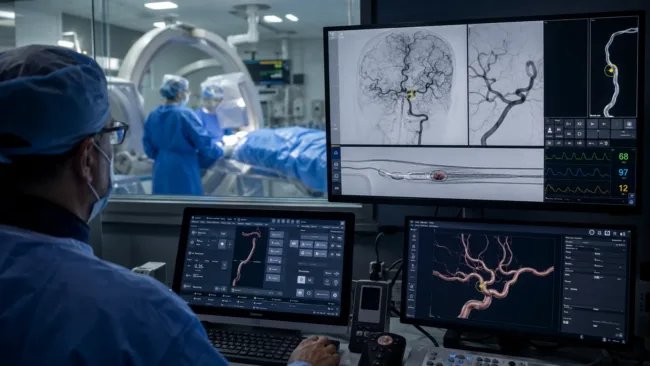
Boston Scientific Corporation has announced a definitive agreement to acquire Penumbra, Inc. for approximately $14.5 billion, marking one of its largest acquisitions to date in the medical device sector. The deal, structured as approximately 73 percent cash and 27 percent stock, offers Penumbra shareholders $374 per share and is expected to close in 2026, subject to regulatory approvals and shareholder consent. Penumbra’s Chairman and Chief Executive Officer, Adam Elsesser, will join the Boston Scientific board following completion.
The acquisition gives Boston Scientific immediate scale and proprietary technology across two of the fastest-growing medtech segments: mechanical thrombectomy and neurovascular intervention. It also signals a significant strategic shift toward higher-acuity, high-margin procedures in stroke, pulmonary embolism, and peripheral vascular disease. Boston Scientific expects the acquisition to be modestly dilutive to adjusted earnings per share in the first year post-close but to turn neutral or accretive by year two and increasingly accretive over time.

Why Boston Scientific is making its biggest vascular bet yet with Penumbra
The strategic rationale behind acquiring Penumbra goes beyond product portfolio expansion. Boston Scientific is placing a calculated bet on the continued proceduralization of vascular care and the shift toward minimally invasive, rapid-deployment devices for thrombotic and ischemic conditions. Penumbra has built a strong commercial and clinical position in this space with its computer-assisted vacuum thrombectomy systems, marketed under the Lightning brand, which are used to treat a broad spectrum of blood clot–related diseases.
The devices target peripheral arterial disease, pulmonary embolism, acute limb ischemia, and even complex stroke scenarios. These are indications where timely clot removal significantly reduces mortality and long-term morbidity, and where hospitals increasingly prefer mechanical extraction over thrombolytics due to bleeding risk and longer procedure times. Penumbra’s innovations in catheter design, intelligent aspiration control, and procedural workflow have been widely adopted across tertiary centers and large hospital systems.
Analysts tracking the transaction believe Boston Scientific’s entry into the thrombectomy space could reset competitive dynamics across the interventional landscape. While companies like Inari Medical and Johnson & Johnson’s Cerenovus have a foothold, Penumbra’s end-to-end clot management offering gives Boston Scientific a stronger starting position.
How the acquisition strengthens Boston Scientific’s push into neurovascular and stroke markets
Penumbra’s neurovascular device segment provides the second major pillar of value in this deal. Historically, Boston Scientific has had a limited footprint in neurovascular interventions, lagging behind companies such as Medtronic and Stryker. By acquiring Penumbra, it gains immediate entry into a sector poised for significant expansion driven by evolving clinical guidelines and broader reimbursement coverage for mechanical thrombectomy in stroke care.
Penumbra’s neuro offerings include access devices, aspiration systems for ischemic stroke, and embolization solutions for cerebral aneurysms and arteriovenous malformations. These are high-complexity, high-reimbursement procedures typically performed in neuro ICUs and comprehensive stroke centers. With stroke continuing to be a leading cause of disability and death worldwide, hospitals are investing in infrastructure and training to deliver rapid, device-based interventions.
Boston Scientific’s expanded access to stroke revascularization tools positions it to participate in this trend. However, successful market entry will depend on retaining the clinical trust Penumbra has built. This means continuing to support trials, generating real-world evidence, and maintaining surgeon-driven innovation roadmaps.
Integration risks and investor sensitivities as Boston Scientific adds $11 billion in cash outlay
Boston Scientific plans to finance the roughly $11 billion cash component of the deal through a mix of cash reserves and new debt. While the company has a track record of executing complex acquisitions, investors are likely to scrutinize this one closely given its size and scope. The near-term EPS dilution, although manageable, underscores the importance of revenue synergy realization and margin expansion in later years.
The medtech sector is entering a phase of elevated capital cost and payor scrutiny. This makes execution discipline essential. The integration of sales forces, alignment of training programs, and coordination of regulatory and quality systems across two highly specialized businesses will require detailed planning. Penumbra’s innovation-centric culture and relatively lean structure may also face friction as it becomes part of a much larger enterprise with broader reporting lines and operational mandates.
Nonetheless, market watchers note that Boston Scientific has previously demonstrated successful integration capabilities through deals like BTG, Lumenis, and Claret Medical. The company’s ability to grow both revenue and operating margin post-deal will depend on how quickly it can commercialize cross-platform synergies and globalize Penumbra’s product lines without eroding their core appeal.
Regulatory clearance may focus on concentration risk in thrombectomy
Given Penumbra’s leadership in clot extraction for both peripheral and neurovascular indications, regulators may scrutinize whether the deal could result in reduced competition or procedural choice in certain hospitals or geographies. While alternatives exist, Penumbra’s systems have become category-defining in some subsegments such as pulmonary embolism and ischemic stroke.
The U.S. Federal Trade Commission and European Commission have shown increased vigilance around horizontal and vertical integration in medtech markets, particularly where product interoperability, pricing transparency, and clinician access are involved. Boston Scientific may need to demonstrate that the acquisition will not diminish market diversity or impose restrictive bundling strategies on hospital buyers.
The company’s stated commitment to innovation continuity and open channel access is likely designed in part to pre-empt such concerns. However, stakeholders will want to see tangible safeguards post-close, including product roadmap independence and investment in ongoing clinical validation.
Competitive implications and potential ripple effects across medtech M&A
The transaction may accelerate consolidation pressure across mid-cap medtech, especially in interventional specialties. As large strategics seek growth in high-margin, low-replacement-cycle categories, thrombectomy, embolization, and neurovascular care offer fertile ground. Companies with complementary technologies, such as robotic vascular navigation, AI-guided thrombus characterization, or advanced embolics, could become attractive acquisition targets in the next 12 to 18 months.
The deal also raises questions for adjacent device manufacturers like Abbott, Terumo, or Siemens Healthineers, which have not made similarly bold moves in clot management. The acquisition may push peers to evaluate their own exposure to thrombectomy markets or pursue licensing and co-marketing arrangements with emerging players.
For smaller innovators, the bar for strategic alignment may rise. Penumbra has built not just a pipeline but a vertically integrated procedural ecosystem, supported by global commercialization infrastructure. Boston Scientific’s interest is as much about platform scale as it is about individual devices. This may influence how venture-backed startups frame their value propositions going forward.
Hospitals, clinicians, and payors will be watching real-world outcomes and pricing dynamics
For hospitals, the key concern will be continuity. Clinical stakeholders will expect Boston Scientific to preserve Penumbra’s strong support systems, device consistency, and physician education channels. Disruption to training or availability could lead to procedural hesitation, especially in stroke and embolism care where workflow familiarity is critical.
Payors will likely examine whether Boston Scientific can demonstrate improved outcomes and reduced total cost of care post-acquisition. With mechanical thrombectomy procedures already under scrutiny for cost justification, the merged entity will need to present real-world data showing shorter hospital stays, fewer complications, and broader access to care.
Reimbursement models are evolving in tandem with these technologies. Bundled payments and value-based procurement initiatives will require Boston Scientific to articulate how the expanded portfolio delivers systemic savings, not just procedural innovation.