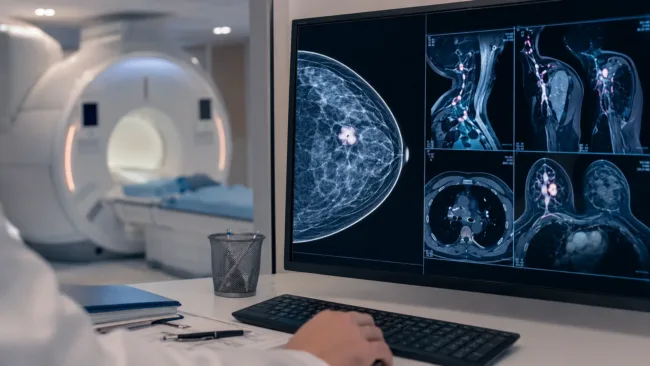
QT Imaging Holdings, Inc. has received U.S. Food and Drug Administration 510(k) clearance for an enhanced configuration of its Breast Acoustic CT scanner, a radiation-free three-dimensional ultrasound tomographic imaging system designed for breast health assessment. The updated configuration introduces a modified transmitter geometry intended to improve visualization and coverage of posterior breast tissue near the chest wall, an anatomical region that conventional imaging modalities often struggle to capture.
The regulatory clearance highlights a persistent technical limitation in breast imaging: obtaining consistent, high-quality visualization of tissue located close to the chest wall. While mammography, ultrasound, and magnetic resonance imaging remain central to breast cancer detection, each modality faces constraints when imaging deep posterior tissue. By focusing on this gap, QT Imaging Holdings, Inc. is positioning acoustic tomography as a complementary technology intended to expand anatomical coverage without exposing patients to ionizing radiation.
Why imaging breast tissue near the chest wall remains one of the hardest problems in diagnostic breast screening
Posterior breast tissue has long presented difficulties for diagnostic imaging because of both anatomical positioning and technological limitations. Breast tissue extends toward the pectoral muscle, and this region often lies at the edge of the imaging field during standard mammography. Compression-based systems may not always capture tissue located close to the chest wall, particularly when patient anatomy limits compression angles.
The challenge becomes more significant in patients with dense breasts, where mammography sensitivity can already be reduced. Dense tissue can obscure lesions, and incomplete visualization near the chest wall may further complicate interpretation when radiologists attempt to determine whether abnormalities represent true findings or imaging artifacts.
Ultrasound imaging, frequently used as a supplemental screening modality, introduces its own limitations. Handheld ultrasound examinations are operator dependent, meaning image quality can vary depending on probe positioning and scanning technique. Deep tissue regions may also produce acoustic shadowing or attenuation that reduces image clarity.
When imaging coverage is incomplete, clinicians may need to rely on multiple modalities to confirm findings. This layered approach can increase diagnostic complexity and contribute to additional follow-up examinations. Technologies that improve coverage of difficult anatomical regions therefore attract attention from imaging specialists seeking to reduce uncertainty in interpretation.
The enhanced configuration of the Breast Acoustic CT scanner attempts to address this challenge through a structural modification to the imaging system’s transmitter geometry. By introducing a tilted transmitter design, the scanner expands its acoustic interrogation field toward the chest wall. Ultrasound signals collected from these additional angles are processed through tomographic reconstruction algorithms that generate volumetric breast images.
Although the engineering change may appear incremental, improvements in imaging coverage can have practical diagnostic implications. More complete visualization of breast tissue may reduce the likelihood that lesions located near the chest wall remain partially obscured.
How acoustic breast tomography attempts to combine ultrasound safety with volumetric imaging capability
Acoustic tomography represents a different technical approach from conventional ultrasound imaging. Traditional ultrasound relies primarily on reflected sound waves to generate two-dimensional images. Acoustic tomography expands this concept by combining reflection-mode and transmission-mode ultrasound measurements.
Transmission ultrasound analyzes how sound waves travel through tissue rather than simply reflecting from tissue boundaries. These measurements provide information about acoustic properties such as sound speed and attenuation, which correlate with tissue composition. When integrated with reflection data, these signals enable the reconstruction of volumetric three-dimensional images.
The resulting datasets resemble tomographic images generated by computed tomography or magnetic resonance imaging but are produced without ionizing radiation. This distinction may be particularly relevant in screening environments where patients undergo repeated imaging over many years.
The Breast Acoustic CT platform also generates quantitative measurements related to tissue composition. The system estimates fibroglandular tissue volume and calculates the ratio of fibroglandular tissue to total breast volume. These metrics may provide additional insight into breast density, which is an established factor influencing both cancer risk and screening sensitivity.
Interest in radiation-free imaging technologies has grown steadily across the diagnostic imaging sector. Mammography remains the foundation of breast cancer screening programs, but concerns about radiation exposure and reduced sensitivity in dense breasts have prompted continued exploration of complementary technologies.
Magnetic resonance imaging offers high sensitivity but remains expensive and resource intensive, limiting its use primarily to high-risk populations. Automated breast ultrasound and contrast-enhanced mammography have emerged as alternative adjunct technologies designed to improve detection in dense breast tissue.
Acoustic tomography attempts to combine the safety profile of ultrasound with volumetric imaging capabilities typically associated with cross-sectional imaging techniques. Whether this approach can achieve comparable diagnostic accuracy will depend on the strength of future clinical validation.
How QT Imaging Holdings, Inc. is attempting to position acoustic CT within an already crowded breast imaging market
The breast imaging sector remains dominated by established technologies including digital mammography, digital breast tomosynthesis, ultrasound, and magnetic resonance imaging. These modalities benefit from extensive clinical evidence, established reimbursement pathways, and widespread physician familiarity.
New imaging platforms rarely replace these technologies directly. Instead, they typically enter clinical practice as complementary tools designed to address specific limitations within existing screening workflows.
QT Imaging Holdings, Inc. appears to be pursuing such a complementary strategy with the Breast Acoustic CT platform. Acoustic tomography may ultimately function as an adjunct imaging tool used when mammography results are inconclusive or when dense breast tissue reduces detection sensitivity.
Legislation requiring dense breast notification in several regions has increased awareness of mammography’s limitations in certain patient populations. In response, clinicians increasingly rely on supplemental imaging to improve detection rates in dense breast screening programs.
Acoustic tomography could offer a radiation-free imaging option capable of producing volumetric datasets without requiring contrast agents or extensive operator manipulation. However, the technology must compete with other ultrasound-based imaging systems that already serve similar roles in supplemental screening.
Automated breast ultrasound platforms, for example, aim to provide standardized volumetric imaging while reducing operator variability. To establish a distinct clinical role, QT Imaging Holdings, Inc. will likely need to demonstrate advantages in lesion characterization, tissue quantification, or workflow efficiency.
Regulatory clearance through the 510(k) pathway confirms that the device is substantially equivalent to a predicate device but does not establish superior clinical performance. Imaging providers generally require strong clinical evidence demonstrating improved diagnostic outcomes before adopting new technologies at scale.
What clinicians and regulators will watch next as acoustic tomography technologies move toward clinical validation
The next phase of evaluation for the Breast Acoustic CT scanner will likely involve clinical studies examining diagnostic performance in real-world imaging environments. Radiologists will focus on whether improved posterior coverage translates into measurable gains in lesion detection or diagnostic confidence.
Comparative studies involving mammography, tomosynthesis, ultrasound, and magnetic resonance imaging could help clarify where acoustic tomography fits within the diagnostic pathway. Evidence demonstrating improved visualization of deep tissue regions could influence adoption decisions among imaging providers.
Patient experience may also influence adoption. Imaging technologies that avoid both compression and radiation exposure may improve comfort during screening procedures. However, imaging centers must also consider workflow efficiency, examination time, and integration with existing picture archiving and communication systems.
Reimbursement remains another important factor. Emerging imaging technologies often face slow adoption when reimbursement pathways are unclear or absent. Without established reimbursement structures, even clinically promising technologies may struggle to achieve widespread use.
The enhanced configuration of the Breast Acoustic CT scanner represents a targeted engineering refinement aimed at addressing a longstanding technical limitation in breast imaging. Whether acoustic tomography ultimately becomes part of routine screening workflows will depend on clinical evidence demonstrating improved lesion detection or diagnostic confidence, as well as the technology’s ability to integrate into existing imaging infrastructure and reimbursement frameworks.