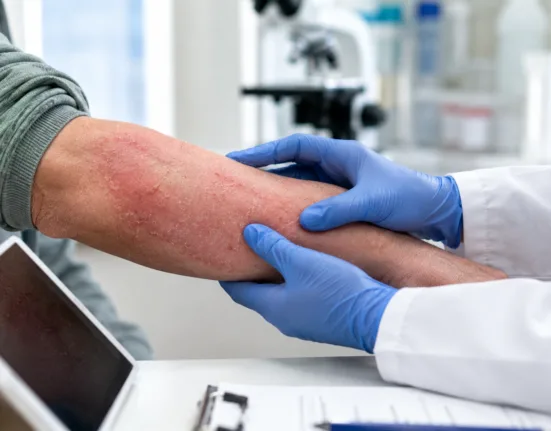
Bambusa Therapeutics, Inc. said it presented positive multiple-ascending-dose Phase 1 data for BBT001 at the 2026 American Academy of Dermatology Annual Meeting, highlighting safety, pharmacokinetics, and biomarker activity for its bispecific IL-4Rα and IL-31 antibody in healthy volunteers and adults with atopic dermatitis. The update matters because BBT001 is being positioned not simply as another inflammation biologic, but as a longer-acting candidate that could potentially reshape how clinicians think about itch control, dosing frequency, and pathway targeting in moderate to severe atopic dermatitis.
Why dual targeting of IL-4Rα and IL-31 could reshape competition in atopic dermatitis biologics
The most important takeaway is not that Bambusa Therapeutics reported positive early-stage data. Small biotechnology firms report encouraging Phase 1 signals all the time. The more meaningful development is that BBT001 is attempting to combine two clinically relevant mechanisms into a single half-life-extended biologic, pairing IL-4Rα blockade, which addresses core type 2 inflammation, with IL-31 inhibition, which is closely associated with itch biology. In a disease area where symptom burden is often driven as much by relentless pruritus as by visible skin lesions, that dual-pathway logic gives the candidate a commercially and clinically interesting angle.
That is where the differentiation argument begins. Existing and emerging atopic dermatitis therapies have already pushed the field well beyond broad immunosuppression. The competitive question is no longer whether targeted biologics can work, but whether new entrants can deliver a materially better balance of onset, durability, tolerability, convenience, and mechanistic precision. Bambusa Therapeutics is clearly trying to argue that BBT001 could sit in that next category by combining inflammation control with a more direct hit on itch signaling. Industry observers tracking the field often note that patients and clinicians do not experience atopic dermatitis as a biomarker problem. They experience it as a sleep-disrupting, quality-of-life-eroding disease in which itch relief can define real-world satisfaction.
That framing helps explain why the company emphasized biomarker readouts such as TARC and pSTAT6. Those measures are not substitutes for clinical benefit, but they are useful in early-stage development because they can suggest whether a drug is biologically active in the expected pathway. Bambusa Therapeutics reported rapid, deep, and sustained reduction in TARC and sustained inhibition of pSTAT6 for at least 12 weeks after multiple doses. For a Phase 1 dataset, that is directionally encouraging because it suggests the molecule is doing more than simply circulating in the body. It appears to be engaging the underlying inflammatory circuitry in a way that could justify the next stage of clinical testing.
Why strong biomarker activity still leaves major questions about real patient benefit unanswered
Even so, the strongest caution in this story is that biomarker depth is not the same thing as patient benefit. TARC correlates with disease severity, and pSTAT6 is a credible downstream mediator of type 2 inflammation, but regulators and clinicians will ultimately care far more about hard clinical endpoints such as Eczema Area and Severity Index improvement, validated itch reduction, durability of response after dosing intervals, flare prevention, tolerability in real patients, and performance across heterogeneous subgroups. Early-stage molecules often look elegant on mechanistic slides before encountering the messier realities of disease complexity in broader patient populations.
That limitation matters even more because the data discussed here came from the single-ascending-dose and multiple-ascending-dose parts of a Phase 1 study involving healthy volunteers and adults with atopic dermatitis, while the more important placebo-controlled patient data from the ongoing 4-week Phase 1b/2a trial are still pending for mid-2026. That means the field still does not know whether the biomarker profile will translate into convincing separation on symptoms that matter most to prescribers and payers. The market for atopic dermatitis therapies has advanced enough that incremental biological activity alone will not be enough. A new entrant has to show a clinically visible reason to switch, add, or preferentially sequence therapy.
This is where Bambusa Therapeutics faces both opportunity and pressure. If BBT001 can show rapid itch improvement, durable control, and a dosing interval that meaningfully reduces treatment burden, the program could attract attention as a potentially differentiated biologic in an already validated market. But if the next data package shows only modest clinical separation despite impressive pharmacodynamic findings, the narrative could quickly shift from best-in-disease ambition to another scientifically clever but commercially constrained asset.
Why a 33-day half-life could matter commercially if Bambusa Therapeutics can prove durability in patients
Among the most commercially relevant pieces of the update is the reported half-life of approximately 33 days. In biologics development, pharmacokinetics often get less public attention than efficacy headlines, but dosing interval has real competitive importance. Longer half-life can support less frequent maintenance dosing, which can improve adherence, reduce administration burden, and make a therapy more appealing in chronic diseases that require long-term management. Bambusa Therapeutics is openly leaning into that possibility by suggesting BBT001 may support prolonged maintenance intervals relative to currently approved medicines.
That matters because in atopic dermatitis, convenience is not a trivial add-on. It can shape physician preference, patient persistence, and payer discussions. A biologic that works well but requires more frequent administration may still succeed, but one that combines durable efficacy with a longer dosing interval gains a practical advantage that extends beyond headline efficacy percentages. In real-world use, patients do not always optimize around clinical-trial discipline. A therapy that fits more easily into life often performs better commercially, even when its mechanistic story is less glamorous than the science suggests.
Still, long half-life can cut both ways. A prolonged duration of exposure may enhance convenience, but it also raises questions about how quickly safety or tolerability issues can be managed if they emerge later in broader populations. Early reports of a clean safety profile and low incidence of anti-drug antibodies are helpful, but they remain preliminary. A molecule intended for chronic inflammatory disease must withstand repeated exposure, broader patient diversity, and longer follow-up before its safety case can be considered robust. The industry has learned repeatedly that early tolerability can look cleaner than later-stage or real-world experience.
What the next placebo-controlled readout will reveal about whether BBT001 is truly differentiated or just promising
The next major inflection point is the ongoing placebo-controlled 4-week Phase 1b/2a trial in patients with moderate to severe atopic dermatitis, which Bambusa Therapeutics expects to read out in mid-2026. That dataset is likely to be the first real test of whether BBT001’s biology translates into a clinically meaningful product profile. The key issue will not merely be whether the readout is positive. It will be whether it is positive in ways that are strategically useful.
Clinicians and regulatory watchers are likely to focus on whether the candidate shows early itch relief, whether efficacy appears broad or limited to certain biomarker-defined patients, whether the safety profile remains clean in actual disease populations, and whether the placebo-controlled design produces a convincing enough signal to justify a rapid progression path. The company is also developing BBT001 beyond atopic dermatitis, including chronic spontaneous urticaria, which suggests Bambusa Therapeutics sees the molecule as a platform asset rather than a single-indication experiment. That broadens the upside, but it also raises execution pressure. A company trying to build a multi-indication immunology platform cannot afford ambiguity in its lead clinical proof-of-concept readout.
Another unresolved question is how regulators and future partners might view a bispecific positioned as first-in-class but entering a field where therapeutic standards are already rising. Novelty helps attract attention, but it can also increase scrutiny around dose selection, immunogenicity, manufacturing consistency, and cross-study comparability. Regulators do not approve molecules for being mechanistically elegant. They approve them for showing clear benefit-risk in the intended population. For Bambusa Therapeutics, that means the coming patient data will need to make a practical case, not just a scientific one.
Why manufacturing, scalability, and market access may matter almost as much as the clinical profile from here
Even if BBT001 clears the next clinical hurdle, the road ahead will not be defined by efficacy alone. Bispecific antibodies can offer strategic differentiation, but they also introduce manufacturing and scalability questions that become more important as programs mature. Bambusa Therapeutics has described its platform around half-life extension and high-concentration subcutaneous delivery, which sounds commercially sensible in chronic disease, but the execution burden rises sharply as one moves from early clinical development into larger controlled studies and eventual launch planning.
Payers and health systems will also matter. Atopic dermatitis is a large market, but it is not an unconstrained one. New entrants must justify their place against established options and pipeline challengers. That justification usually requires either meaningfully better outcomes, a compelling convenience advantage, stronger performance in hard-to-treat patients, or some combination of all three. Without that, even scientifically credible products can struggle to move beyond niche use.
For now, Bambusa Therapeutics has done enough to ensure that BBT001 stays on the watchlist. The Phase 1 update suggests the molecule has biological potency, an apparently favorable early tolerability profile, and a pharmacokinetic profile that could support a differentiated maintenance story. But the field should resist over-reading the result. This remains an early program, and the harder questions have not been answered yet. In atopic dermatitis, the winners are rarely the therapies with the most elegant mechanism alone. They are the ones that prove they can turn that mechanism into visible patient benefit, durable control, practical dosing, and a regulatory path clean enough to support broad adoption.
If the mid-2026 patient data confirm that BBT001 can deliver rapid clinical relief, particularly on itch, while preserving a durable dosing profile, Bambusa Therapeutics may begin to look less like an ambitious development-stage entrant and more like a legitimate contender in next-generation inflammatory skin disease therapy. If not, the program may still have scientific value, but the distance between biomarker promise and market relevance will become much harder to ignore.