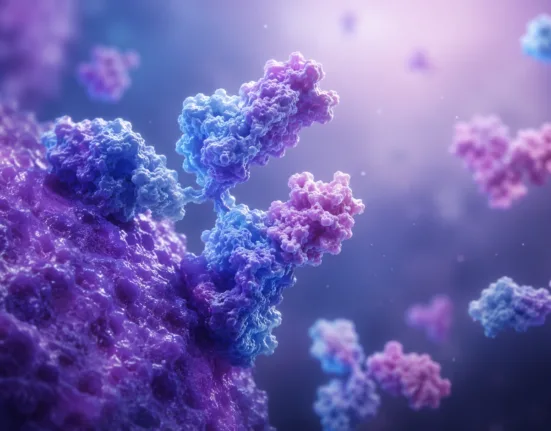
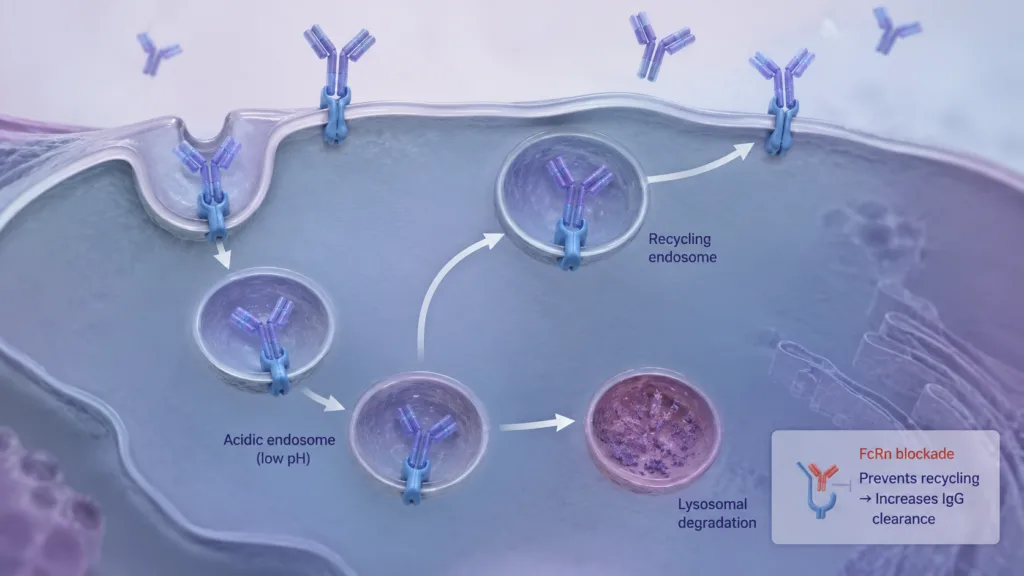
Human IgG survives in the circulation far longer than many proteins because the body continually rescues it from destruction. Cells internalize circulating proteins into acidic endosomes, where the neonatal Fc receptor, or FcRn, binds IgG and diverts it away from lysosomal degradation before recycling the antibody back to the cell surface. This salvage pathway is so efficient that IgG can persist for weeks. Autoimmune disease can exploit the same machinery: a pathogenic antibody attacking the acetylcholine receptor, peripheral nerve or another self-antigen is protected by FcRn just as effectively as a useful antibody generated after infection or vaccination.
FcRn inhibitors reverse that advantage. By preventing IgG from binding the recycling receptor, medicines such as efgartigimod, rozanolixizumab and nipocalimab allow more internalized IgG to be sent toward lysosomal degradation. Total IgG falls, and pathogenic autoantibodies fall with it, without requiring clinicians to eliminate the B cells or plasma cells producing those antibodies directly. The approach has moved rapidly from mechanistic curiosity into an established therapeutic class, with several FDA-approved FcRn-targeting drugs already available in generalized myasthenia gravis and efgartigimod also approved for chronic inflammatory demyelinating polyneuropathy.
Why does the body recycle IgG instead of simply replacing it constantly?
Antibodies are expensive biological molecules to manufacture, and maintaining durable humoral immunity requires useful IgG to remain available after the original immune response subsides. FcRn therefore acts as a molecular sorting system.
When IgG enters an acidic endosomal compartment, FcRn binds the Fc portion of the antibody. The receptor-antibody complex avoids lysosomal degradation and travels back toward the cell membrane. At the more neutral pH outside the cell, IgG dissociates and returns to circulation.
Albumin also benefits from FcRn-mediated salvage, which partly explains the unusually long circulating half-lives of both molecules. IgG and albumin interact with different receptor regions, however, allowing drug developers to design inhibitors that preferentially disrupt IgG recycling rather than simply eliminating every FcRn function indiscriminately.
The therapeutic opportunity appears whenever disease is driven substantially by circulating IgG. Instead of identifying and blocking every individual autoantibody specificity, clinicians can shorten the lifespan of the entire IgG pool temporarily.
How is this different from B-cell depletion?
Anti-CD20 medicines such as rituximab remove circulating B cells expressing the CD20 surface marker. That can reduce future autoantibody production and modify several immune pathways, but long-lived plasma cells generally do not express CD20 and can continue producing pathogenic antibodies after B-cell depletion.
FcRn inhibition acts downstream. It does not need to know which B cell generated the antibody or eliminate the cell producing it. The medicine simply accelerates clearance of the IgG after it enters circulation.
This can create faster pharmacodynamic effects because clinicians do not have to wait for existing antibodies to disappear through normal turnover. FcRn blockade compresses that turnover directly.
The trade-off is durability. When the inhibitor is withdrawn, FcRn function recovers and newly produced IgG can accumulate again. FcRn therapy can therefore behave more like controllable antibody reduction than permanent immune reprogramming.
That reversibility may be useful in diseases whose activity fluctuates, but it can also require recurring treatment cycles or continued maintenance dosing.
Why did generalized myasthenia gravis become the first major proving ground?
Myasthenia gravis provides an unusually clear link between circulating IgG autoantibodies and symptoms. In many patients, antibodies target the acetylcholine receptor or muscle-specific kinase at the neuromuscular junction, impairing communication between nerves and skeletal muscle and producing fatigable weakness affecting the eyes, face, swallowing, respiration and limbs.
Reducing those antibodies has a direct biological rationale, and treatments such as plasma exchange already demonstrated that physically removing circulating immunoglobulin can improve severe disease. FcRn inhibition offers a pharmacological way to accelerate IgG removal without connecting the patient to an extracorporeal plasma-exchange system.
FDA approved Rystiggo, or rozanolixizumab, in 2023 for adults with generalized myasthenia gravis who are AChR- or MuSK-antibody positive. Imaavy, or nipocalimab, followed in April 2025 for AChR- or MuSK-positive generalized myasthenia gravis in adults and patients aged 12 years and older. Efgartigimod-based therapy established the class even earlier in AChR-positive disease.
A 2025 meta-analysis covering 873 participants across eight randomized trials found FcRn inhibition improved several standard myasthenia-gravis functional measures compared with placebo, supporting the mechanism as a class rather than an effect limited to one molecule.
Why does FcRn inhibition lower useful antibodies as well as harmful ones?
The receptor does not know whether an IgG molecule protects against influenza or attacks the patient’s own acetylcholine receptor. It recognizes Fc structure rather than antibody intent.
Blocking FcRn therefore reduces total IgG, including protective antibodies generated by previous infection or vaccination. This is the central biological price of the strategy.
The class is still more selective than therapies that broadly suppress multiple immune-cell populations, but “selective” should not be mistaken for immunologically neutral. Patients can face increased infection risk, and prescribing information can contain vaccination considerations because an intervention deliberately lowering antibody concentrations may alter protection against pathogens.
The practical advantage is that other immunoglobulin classes and cellular immune compartments can be affected far less directly than with broad immunosuppression. Recent reviews consequently describe FcRn blockade as targeted modulation of IgG-mediated disease rather than generalized suppression of the entire immune response.
Why did efgartigimod also work in CIDP?
Chronic inflammatory demyelinating polyneuropathy is an immune-mediated peripheral neuropathy characterized by progressive or relapsing weakness, sensory abnormalities and impaired nerve conduction. Its biology is heterogeneous, and not every patient has an identifiable pathogenic antibody, yet IgG-mediated mechanisms appear sufficiently important in a substantial subset that FcRn inhibition can affect relapse risk.
FDA approved Vyvgart Hytrulo, a subcutaneous combination of efgartigimod alfa and hyaluronidase, for adults with CIDP after a study using a withdrawal design demonstrated a lower probability of clinical deterioration among patients continuing therapy than among those switched to placebo.
This expansion was conceptually important. Myasthenia gravis provides a relatively direct antibody-mediated disease model. CIDP is biologically more complex, so success suggested that FcRn inhibition could extend into disorders where pathogenic IgG contributes materially even when the antibody target is not identical or measurable in every patient.
The opposite can also reveal where the strategy should not work. Recent reviews note disappointing results in disorders such as multifocal motor neuropathy, whose biology is often associated more strongly with IgM antibodies. FcRn blockade primarily accelerates IgG clearance, so a disease driven by another immunoglobulin class provides little reason to expect the same pharmacology.
Why might FcRn inhibitors be attractive in rheumatology?
Many rheumatic autoimmune diseases involve IgG autoantibodies and immune complexes, including lupus, inflammatory myopathies, Sjögren’s disease and ANCA-associated vasculitis. That creates an obvious mechanistic rationale for reducing circulating IgG.
Clinical translation is more difficult than in myasthenia gravis because these diseases often depend on several immune pathways simultaneously. T cells, complement, interferon signaling, innate immune cells and tissue-specific inflammation can remain active even when autoantibody concentrations fall.
This means FcRn inhibition may prove highly effective in selected antibody-dominant phenotypes and much less powerful in patients whose disease is being sustained by broader immune circuitry. Patient stratification could therefore become one of the most important next stages for the class.
The same logic creates combination opportunities. An FcRn inhibitor could rapidly lower circulating pathogenic IgG while another medicine reduces production of new autoantibodies or suppresses downstream inflammation.
Combination therapy also increases infection and cost concerns, so the mechanistic elegance has to translate into a large enough clinical benefit to justify layering treatments.
How does FcRn inhibition compare with plasma exchange or IVIG?
Plasma exchange physically removes antibodies from the bloodstream and can act rapidly, but it requires vascular access, specialized equipment and repeated procedures. Intravenous immunoglobulin has complex immunomodulatory effects and is effective in several antibody-mediated diseases but requires large quantities of donor-derived IgG and can involve long infusions.
FcRn inhibition tries to produce a related antibody-lowering effect pharmacologically by changing the body’s own recycling dynamics. The medicines can be given intravenously or subcutaneously depending on the product and can potentially support repeated outpatient treatment more easily than plasma exchange.
The class is not automatically interchangeable with those therapies. Plasma exchange can be essential during acute life-threatening deterioration when very rapid removal is required, while decades of IVIG experience support its use across diseases whose mechanisms extend beyond one receptor pathway.
FcRn inhibitors instead create another therapeutic lever, particularly valuable when chronic IgG reduction is the objective.
Could FcRn eventually become one of the largest autoimmune drug classes?
The addressable biology is broad enough. Pathogenic IgG contributes to dozens of neurological, hematological, dermatological and rheumatological diseases, and companies can often test the same FcRn molecule across several indications without redesigning its core mechanism.
Commercial success will depend on disease selection. Lowering IgG indiscriminately makes sense only when enough of the pathology depends on pathogenic IgG to produce a clinically meaningful result.
Long-term safety also matters because many autoimmune diseases require years of treatment. Clinical trials can establish short- and medium-term infection rates, but widespread use across large populations will clarify how sustained cycles of lower IgG affect immunity over time.
The class nevertheless represents a striking change in therapeutic logic. Traditional autoimmune drugs frequently attempt to suppress the cells generating an immune response or block the inflammatory molecules those cells release. FcRn inhibitors intervene somewhere else entirely: after the antibody has already been made.
They exploit an elegant weakness in pathogenic IgG. Autoantibodies survive for weeks partly because FcRn repeatedly rescues them from destruction. Block that rescue system, and the body’s own lysosomes begin doing much of the therapeutic work.