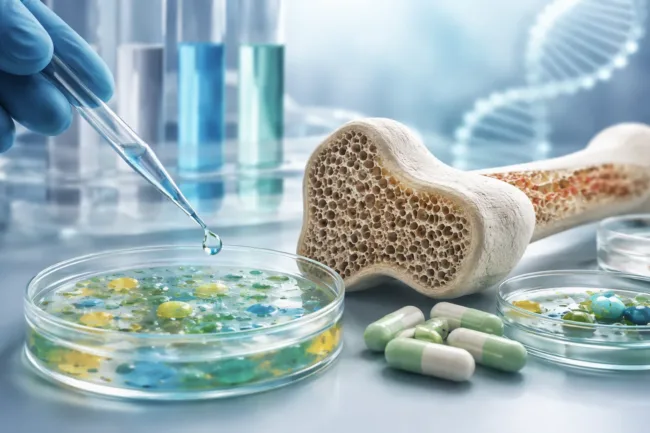
Sōlaria Biō has disclosed new mechanistic data showing that its synbiotic medical food, Bondia, reinforces gut barrier integrity, reduces systemic inflammation, and suppresses osteoclast activity—offering biological insight into the 85 percent improvement in bone density reported in a prior large-scale clinical trial. These results support Bondia’s positioning as a novel intervention for osteopenia and age-related bone loss, as the company prepares to launch a government-funded 18-month follow-up trial in collaboration with Harvard-affiliated researchers.
What this reveals about inflammation, leaky gut, and skeletal degeneration
The mechanistic findings provide a detailed map of how Bondia exerts its protective effects through the gut–bone axis. The study shows that Bondia improves epithelial barrier integrity, thereby limiting the translocation of inflammatory molecules from the gastrointestinal tract into systemic circulation. This is significant because increased gut permeability, often referred to as “leaky gut,” has been implicated as a driver of chronic inflammation and degenerative conditions including osteoporosis.
Bondia’s formulation also demonstrated immunomodulatory effects in cell models that mimic aging-related inflammation and high body mass index. In these models, Bondia reduced pro-inflammatory cytokines and downregulated osteoclast activity, the process by which bone tissue is broken down. Specific reductions were observed in biomarkers such as TRAP and CTX-1, both of which are strongly associated with bone resorption.
These mechanistic insights align closely with the earlier clinical trial results published in Osteoporosis International. That study tracked 286 postmenopausal women over 12 weeks and found that Bondia significantly slowed bone density loss in women diagnosed with osteopenia or with elevated body mass. Femoral neck bone loss was reduced by 85 percent compared to placebo, despite both cohorts receiving vitamin D supplementation. This differential effect suggests Bondia’s benefit is independent of standard micronutrient support.
Industry observers note that this dual-layer validation—clinical and mechanistic—positions Bondia as one of the first microbiome-based products to provide hard evidence of systemic skeletal impact, rather than relying on proxy endpoints or exploratory markers.
Why this could challenge long-held assumptions in osteoporosis care pathways
Osteoporosis is typically treated as a late-stage condition, with interventions initiated only after substantial bone loss has occurred or a fracture has been documented. Standard screening with DEXA scans begins at age 65, often leaving women in their 40s and 50s without clear pathways for early intervention. Bondia targets this gap by offering a dietary management approach for osteopenia, which is a precursor to osteoporosis but is not always formally addressed in clinical practice.
Medical foods like Bondia are distinct from supplements or pharmaceuticals. They must meet U.S. Food and Drug Administration criteria for managing conditions that require dietary intervention, and their composition is often based on specific metabolic or biochemical mechanisms. In this case, Bondia combines prebiotics and probiotics in a high-potency synbiotic designed to restore balance in the gut–immune–bone triad.
This model is gaining traction as clinicians begin to accept that bone homeostasis is influenced by systemic inflammatory tone and gut microbial diversity. Declining estrogen levels during menopause are now understood to disrupt both immune function and gut barrier health, accelerating bone breakdown through overactive osteoclasts. Bondia’s approach targets these upstream causes, rather than simply increasing calcium or inhibiting bone turnover pharmacologically.
For endocrinologists and primary care providers, the broader implication is that gut health may emerge as a legitimate target in the prevention of skeletal degeneration. However, the success of such interventions will depend heavily on clinician education, coding and reimbursement structures, and the perceived legitimacy of the medical food category within evidence-based practice.
What the STARS trial will need to prove for Bondia to enter mainstream care
Sōlaria Biō has initiated a new clinical trial funded by the National Institute on Aging to evaluate Bondia’s long-term potential. Known as the STARS trial (Study To Attenuate Resorption of Skeleton), the study will track 220 postmenopausal women aged 60 and above over an 18-month period. It is being led by investigators at Hebrew SeniorLife’s Marcus Institute for Aging Research, with participation from Beth Israel Deaconess Medical Center, Tufts University, and Maine Medical Center.
Unlike the earlier 12-week study, STARS will be positioned to evaluate duration of effect, safety over extended use, and real-world tolerability in a more diverse cohort. Analysts tracking the space suggest that fracture incidence, mobility metrics, and patient-reported outcomes may be layered in as secondary endpoints to support broader reimbursement and clinical adoption.
If Bondia shows sustained benefit over 18 months, it could become one of the first synbiotics to secure a foothold in mainstream bone health protocols. However, failure to replicate initial findings in a larger or more heterogeneous cohort could dampen investor and clinician confidence. Experts also caution that real-world effectiveness may vary based on individual gut microbiome composition, diet, concurrent medication use, and adherence—factors that are notoriously difficult to standardize across trials.
Regardless of trial outcome, STARS is expected to generate high-quality longitudinal data that will shape the evidence base for microbiome-targeted interventions in age-related conditions beyond osteoporosis, including sarcopenia, frailty, and metabolic syndrome.
What barriers may still limit commercial and clinical uptake
Despite compelling data, Bondia’s adoption will likely face several practical and regulatory barriers. First, awareness and understanding of medical foods among prescribers remain limited. While the regulatory framework defines medical foods as distinct from both supplements and drugs, confusion persists in the clinical community regarding when and how they should be used, especially in a preventive context.
Second, scalability and manufacturing consistency are critical variables. Sōlaria Biō has built its pipeline on a proprietary microbial library derived from fresh produce, supported by AI-driven genomic analysis. But the company has not yet disclosed detailed manufacturing controls or comparative benchmarks for batch-to-batch consistency—an issue that has plagued other companies in the probiotic and synbiotic categories.
Third, the 85 percent figure cited in the original trial refers specifically to a subset of women with osteopenia at the femoral neck, rather than overall bone mass across multiple skeletal sites. Industry observers caution against extrapolating this reduction as a generalizable metric for all women at risk of osteoporosis. Regulatory watchers and payers will likely require additional data on fracture prevention, cost-effectiveness, and population-level applicability before considering Bondia for broad-scale adoption.
Clinicians tracking this space suggest that without clear clinical guidelines, Bondia may find its initial traction in integrative medicine, geriatric care, and specialist women’s health practices before reaching generalist adoption.