PDV MedTech and Corscience GmbH & Co. KG have formed a strategic partnership intended to give medical-device companies a more connected route from early product development through regulatory preparation, manufacturing scale-up and commercialization. The alliance combines Corscience’s engineering experience in complex and safety-critical systems with PDV MedTech’s manufacturing operations in the United States and its wider international production network.
The partnership is aimed at one of the medtech industry’s most persistent operational problems. A promising device can complete laboratory development and still fail to reach commercial production because its design is difficult to manufacture, its documentation is incomplete or its supply chain cannot support consistent output. PDV MedTech and Corscience are attempting to reduce those handover risks by coordinating engineering and production earlier in the development cycle.
European innovators will gain access to PDV MedTech’s manufacturing capabilities, while companies in the United States can use Corscience’s European development experience and knowledge of the European Union Medical Device Regulation. The companies are offering a flexible model that can cover engineering alone, manufacturing alone or a combined programme shaped around the device’s risk classification, regulatory strategy, production volume and target markets.
How will the PDV MedTech and Corscience partnership connect medical-device design with manufacturing?
Medical-device development is frequently divided among several contractors. One organisation may create the initial design, another may develop embedded software, a third may build prototypes and a contract manufacturer may eventually be selected for production.
That fragmented structure can work when responsibilities are clearly controlled, but it can also create expensive gaps. A development team may choose components that are unavailable at commercial volumes. A prototype may depend on manual assembly methods that are unsuitable for routine manufacturing. Documentation prepared for an engineering milestone may not be complete enough for regulatory submission or production transfer.
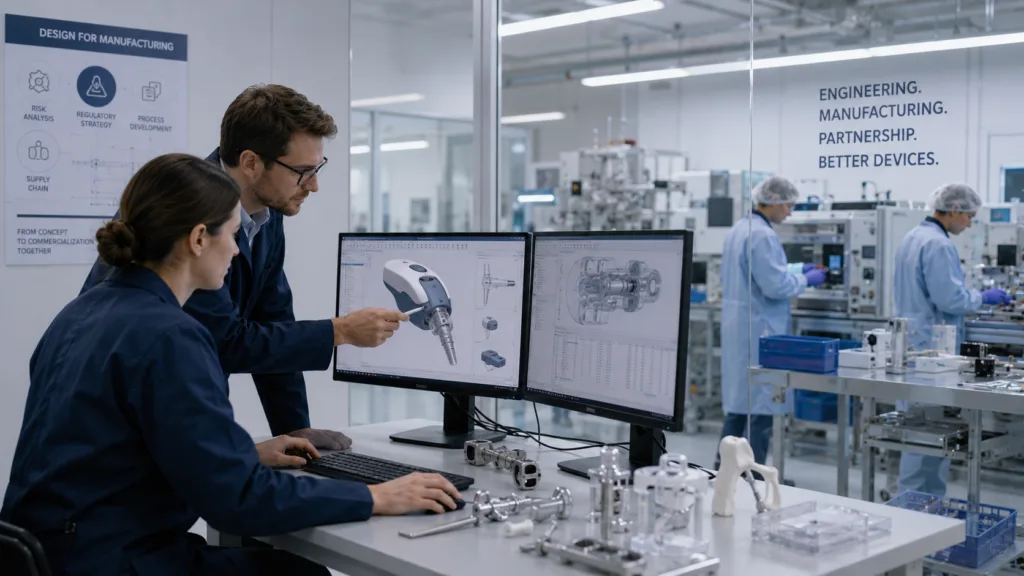
The PDV MedTech and Corscience partnership is designed to move manufacturing considerations closer to the beginning of development. Corscience can lead or support systems architecture, hardware, software, mechanics, verification and regulatory preparation, while PDV MedTech can assess how the resulting product will be tooled, assembled, inspected, packaged and scaled.
That does not mean every project will move directly from Corscience’s engineering teams into PDV MedTech factories. Device sponsors will continue to control their programmes, intellectual property and supplier decisions. The commercial argument is that customers can use one coordinated network when they need both development depth and manufacturing capacity.
Earlier production input may help identify design changes before formal verification begins. Altering an enclosure, component or circuit during an early prototype phase is usually less disruptive than making the same change after testing, regulatory documentation and tooling have been completed.
Why are safety-critical cardiovascular and emergency devices central to the alliance?
Corscience is based in Erlangen, Germany, and has approximately 25 years of experience developing medical technology in areas including defibrillation, patient monitoring and other safety-critical systems. Its work covers hardware, software, embedded systems, testing, regulatory support and technology modules that can be incorporated into original equipment manufacturers’ products.
These are demanding device categories because technical failure can carry an immediate clinical consequence. A defibrillator must deliver therapy reliably under emergency conditions. Patient-monitoring equipment must acquire, process and display physiological information accurately. Connected systems must maintain performance while managing software updates, communications and cybersecurity risks.
Corscience focuses particularly on higher-risk Class IIb and Class III devices under the European regulatory framework. These projects generally require rigorous risk management, verification, validation, clinical evidence and post-market planning. The European Commission also requires conformity assessment by a notified body for device categories where independent intervention is mandated before market placement.
The company’s development process extends from early product definition through qualification, production transfer and lifecycle management. Corscience said its teams establish requirements and system architecture, develop and validate near-production devices, coordinate external assessments and support industrialization with manufacturing partners.
This capability gives the partnership a more specialised proposition than a conventional prototyping arrangement. Customers developing connected therapeutic or monitoring systems may need expertise across electronics, firmware, mechanical design, usability, electrical safety and regulatory documentation at the same time.
The alliance will still need to demonstrate that its combined operating model can manage those disciplines without creating an additional coordination layer. Its value will depend on whether shared project governance genuinely simplifies execution rather than merely adding another commercial relationship.
What manufacturing capacity does PDV MedTech bring to the partnership?
PDV MedTech was founded in 2001 as Phoenix DeVentures and was acquired by precision-component manufacturer INDO-MIM in 2025. It now operates as an INDO-MIM company providing medical-device design, prototyping, injection moulding, contract manufacturing, clean-room assembly, inspection and packaging.
The company said it has worked on more than 600 projects across a broad range of medical devices. Its facilities in California, Utah and Colorado are supported by production options that can extend from prototype and low-volume manufacturing in Morgan Hill, California, and Utah to medium and higher-volume production in San Antonio, Texas.
Customers requiring larger international capacity may also access manufacturing in Mexico, India and the United Kingdom. The planned model is intended to cover the progression from an early prototype through pilot production and eventual commercial volumes without requiring the device sponsor to rebuild its supplier network at every stage.
INDO-MIM adds experience in metal injection moulding, ceramic injection moulding, investment casting, precision machining and additive manufacturing. Those capabilities may be relevant for medical devices containing specialised metal or ceramic parts, although the precise production route will depend on each customer’s design and regulatory requirements.
The acquisition of Phoenix DeVentures was intended to combine its medtech product-development and commercialization experience with INDO-MIM’s manufacturing scale and automation. The Corscience agreement extends that strategy by adding a European engineering partner with experience in high-risk electronic and connected devices.
For PDV MedTech, the partnership could increase its involvement before a customer reaches the manufacturing stage. Contract manufacturers are often approached after most design choices have been fixed. Working alongside Corscience could allow PDV MedTech to influence manufacturability, tooling and supply-chain decisions while the product can still be modified efficiently.
Could the alliance reduce the risks created during design transfer and production scale-up?
Design transfer is the point where a verified product design becomes a repeatable manufacturing process. It requires more than sending engineering drawings to a factory. Specifications, supplier controls, inspection procedures, assembly instructions, software configurations, testing methods and acceptance criteria must all be sufficiently detailed.
The risk increases when the development and manufacturing organisations use different documentation systems or make different assumptions about the product. A prototype team may understand how to assemble a device through experience that has never been captured in formal instructions. Production employees cannot be expected to rely on that undocumented knowledge.
A connected engineering and manufacturing model may reduce this risk by involving production personnel during development reviews. Manufacturing engineers can identify components with long lead times, processes that are difficult to validate or tolerances that could cause inconsistent output.
The commercial benefit is not necessarily a dramatically shorter project in every case. Some products will still require extensive redesign, testing or clinical evidence. The more realistic advantage is the possibility of detecting expensive problems sooner and creating a cleaner route into pilot production.
Regulatory expectations make that coordination increasingly important. The United States Food and Drug Administration’s Quality Management System Regulation became effective on February 2, 2026 and incorporates ISO 13485:2016 requirements into the medical-device quality framework. The regulation covers quality systems used for device design, manufacturing, packaging, labelling, storage, installation and servicing.
PDV MedTech already promotes ISO 13485-certified manufacturing, while Corscience provides design, testing and regulatory support. Their combined proposition may appeal to device developers looking for partners familiar with quality-system requirements on both sides of the Atlantic.
Why could European medtech companies benefit from access to U.S. manufacturing?
European medical-device startups often build strong clinical and engineering foundations close to universities, hospitals and specialist technology clusters. Commercial expansion into the United States, however, can require local manufacturing support, supplier relationships and quality infrastructure.
The PDV MedTech partnership gives Corscience’s European customers a route into U.S.-based production without requiring Corscience to build its own factories. A customer could begin development in Germany, use PDV MedTech for production preparation and then manufacture closer to its intended U.S. market.
Local or regional manufacturing may shorten supply routes, simplify communication and reduce the operational risk associated with relying on a single distant factory. It can also help sponsors respond more quickly when production changes, inspection issues or component substitutions must be evaluated.
The partnership does not remove the need for a United States Food and Drug Administration submission where one is required. European engineering documentation must still be assessed against the appropriate U.S. classification, premarket pathway and quality-system expectations.
Its practical value lies in giving companies access to teams that understand both development and production. This may be particularly useful for smaller businesses that do not yet have large internal regulatory, manufacturing and supplier-quality departments.
What does Corscience gain from PDV MedTech’s North American presence?
Corscience has identified expansion in the United States as a strategic priority. The partnership provides it with manufacturing depth and customer access without the cost and delay of constructing a complete U.S. production organisation.
The arrangement may allow Corscience to compete for larger programmes where customers want one development partner capable of supporting eventual commercialization. Engineering consultancies can lose projects when sponsors prefer suppliers that already have a credible manufacturing pathway.
PDV MedTech also gains a European entry point through Corscience’s regional relationships and familiarity with the European Union Medical Device Regulation. U.S. developers seeking access to Europe may need to reconsider classification, technical documentation, clinical evaluation, post-market surveillance and relationships with notified bodies.
The European Commission’s device framework assigns defined responsibilities to manufacturers and other economic operators, while guidance continues to evolve across classification, software, cybersecurity, clinical evidence and product availability. A partner experienced in these requirements can help a sponsor identify European issues before they disrupt a planned launch.
The two companies may therefore generate business for each other while presenting customers with a broader geographic offering. Whether the relationship develops into a meaningful commercial channel will depend on the number and quality of jointly delivered projects.
Which medtech companies are most likely to use the combined development model?
The most obvious customers are startups and emerging device companies developing technically complicated products without the internal resources to hire complete engineering and manufacturing teams.
A young company may have clinical founders, intellectual property and early financing but lack systems engineers, firmware developers, quality specialists and supply-chain personnel. Using an external development and manufacturing network can conserve capital, provided the sponsor retains sufficient control over design decisions and regulatory strategy.
Established original equipment manufacturers may also use the partnership for new platforms, product variants or specialised subsystems. Larger companies frequently outsource defined development packages when internal engineering teams are occupied or when a project requires expertise outside their normal portfolio.
Connected cardiovascular equipment, emergency-care systems, monitoring devices and products combining hardware with embedded software appear particularly well aligned with Corscience’s experience. PDV MedTech’s wider manufacturing portfolio may allow the alliance to serve other therapeutic and diagnostic areas as well.
The partnership could also support companies that have already developed a prototype but discovered that it is not production-ready. Such rescue projects can be commercially valuable, although they often involve greater technical and schedule risk than programmes structured correctly from the beginning.
What execution challenges could limit the partnership’s impact?
Cross-border collaboration creates its own complexity. Engineering teams in Germany and manufacturing teams across several U.S. and international locations must use compatible documentation, project-management and quality processes.
The partners will need clear responsibility for design authority, change control, supplier qualification, complaint handling and regulatory records. Customers should understand which organisation is accountable for each deliverable and how information will be transferred when a project moves from development into production.
Intellectual-property protection will also be important. Device companies may share sensitive designs, source code, clinical concepts and manufacturing methods across multiple facilities. Contracts must establish ownership, confidentiality and access rights before significant development work begins.
Cost is another consideration. A highly integrated development model may reduce rework, but specialised engineering and regulated manufacturing are not inexpensive. Startups will need to compare the partnership’s proposed efficiencies with the fees associated with using two established service providers.
Neither company disclosed financial terms, minimum project volumes, exclusivity provisions or revenue expectations. The agreement should therefore be viewed as a commercial framework rather than a confirmed pipeline of manufacturing contracts.
The strongest evidence will come from future customer programmes. Successful transfers into production, regulatory milestones and repeat business would show that the collaboration is delivering more than expanded marketing reach.
Could this model become more important as medical devices grow more complex?
Medical devices increasingly combine electronics, software, connectivity, cloud services, sensors and advanced materials. That convergence makes it harder to separate engineering decisions from manufacturing and regulatory consequences.
A connected device may need cybersecurity controls, software lifecycle documentation, electrical-safety testing, wireless-performance evaluation and a supply chain capable of maintaining validated components. Changing one processor or communications module can affect several parts of the technical file.
The PDV MedTech and Corscience alliance reflects a wider shift toward development networks that remain involved beyond the prototype. Device sponsors are seeking partners capable of supporting industrialization, regulatory readiness and lifecycle management rather than completing one isolated engineering task.
That demand does not guarantee the partnership will succeed. The companies must prove they can coordinate teams across continents while preserving speed, technical accountability and customer control.
Their capabilities are nevertheless complementary. Corscience brings experience in safety-critical engineering and the European regulatory environment, while PDV MedTech contributes U.S. manufacturing, scalable international production and the precision-component capabilities available through INDO-MIM.
For medtech innovators, the attraction is straightforward: fewer disruptive handovers between the initial concept and the commercial device. The harder task for PDV MedTech and Corscience will be turning that promise into repeatable execution across products where delays, documentation gaps and manufacturing errors can carry both financial and clinical consequences.