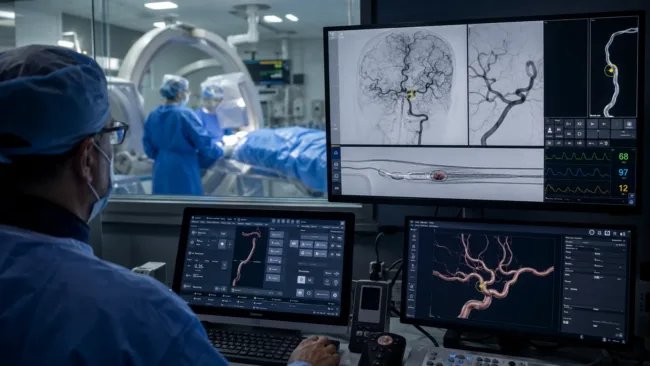
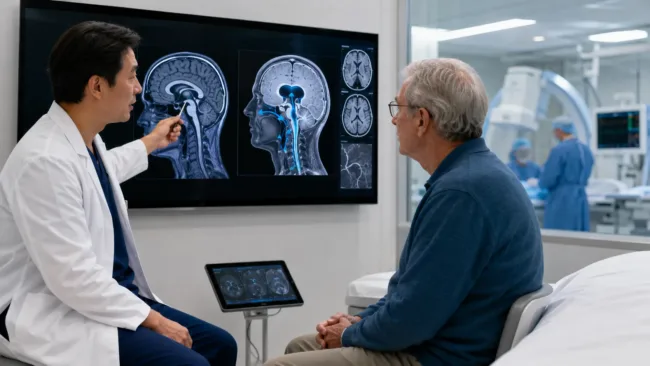
CereVasc, Inc. has completed patient enrollment in the ETCHES 1 trial of its eShunt System, a minimally invasive cerebrospinal fluid (CSF) diversion device being evaluated for the treatment of communicating hydrocephalus following subarachnoid hemorrhage. Conducted at Clinica la Sagrada Familia in Buenos Aires, the single-center pilot study assessed feasibility, safety, and performance in patients with increased intracranial pressure after aneurysmal bleeding.
With follow-up now extending to 24 months, the trial sets the stage for broader evaluation of what could be the first minimally invasive endovascular alternative to ventriculo-peritoneal (VP) shunts—an intervention long associated with high complication rates and surgical burden.
What the ETCHES trial suggests about a new class of endovascular hydrocephalus interventions
The eShunt System marks a potentially significant shift in how industry views treatment innovation in hydrocephalus—a historically under-innovated segment of neurosurgical intervention. Unlike traditional VP shunts, which require open brain surgery, the eShunt is designed to drain CSF from the subarachnoid space into the venous system using a proprietary percutaneous, transvenous-transdural access route. This model, if validated, could reclassify certain hydrocephalus procedures from major surgical interventions to neuro-endovascular procedures suitable for interventional radiology or neurosurgery suites.
What makes the ETCHES study notable is not just its completion, but its framing. Rather than targeting idiopathic normal pressure hydrocephalus (iNPH)—a broader, chronic indication often studied in U.S. and European trials—CereVasc chose a more acute, post-aneurysmal population. Communicating hydrocephalus following subarachnoid hemorrhage remains a well-defined yet clinically complex condition, and this focus offers clear physiological endpoints (e.g., CSF diversion efficacy and intracranial pressure trends) that may strengthen regulatory filings. However, this also narrows the patient base and raises questions about generalizability across broader CH populations.
Industry observers suggest that while first-in-human studies like ETCHES 1 are not designed for statistical significance, the successful enrollment and device deployment in a real-world surgical environment improves investor and clinical confidence in the platform’s operability. That said, the open-label, single-arm design limits comparative claims, and longer-term follow-up will be critical to assess implant durability, infection risk, and device migration—all concerns that have historically plagued shunt technology.
Why clinicians may welcome alternatives to VP shunts—but caution remains
Clinicians have long been wary of ventriculo-peritoneal shunts, particularly in post-hemorrhagic hydrocephalus where clot burden, inflammation, and patient fragility complicate outcomes. While VP shunts remain standard of care, they are associated with failure rates of up to 50 percent within two years, including complications such as infection, obstruction, over-drainage, and revision surgeries. From a procedural burden standpoint, they require a craniotomy and abdominal tunneling—an invasive combination that can result in prolonged ICU stays and elevated infection risk.
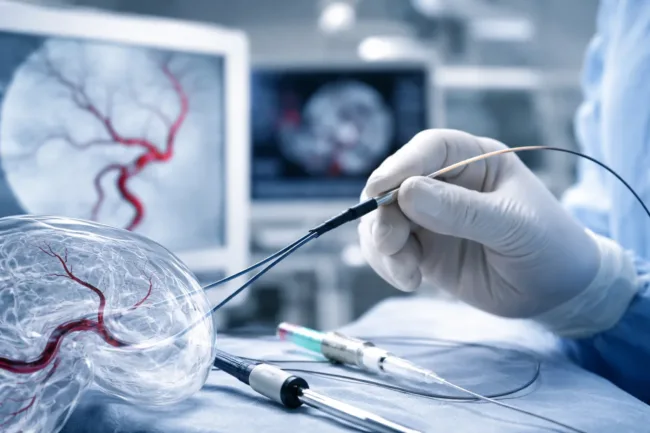
The eShunt System, by contrast, uses a catheter-based implant introduced through an endovascular access route. If follow-up confirms safety and efficacy, this could eliminate the need for cranial entry, reduce anesthesia requirements, and offer shorter post-op recovery—all important factors in acute neurocritical care settings. However, such a pathway also introduces new variables, including venous occlusion risk, implant migration, or unintended CSF over-drainage into the vascular system. Without a control arm or VP shunt comparator group in ETCHES 1, these questions remain unresolved.
Clinicians tracking the hydrocephalus field also note that an endovascular CSF diversion system could require a significant learning curve. Placement accuracy, radiologic guidance protocols, and post-implant monitoring may diverge significantly from traditional neurosurgical workflows, requiring cross-specialty collaboration. Training, reimbursement pathways, and site readiness may be key limiting factors, even if regulatory hurdles are cleared.
What CereVasc must prove next to gain regulatory traction and investor momentum
The most immediate question now is whether the ETCHES 1 pilot data, once fully collected and analyzed, will be sufficient to unlock a path toward a larger pivotal study. CereVasc has not disclosed whether it intends to file for an Investigational Device Exemption (IDE) with the U.S. Food and Drug Administration or pursue a CE Mark in Europe under the MDR framework. Either route would likely demand controlled comparative data against standard VP shunts or programmable valves.
Because hydrocephalus has been historically underserved by device innovation, regulators may show openness to breakthrough designations or accelerated reviews if clinical outcomes appear promising. However, CereVasc will need to demonstrate not only safety and feasibility but also real-world performance advantages that matter to payers, providers, and proceduralists.
Manufacturing scalability and reliability of the delivery system will be additional focus areas. The eShunt System’s proprietary catheter and implant technology must prove robust across varied patient anatomies and clinical settings. Device complexity or material risks could delay broader adoption, especially if smaller neuro-interventional centers lack the procedural infrastructure or radiologic support for such implants.
From a reimbursement perspective, classification as a novel endovascular implant may place the eShunt System in an ambiguous zone. Without a clear DRG (Diagnosis-Related Group) pathway or outpatient procedural code, the device could face hospital-level economic friction. CereVasc will likely need to partner with health economics experts and provider groups to establish cost-benefit narratives and demonstrate downstream savings from reduced complications and reoperations.
The broader context for hydrocephalus innovation and unmet needs
Hydrocephalus affects over one million people in the United States alone, with diverse subtypes including congenital, normal pressure, post-traumatic, and post-hemorrhagic forms. Despite its prevalence, the treatment landscape has remained largely stagnant for decades. VP shunt designs have seen incremental improvements, such as programmable valves and anti-siphon features, but no transformative shift in delivery model or patient burden.
The eShunt System, if clinically validated, may represent the first step toward repositioning hydrocephalus as a condition that can be managed with precision, minimally invasive technologies rather than lifelong surgical implants. Industry analysts tracking the neurovascular device space have compared its potential impact to the evolution of intracranial aneurysm treatment from surgical clipping to coiling and flow diversion.
Yet this transformation will depend not just on clinical efficacy but also on how effectively CereVasc can integrate the eShunt platform into real-world neurocritical workflows. Successful adoption would require education, procedural standardization, and a compelling value story. With ETCHES 1 enrollment completed, CereVasc has cleared a foundational milestone—but the path to regulatory approval and commercial uptake remains demanding.