CStone Pharmaceuticals used AACR 2026 to showcase preclinical data for three proprietary antibody-drug conjugates, including CS5007 targeting EGFR and HER3, CS5006 targeting integrin beta 4, and CS5008 targeting DLL3 and SSTR2, with all three built on its in-house linker-payload platform and positioned for investigational new drug filings in 2026. The update matters because it signals that the Hong Kong-listed oncology developer is no longer presenting a single-asset antibody-drug conjugate story, but a broader platform push aimed at differentiated solid tumor opportunities where heterogeneity, resistance, and therapeutic window remain central commercial and clinical bottlenecks.
Why CStone Pharmaceuticals is trying to stand out in an antibody-drug conjugate market that is getting crowded fast
The antibody-drug conjugate field is no longer defined by whether a company has an antibody-drug conjugate platform. It is increasingly defined by whether that platform can solve the problems that first-generation and even second-generation programs have exposed in the clinic. Stability in circulation, selective payload release, internalization efficiency, payload potency, and the ability to handle tumor heterogeneity are now the real dividing lines. That is the context in which CStone Pharmaceuticals chose to present three preclinical programs at once rather than highlight only a single lead asset.
The strategic message is fairly clear. CStone Pharmaceuticals wants investors and industry observers to view its linker technology and bispecific design capabilities as reusable engines, not isolated science projects. That matters because platform credibility tends to support licensing optionality, partnership appeal, and valuation support in biotech. It also matters because preclinical antibody-drug conjugate announcements, by themselves, are rarely enough to command attention unless they imply repeatability across targets. The risk, however, is that preclinical breadth can also dilute focus. Until one of these assets generates early human data, the company is still making a platform argument largely on internal comparisons, animal models, and mechanistic rationale.
How CS5007 could fit into the race to overcome EGFR resistance and HER-family signaling escape
Among the three candidates, CS5007 appears to be the most strategically important because it goes after one of the most commercially validated and clinically frustrating pathways in oncology. EGFR is already a heavily worked target, but resistance has repeatedly limited durability across tumor types. HER3 has become increasingly relevant in that resistance story because compensatory signaling can preserve downstream survival pathways even when EGFR is inhibited. By designing a bispecific antibody-drug conjugate against EGFR and HER3, CStone Pharmaceuticals is trying to do more than deliver a cytotoxic payload. It is trying to turn the targeting arm itself into part of the efficacy narrative.
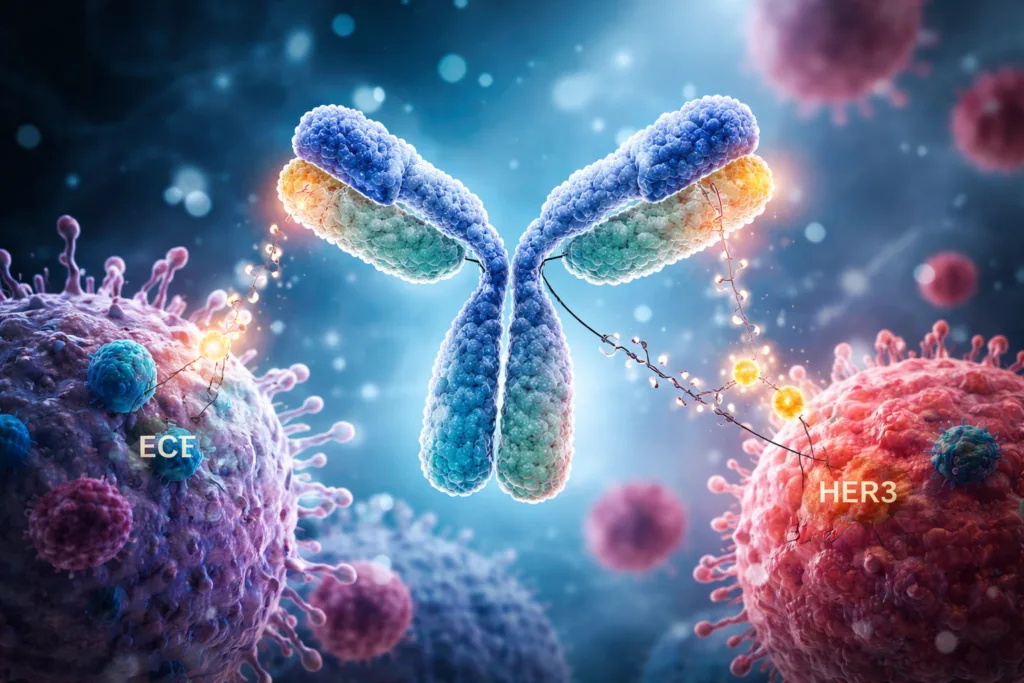
That dual-function logic is important. In theory, a molecule that both blocks signaling and delivers an exatecan payload could create a stronger therapeutic profile in tumors where single-target agents lose relevance as pathway adaptation emerges. The company’s emphasis on signal blockade, internalization, and bystander killing suggests it understands that target biology alone will not be enough to impress clinicians. The challenge is that this is precisely where many promising preclinical stories become less persuasive in the clinic. Signaling complexity in human tumors, variable receptor expression, prior-treatment effects, and tolerability trade-offs often narrow the apparent edge seen in model systems.
The most interesting part of the CS5007 package is not simply that it hit multiple tumor models, but that CStone Pharmaceuticals highlighted activity in resistant and low-EGFR settings, including an osimertinib-resistant model and a low-EGFR, high-HER3 model. That framing suggests the company is trying to position CS5007 less as another HER-family asset and more as a candidate built for escape-pathway biology. If that translates clinically, the opportunity could extend beyond crowded first-line spaces into later-line solid tumor settings where biomarker complexity is higher and treatment options are thinner. Still, early-phase development will need to answer whether the molecule’s broader target reach improves efficacy without expanding skin, gastrointestinal, or other on-target toxicities that have historically complicated EGFR-directed development.
Why the claimed stability and payload-release profile may matter more than the headline efficacy claims
CStone Pharmaceuticals devoted significant attention to its proprietary CSL20 linker and tandem-cleavage release mechanism, and that was not accidental. In the current antibody-drug conjugate landscape, linker chemistry is often the quiet determinant of whether a program becomes clinically usable or commercially constrained. Excessive premature payload release can widen toxicity, narrow dose intensity, and weaken differentiation even when tumor-killing activity looks impressive in early testing.
The company’s claim that free payload release stayed below very low thresholds after seven days in plasma is meant to reinforce a central investment thesis: that this platform may preserve potency while reducing off-target exposure. If that proves true in humans, it could become one of the more meaningful differentiators across the portfolio. A stable conjugate with selective intracellular release can help expand the therapeutic window, which in turn influences dosing flexibility, combination potential, and physician confidence.
But this is also where caution is required. Plasma stability is necessary, not sufficient. Clinical tolerability depends on much more than linker integrity. Tissue distribution, receptor expression in normal tissue, metabolite behavior, and cumulative toxicity all matter once patients are exposed over time. In other words, the platform’s chemistry story is promising, but still incomplete until human pharmacokinetics and safety data validate that the elegant mechanism survives contact with clinical reality.
What CS5006 reveals about CStone Pharmaceuticals’ attempt to find less saturated solid tumor targets
CS5006, which targets integrin beta 4, may be the most quietly ambitious of the three programs because it moves away from the most obvious target classes and into a marker linked to tumor invasion, signaling amplification, and immune resistance biology. That gives the asset a potentially attractive niche if CStone Pharmaceuticals can show that target expression maps cleanly onto tumor types and patient subsets with meaningful unmet need.
From a portfolio perspective, CS5006 is important because it broadens the company’s antibody-drug conjugate thesis beyond headline targets that every investor already recognizes. Integrin beta 4 has biological relevance in multiple epithelial malignancies, and CStone Pharmaceuticals is trying to connect that biology to both rapid internalization and payload sensitivity. If successful, the asset could appeal to partners or future acquirers looking for differentiated entry points rather than another iteration on an already crowded receptor class.
The commercial question is whether this target can support a compelling clinical development path. Less saturated targets can offer white space, but they also carry higher translational uncertainty. Diagnostic strategy, expression thresholds, patient selection, and competitive positioning are all harder when the target lacks established treatment precedent. There is also a broader market reality. Oncology investors often reward clinically de-risked target classes faster than novel ones, even when the science is interesting. That means CS5006 may need unusually convincing early efficacy signals to move from scientific curiosity to commercially credible asset.
Why CS5008 may be CStone Pharmaceuticals’ most direct bet on tumor heterogeneity in small cell lung cancer
CS5008, the DLL3 and SSTR2 bispecific antibody-drug conjugate, is arguably the clearest example of CStone Pharmaceuticals building around heterogeneity rather than pretending it can be ignored. Small cell lung cancer and neuroendocrine tumors are biologically diverse, treatment resistant, and often clinically aggressive. A dual-targeting strategy in this setting makes intuitive sense because single-antigen approaches can lose relevance when tumors shift phenotype or when target expression is uneven across lesions and over time.
The company’s emphasis on subtype switching in small cell lung cancer is especially notable because it shows an attempt to align drug design with a disease-evolution problem that clinicians increasingly recognize. If therapy pressure can alter molecular subtype and reduce dependence on one marker, then a bispecific construct could, in theory, maintain utility longer than a monospecific agent. That is a sophisticated development angle and one that may resonate with industry observers who have watched multiple precision strategies struggle against dynamic tumor biology.
Still, the path is not simple. Small cell lung cancer remains one of the hardest places in oncology to translate elegant biology into durable clinical gain. Patients often deteriorate quickly, trial execution can be difficult, and safety margins matter because the disease population is fragile and heavily pretreated. In that context, favorable monkey pharmacokinetics and high provisional non-severe toxic dose estimates are encouraging, but they do not yet address the more important question of whether CS5008 can produce meaningful, durable tumor control in real-world clinical settings.
How CStone Pharmaceuticals’ 2026 investigational new drug timelines could reshape views of its pipeline maturity
CStone Pharmaceuticals said it plans an investigational new drug filing for CS5007 in the first half of 2026, with CS5006 and CS5008 expected in the second half of the year. That timing matters because it turns the AACR presentation from a purely scientific event into a near-term execution story. Once a company attaches calendar expectations to multiple antibody-drug conjugate programs, observers begin to judge not just the science, but the organization’s ability to prioritize manufacturing, toxicology, regulatory preparation, and clinical strategy in parallel.
For a company trying to present itself as a credible innovation platform, this transition from poster data to development milestones is essential. The market can tolerate scientific ambition, but it discounts programs heavily if regulatory readiness, chemistry manufacturing and controls, or trial design clarity appear weak. The planned Phase I design for CS5007, focused on dose escalation and expansion in advanced solid tumors, is standard and sensible. The real test will be whether patient selection and cohort construction are sharp enough to reveal signal early rather than bury it in an overly broad all-comers design.
There is also an external timing issue. The antibody-drug conjugate space moves quickly, and being scientifically differentiated does not automatically mean being strategically well-positioned. If competing programs produce meaningful clinical data while CStone Pharmaceuticals is still entering the clinic, investor comparisons may become less generous. The company therefore needs not only clean execution, but also a development story that clearly explains where each asset could win, against whom, and in which biomarker-defined populations.
Why AACR 2026 may matter less for immediate valuation and more for long-term partnering credibility
Preclinical AACR presentations do not usually transform biotech companies overnight, and this one is unlikely to be an exception. The more realistic significance is that CStone Pharmaceuticals has used the meeting to present a coherent platform narrative across three assets, each aimed at biologically messy solid tumor settings where bispecific targeting and controlled payload delivery could matter. That kind of coherence can improve partnering discussions, especially if larger companies are looking for earlier-stage antibody-drug conjugate assets with mechanistic differentiation.
What changes now is not the clinical standard of care, but the way CStone Pharmaceuticals can be evaluated. It is moving from being judged largely on the existence of an antibody-drug conjugate platform to being judged on whether that platform can generate credible first-in-human candidates at scale and on schedule. That is progress, but it also raises the bar. Once clinical development begins, internal benchmark claims, xenograft strength, and linker elegance become secondary to response rates, durability, tolerability, and biomarker learnings.
For now, the company has done enough to justify attention, especially around CS5007 and CS5008, which map onto two of oncology’s most stubborn problems: adaptive resistance and tumor heterogeneity. But the broader verdict remains reserved. In oncology drug development, preclinical sophistication earns interest. Only clinical translation earns trust.