
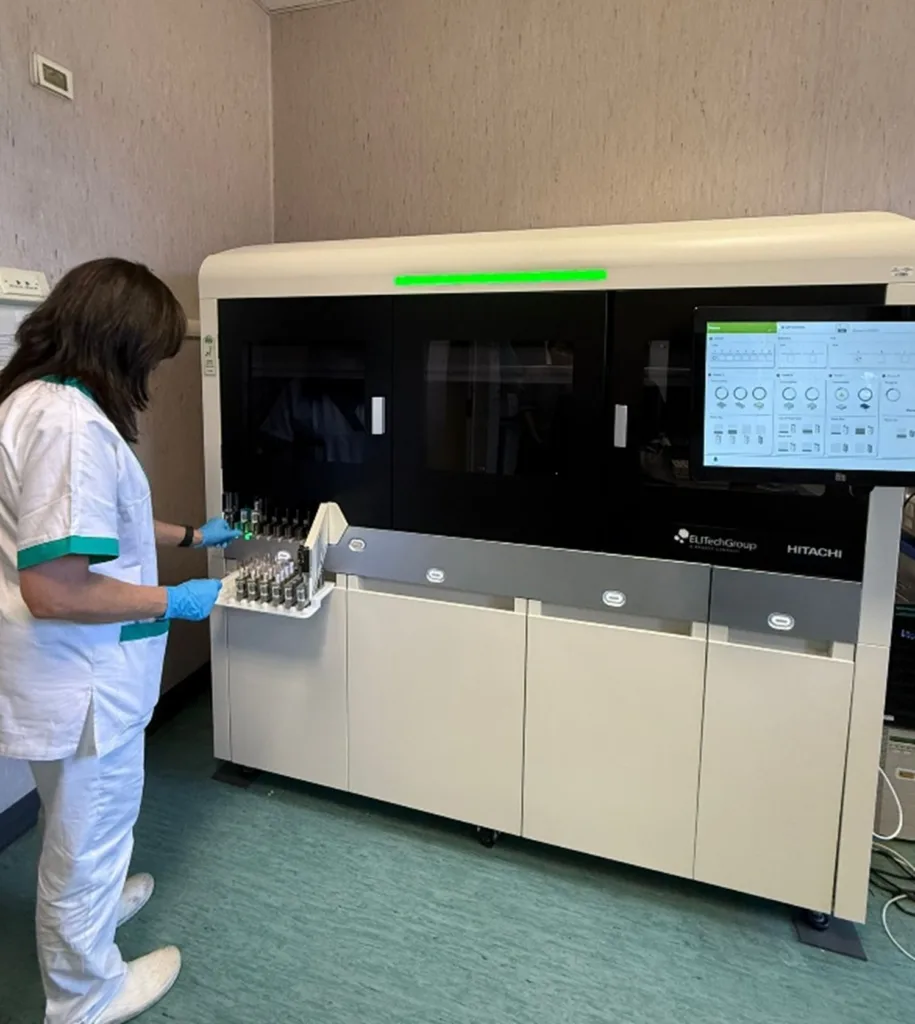
Bruker Corporation has launched MyGenius PRO, a high-throughput sample-to-answer molecular diagnostics system, at ESCMID Global 2026 in Europe. The platform enters the infectious disease diagnostics market with IVDR assays for Cytomegalovirus, Epstein-Barr virus, and BK virus, positioning it squarely in transplant and immunocompromised patient testing where automation, turnaround time, and workflow reliability matter commercially as much as analytical performance.
Why Bruker’s MyGenius PRO launch matters beyond another PCR instrument release
The significance of this launch lies less in the fact that Bruker now has another PCR box and more in what kind of laboratory environment it is targeting. MyGenius PRO is aimed at the operational pressure point where medium-throughput flexibility starts to become insufficient, but where laboratories may still want the menu specificity and assay control of PCR rather than shifting all testing toward larger centralized systems or broad syndromic panels. That makes this a workflow strategy as much as a product launch. The promise of continuous loading, random access, and full automation speaks directly to laboratories managing uneven sample arrival patterns, transplant monitoring schedules, and the need to process clinically important viral load testing without building staffing models around manual bottlenecks.
How IVDR pressure is reshaping the case for fully automated molecular testing systems
This is where the platform could matter most in Europe’s post-IVDR diagnostics environment. For many laboratories, the regulatory reset has done more than raise documentation requirements. It has increased the value of fully integrated systems that can reduce complexity across extraction, amplification, result handling, and traceability. In that sense, Bruker is not simply selling throughput. It is selling operational simplification under a tighter regulatory framework. That matters because the practical burden of compliance often shapes purchasing decisions as much as raw instrument specifications. The risk, however, is that automation alone does not guarantee adoption if laboratories perceive the assay menu as too narrow at launch or if switching costs from incumbent platforms remain high.
Why the initial Cytomegalovirus, Epstein-Barr virus, and BK virus menu is strategically important
The initial assay menu makes Bruker’s commercial priorities unusually clear. Cytomegalovirus, Epstein-Barr virus, and BK virus are not random first targets. These are clinically consequential pathogens in immunocompromised populations, especially transplant recipients, where repeated monitoring can drive steady testing volumes and where result timeliness can influence care pathways. By opening with transplant-linked virology, Bruker is entering a testing segment that is specialized enough to reward performance and reliability, but also routine enough to support recurring reagent demand. That is often a stronger starting point than attempting to compete immediately across every infectious disease category. At the same time, a transplant-focused launch can limit near-term scale if expansion into broader virology and blood-borne pathogen testing does not arrive quickly enough.
What Bruker’s planned 2026 assay expansion could mean for long-term platform adoption
That expansion plan is therefore central to the real commercial story. Bruker has indicated that Human Immunodeficiency Virus type 1, Hepatitis B virus, Hepatitis C virus, and Human Herpesvirus 6 assays are planned through 2026. If those additions arrive on schedule and perform well, MyGenius PRO begins to look less like a niche virology platform and more like a modular molecular diagnostics franchise with room to grow inside hospital laboratories already seeking menu consolidation. If rollout slips, the system risks being viewed as promising hardware waiting for a fuller test portfolio. In molecular diagnostics, platforms are rarely judged on engineering elegance alone. They are judged on installed base growth, menu breadth, service quality, and the ability to become embedded in routine testing economics.
How MyGenius PRO fits into Bruker’s broader molecular diagnostics portfolio strategy
The launch also highlights how Bruker is trying to build laddered segmentation within its molecular diagnostics portfolio. The company already has InGenius and BeGenius systems, and MyGenius PRO appears designed to extend that architecture upward into higher-volume environments. Strategically, that matters because diagnostics vendors with multiple throughput tiers can position customers within the same ecosystem as testing needs evolve. A laboratory that starts with one workflow profile may eventually need more automation, more throughput, or more continuous operation. If Bruker can keep those customers within its menu and software environment, the value of each placement rises over time. The unresolved question is whether the product family is differentiated clearly enough for buyers to understand where one platform ends and the next begins, especially in a market where purchasing committees prefer simple upgrade logic.
Why the ELITechGroup and Hitachi High-Tech collaboration adds industrial credibility and execution risk
The collaboration structure behind MyGenius PRO is another notable element. The system was developed through cooperation between ELITechGroup, a Bruker company, and Hitachi High-Tech, combining assay expertise with automation and engineering capability. That arrangement could give the platform a sturdier industrial backbone than many standalone assay developers can achieve on their own. In diagnostics, engineering quality, uptime, consumables handling, and serviceability can matter as much as analytical claims once systems move into routine use. Partnering with a company experienced in instrumentation and automation may improve Bruker’s odds of delivering a robust platform at scale. Even so, joint development models can introduce coordination risk if product roadmaps, regional commercial priorities, or service expectations diverge over time.
What the Japan rollout reveals about Bruker’s geographic expansion ambitions for the platform
The Japan angle adds another layer of strategic relevance. Hitachi High-Tech plans to introduce the same platform in Japan under the LABOSPECT GA-5 name, paired with Bruker molecular diagnostic assays under local regulatory requirements. That suggests the technology is being built with a broader geographic life cycle in mind rather than as a Europe-only launch. For Bruker, this could open a useful expansion pathway without requiring a fully standalone route into every market. But geographic replication in diagnostics is never automatic. Regulatory timing, reimbursement alignment, local workflow expectations, and competitor entrenchment can all reshape the commercial outcome. A platform that fits one regional lab structure well does not always translate cleanly into another.
Why the sample-to-answer diagnostics market is becoming more specialized, not less, in 2026
From an industry perspective, MyGenius PRO arrives at a moment when the sample-to-answer category is becoming more segmented, not less. The pandemic years accelerated molecular automation awareness, but the next phase is being shaped by specialization. Laboratories are increasingly distinguishing between near-patient rapid systems, syndromic multiplex platforms, centralized high-throughput analyzers, and flexible PCR-based automation for specific disease areas. Bruker appears to be positioning MyGenius PRO in the last of those categories, where the value proposition is not maximal breadth in a single run, but smoother operation for recurring, clinically significant assays. That can be a durable position if the company executes well. It can also be a narrow one if market demand moves faster toward broader menu consolidation or if procurement teams favor vendors with deeper installed relationships.
How transplant and immunocompromised patient testing could become the platform’s first real proving ground
Clinically, the transplant and immunocompromised testing focus is sensible because these are settings where viral load monitoring is tied to high-consequence decision-making. Faster, more automated workflows can reduce batching delays and improve the consistency of test delivery across busy laboratory schedules. That does not automatically mean better clinical outcomes, but it does strengthen the operational conditions under which clinicians receive actionable information. Industry observers will likely watch whether Bruker can demonstrate not only analytical performance but also measurable improvements in laboratory efficiency, staffing utilization, and turnaround predictability. Those operational proofs often become decisive in procurement discussions once the initial product launch attention fades.
Whether Bruker can convert microbiology strength into broader molecular diagnostics market share
Another important issue is whether Bruker can translate its broader microbiology and diagnostics brand footprint into molecular adoption. The company is well known in clinical microbiology and analytical instrumentation, but each diagnostics segment has its own competitive logic. Success in microbial identification or adjacent lab technologies does not automatically secure molecular market share. What helps is the ability to present a coherent laboratory value proposition across platforms. What hurts is any perception that molecular diagnostics remains a secondary or still-maturing pillar within a broader portfolio. MyGenius PRO therefore functions not only as a new instrument, but as a credibility test for Bruker’s larger infection diagnostics strategy.
What LiquidArray and multiplex ambitions could signal for Bruker’s next diagnostics growth phase
The reference to LiquidArray and more affordable syndromic panel testing hints at where the company may want to go next. If Bruker can combine flexible PCR automation with advanced multiplexing options, it could eventually offer laboratories a more layered menu strategy instead of forcing an either-or choice between targeted viral monitoring and expensive broad panels. That is strategically attractive because many labs want to reserve high-cost multiplex tools for selected cases while keeping routine testing economically disciplined. The challenge is integration. Portfolio logic that looks compelling in investor or trade-show messaging still has to translate into procurement simplicity, workflow compatibility, and consistent support on the ground.
Why MyGenius PRO looks like a platform strategy test rather than a standalone product debut
For now, MyGenius PRO should be read as a targeted escalation in Bruker’s molecular ambitions rather than a one-off instrument release. It pushes the company deeper into automated infectious disease testing, gives it a stronger foothold in transplant-related virology, and broadens its ability to serve laboratories that need more than medium-throughput flexibility. Whether that becomes meaningful market share growth will depend on menu expansion speed, instrument reliability in real-world routine use, and Bruker’s ability to turn a technically credible launch into a scalable laboratory platform business. In molecular diagnostics, that is the difference between a good debut and a durable franchise.