Science Corporation has launched its PRIMA visual prosthesis commercially in Europe after the retinal implant received CE marking under the European Union Medical Device Regulation from notified body DEKRA. The company said the certification permits commercial availability across 30 European countries for patients with geographic atrophy caused by age-related macular degeneration, although the first commercial implantation is still expected to take place in Germany.
The July 22 announcement shifts PRIMA from a clinical and regulatory programme into an early commercial rollout. Country-specific reimbursement applications and specialist clinical-site activations are underway, meaning the CE mark opens the market but does not yet guarantee that patients can obtain the system or that healthcare systems will pay for it.
The distinction matters because PRIMA is not intended simply to slow the expansion of geographic atrophy. It creates prosthetic form vision within an area where photoreceptors have already been lost, using a subretinal photovoltaic implant, camera-equipped glasses and digital image processing. That gives the technology a fundamentally different clinical objective from medicines designed to reduce the rate of disease progression.
The supporting evidence is unusually consequential for the retinal prosthesis field, but it also defines the limits of the initial commercial opportunity. The pivotal PRIMAvera study evaluated only 38 participants with profound central vision loss, used a single-arm design and required subretinal surgery followed by visual rehabilitation. Europe’s adoption decision will therefore depend on whether selected specialist centres can reproduce the reported benefits safely and consistently outside a controlled trial.
How does PRIMA create useful central vision without regenerating damaged photoreceptors?
Geographic atrophy is an advanced form of dry age-related macular degeneration in which progressive photoreceptor loss produces blind areas in the central visual field. Once those photoreceptors have been destroyed, conventional optical correction cannot restore the missing visual information.
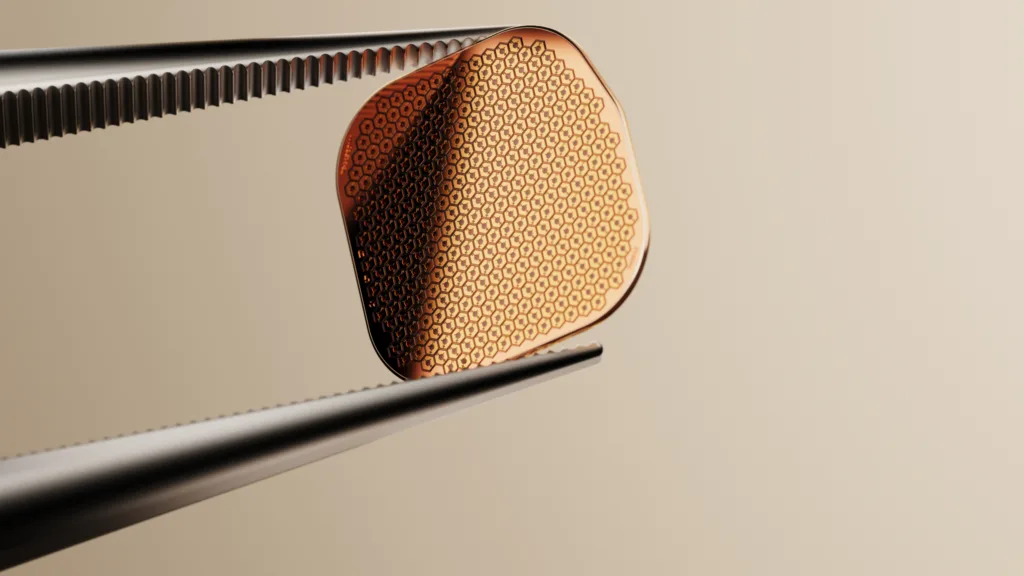
PRIMA does not regenerate those cells. Instead, its 2 mm by 2 mm wireless silicon implant is placed beneath the retina within the atrophic area. The implant contains 378 photovoltaic pixels that convert near-infrared light projected from the external glasses into electrical signals, stimulating surviving inner retinal neurons and allowing visual information to travel through the optic nerve.
A camera mounted on the glasses captures the scene in front of the user. A processor adjusts the image and sends it back through a near-infrared projector, while zoom, brightness and contrast controls help the user distinguish letters and other visual forms. The transparent glasses allow prosthetic central vision to be used alongside residual natural peripheral vision.
This is an important distinction from the idea of restoring normal sight. PRIMA provides a limited field of prosthetic vision whose usefulness depends on the implant, external hardware, image processing and the user’s ability to interpret the resulting signals. Its first commercial value proposition is consequently centred on tasks such as reading letters, numbers and words, rather than recreating the full resolution, colour and visual field of an unaffected eye.
What does the PRIMAvera study establish about functional vision restoration?
The peer-reviewed PRIMAvera study was an open-label, baseline-controlled, non-randomised, prospective trial involving 38 people at 17 clinical sites in France, Germany, Italy, the Netherlands and the United Kingdom. Participants were at least 60 years old, had geographic atrophy in both eyes and had profound central visual impairment in the implanted eye.
The study’s primary efficacy endpoint measured the proportion of participants achieving an improvement of at least 0.2 logMAR, equivalent to 10 letters on a standard ETDRS eye chart, at 12 months. Thirty-two of the 38 enrolled participants were available for the 12-month evaluation.
Among those 32 participants, 26, or 81.3%, achieved the prespecified clinically meaningful improvement. A statistical analysis accounting for the six participants without 12-month assessments estimated a response rate of 79.9% across the full enrolled population. The study therefore met its predefined efficacy threshold.
Mean visual-acuity improvement at 12 months was 24.5 letters when vision was measured using the PRIMA glasses and 25.5 letters when participants could choose their preferred testing condition. The largest individual improvement was 59 letters. These results were statistically significant against the study’s prespecified thresholds.
The functional findings provide a second layer of evidence. At 12 months, 27 of the 32 assessed participants reported that they could use prosthetic vision at home to read letters, numbers or words, while 68% reported medium or high satisfaction with the system.
Those outcomes support the clinical relevance of the visual-acuity improvement, but they should not be interpreted as proof of broad restoration of daily independence. The Impact of Vision Impairment questionnaire did not show behavioural changes, and the study was not powered to establish improvements across every aspect of vision-related quality of life. The reported home-use findings were also based on participant responses rather than a blinded comparison with another intervention.
The study nevertheless represents stronger evidence than a technical feasibility demonstration. The results were peer-reviewed, the primary endpoint was prespecified, follow-up reached 12 months and the trial was conducted across multiple European centres. At the same time, the absence of randomisation or a parallel control group, the small sample and the six missing 12-month assessments limit how broadly the findings can be generalised.
Why will surgical safety and rehabilitation shape the first commercial cases?
PRIMA’s benefit cannot be separated from the risks and operational demands of subretinal implantation. The pivotal study recorded 26 device-related or procedure-related serious adverse events among 19 participants during the first 12 months. All were attributed either to the surgical procedure or to a combination of the procedure and device; none was classified as being caused by the device alone.
Twenty-two of the events were classified as mild or moderate, while four were severe. Reported complications included ocular hypertension, peripheral retinal breaks, subretinal haemorrhage, macular holes, choroidal neovascularisation, retinal detachment and proliferative vitreoretinopathy. Most events occurred during the first two months after implantation, and most of those early events resolved within two months of occurrence.
Mean residual natural visual acuity did not decline from baseline in the implanted eyes. Preserving peripheral vision is particularly important because users rely on a combination of their remaining natural vision and the prosthetic central image generated by PRIMA.
Even so, the frequency of procedure-related events makes careful centre and patient selection essential. Early commercial implantation is likely to be concentrated in hospitals with experienced vitreoretinal surgeons, advanced retinal imaging, postoperative monitoring and the capacity to manage complications promptly.
Surgery is only one part of the pathway. Patients must learn how to interpret prosthetic visual information and use the glasses’ digital magnification and image-enhancement features. Commercial implementation will therefore require trained rehabilitation teams and structured follow-up, not simply delivery of an implant and external hardware.
Why does CE marking not automatically translate into broad European patient access?
CE marking indicates that PRIMA conforms with applicable European medical-device requirements for its specified use. It permits the company to place the system on covered European markets, but it is not equivalent to national reimbursement, guaranteed hospital funding or immediate treatment availability.
Science Corporation said country-specific reimbursement applications and clinical-site activations are underway. The first commercial implantation is expected soon in Germany, but the company has not disclosed a confirmed procedure date, European price, reimbursement decision or initial number of participating centres.
That leaves several commercial variables unresolved. Hospitals must determine how the implant, surgery, external glasses, processor, rehabilitation and long-term support will be funded. Payers will need to decide which patients qualify, what evidence is sufficient for coverage and whether payment will be provided through existing hospital budgets or a dedicated pathway.
A concentrated concentrated launch could help Science Corporation control training and collect consistent real-world data. It could also restrict early access geographically, particularly if patients need repeated visits to a specialist centre. Expansion across Europe will depend less on the theoretical number of CE-marked markets than on the number of countries that establish workable payment and referral pathways.
Manufacturing and after-sales support will matter as well. The company must supply both implantable and external components, maintain the image-processing system and support patients whose use of the device may extend for years. Reliability, software support, replacement arrangements and the economics of rehabilitation will influence how hospitals assess the complete cost of treatment.
Which geographic atrophy patients are most likely to benefit from the first rollout?
Science Corporation estimates that geographic atrophy associated with age-related macular degeneration affects more than five million people worldwide. That figure describes the disease burden, not PRIMA’s immediately addressable commercial population.
The PRIMAvera evidence applies most directly to adults aged 60 or older with geographic atrophy in both eyes, foveal involvement and profound central visual loss in the implanted eye. Patients also need retinal anatomy capable of supporting the implant, sufficient surviving inner retinal circuitry, fitness for surgery and the ability to participate in rehabilitation.
This places PRIMA toward the advanced end of the geographic atrophy treatment pathway. Therapies intended to slow lesion growth are generally most relevant before additional photoreceptors are lost. PRIMA is designed for a later stage, when the clinical objective has shifted from preserving remaining central vision to creating prosthetic visual perception within the damaged area.
The two approaches are not directly interchangeable, and results from unrelated drug and device studies cannot establish superiority. The more useful commercial question is whether retina specialists can identify a sufficiently large group of advanced patients for whom the possibility of functional form vision justifies surgery, training and continued use of external hardware.
What do the United States designations mean for PRIMA’s regulatory pathway?
Science Corporation is also pursuing the United States market, but PRIMA remains investigational there. The system previously received Breakthrough Device designation, and the United States Food and Drug Administration has now granted two Humanitarian Use Device designations.
One designation covers an orphan subset of patients blinded in both eyes by advanced geographic atrophy secondary to age-related macular degeneration. The other relates to vision loss caused by Stargardt disease, a rare inherited retinal disorder.
Humanitarian Use Device designation does not authorise commercial marketing. Science Corporation must still obtain approval through the Humanitarian Device Exemption pathway before PRIMA can be marketed for the corresponding United States indication. The European CE mark also does not substitute for a Food and Drug Administration review.
Early European commercial cases could nevertheless strengthen the company’s future regulatory package by producing post-market information on durability, surgical complications, device reliability, rehabilitation and real-world functional use. The relevance of those data will depend on whether European treatment conditions and patient selection align with the population proposed for the United States.
Which milestones will show whether PRIMA can progress from launch to routine care?
The next meaningful milestone is the first reimbursed commercial implantation, not simply the announcement of European availability. After that, the industry will watch the pace of specialist-site activation, the number of patients treated, national reimbursement decisions and whether outcomes remain consistent outside the original PRIMAvera centres.
Longer follow-up will be equally important. The pivotal evidence established benefit through 12 months, while extended observation is planned to assess durability, implant stability and late complications. Hospitals and payers will want to know whether functional use persists, how frequently external components require replacement and whether patients continue using the system after the intensive initial rehabilitation period.
PRIMA enters Europe with a peer-reviewed efficacy signal that is rare in retinal prosthetics and a clinical objective that existing disease-slowing treatments do not address. The commercial verdict, however, will be decided centre by centre and patient by patient. Science Corporation must now demonstrate that restored form vision can be delivered reproducibly, funded sustainably and maintained long enough to justify the complete surgical and rehabilitation pathway.