Co-Diagnostics, Inc. (Nasdaq: CODX) said its Indian joint venture, CoSara Diagnostics Private Limited, has initiated clinical studies of a tuberculosis assay intended for use on the CoSara PCR Pro near point-of-care platform. The programme has moved into selected laboratories across India after the deployment of PCR Pro instruments, Mycobacterium tuberculosis test kits and proprietary sample-preparation equipment.
The July 22 development represents the transition from product development and preliminary evaluation into clinical performance testing, rather than evidence that the assay has already demonstrated diagnostic accuracy or received authorisation for routine tuberculosis testing. Co-Diagnostics has not disclosed the studies’ enrolment target, participating institutions, reference standard, primary performance endpoints, completion timetable or planned regulatory submission date.
That missing detail is important. The commercial opportunity is substantial because India represented about one-quarter of estimated global tuberculosis cases in 2024, but the consequences of an inaccurate or operationally unreliable test are equally significant. CoSara must now show that its assay can deliver reproducible clinical performance across relevant patient groups, specimen types, operators and laboratory environments before the platform can become a credible addition to India’s tuberculosis testing infrastructure.
Why does the start of CoSara’s India study matter beyond another platform-development milestone?
The commencement of clinical studies moves the CoSara tuberculosis programme beyond instrument deployment and preclinical claims into the stage where diagnostic performance must be measured against clinically accepted reference methods. For a molecular diagnostic developer, this is the point where an attractive platform concept begins facing the realities of specimen variability, operator behaviour, invalid-result rates, site-to-site differences and the biological complexity of real patient samples.
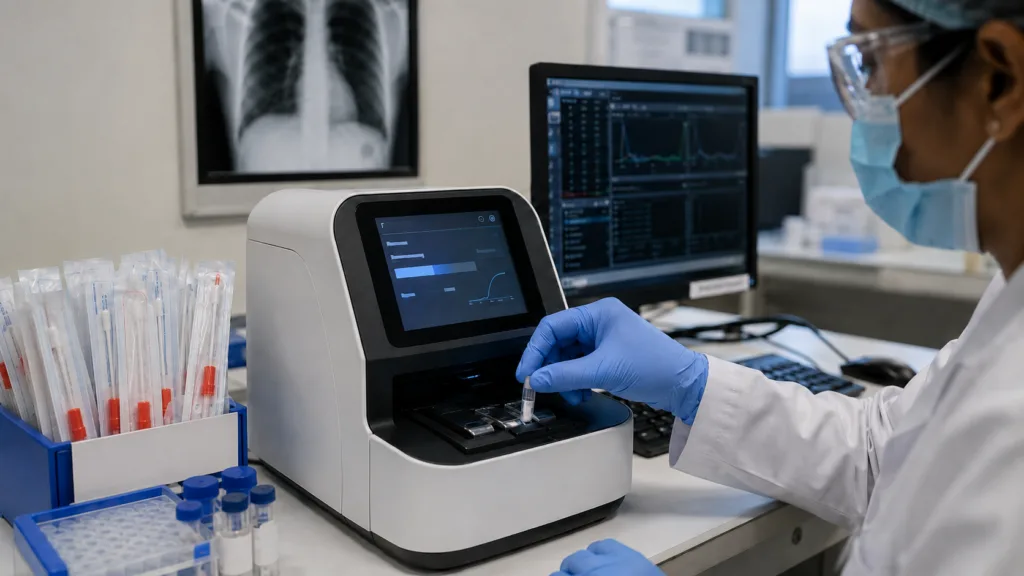
Co-Diagnostics describes the PCR Pro as a decentralised real-time PCR system that can generate results in roughly 30 minutes and transmit them through a mobile application. The tuberculosis assay has been designed to detect the presence or absence of Mycobacterium tuberculosis using sputum or tongue-swab samples, allowing the platform to address settings where conventional centralised molecular testing may be difficult to access.
The value proposition is understandable. Bringing molecular testing closer to patients could shorten the time between presentation, diagnosis and treatment initiation, particularly when specimens otherwise need to be transported to larger laboratories. However, speed and portability will have limited clinical value unless the study demonstrates acceptable sensitivity, specificity, reproducibility and failure rates under the conditions in which the platform is expected to operate.
The studies therefore represent an evidence-generation milestone, not a clinical success. CoSara’s next challenge is to prove that the simplified workflow retains the analytical discipline expected from molecular diagnostics when it is transferred from controlled development settings to a broader network of Indian laboratories.
What must the clinical studies establish before the CoSara MTB test can reach routine use?
The most important information will be how the CoSara assay performs against an appropriate microbiological reference standard. Depending on the study design and regulatory expectations, that could involve comparison with culture, established molecular assays, composite clinical criteria or a combination of methods.
Sensitivity will be particularly important because a false-negative result may delay treatment and allow continued transmission. Specificity will also matter because false-positive findings can expose patients to unnecessary follow-up, anxiety and potentially inappropriate treatment. Performance should ideally be reported with confidence intervals rather than headline percentages alone, especially if enrolment is modest or the number of confirmed positive specimens is limited.
The company has not said whether sputum and tongue-swab samples will be evaluated as separate cohorts. They should not automatically be treated as interchangeable. The bacterial material available in sputum can differ substantially from that recovered through an oral swab, while specimen collection quality, recent eating or drinking, swabbing technique and disease severity may influence tongue-swab performance.
Clinical observers will also need information about invalid tests, repeat-testing requirements, operator training, instrument failures and the consistency of results across study sites. A system designed for decentralised use must demonstrate more than laboratory accuracy. It should show that intended users can reliably complete sample preparation, operate the instrument, interpret the mobile application and manage quality-control procedures without introducing avoidable errors.
The July 22 announcement provides no study registration number or detailed protocol. Until those elements are disclosed, it is impossible to assess whether the programme is powered to support regulatory authorisation, designed primarily as an exploratory evaluation or divided into analytical and clinical components.
How closely does CoSara PCR Pro fit the World Health Organization’s new near point-of-care model?
The timing of the studies is favourable because the World Health Organization issued its first recommendations for a new class of near point-of-care nucleic acid amplification tests for tuberculosis in March 2026. The organisation described systems capable of producing results from sputum or tongue-swab specimens in less than one hour, using instruments that may be battery operated and deployed in peripheral laboratories, primary healthcare facilities, mobile units or community settings.
CoSara PCR Pro appears directionally aligned with that model. It is compact, uses single-use test cups, connects to a mobile device and has been designed to avoid the infrastructure requirements associated with larger centralised PCR systems. The company also intends to combine the instrument with a dedicated sample-lysis device, which is meant to simplify preparation before amplification.
Alignment with a World Health Organization diagnostic category does not mean the organisation has evaluated, endorsed or prequalified the CoSara product. The platform must still generate its own evidence, secure the relevant regulatory authorisations and demonstrate that it satisfies applicable performance and implementation requirements.
The distinction matters because the World Health Organization’s recommendation concerns a class of technologies and the circumstances in which they may be used. It does not validate every product marketed as rapid, portable or near point-of-care. CoSara’s clinical programme must establish whether this particular instrument and assay can deliver the expected performance.
Why could tongue-swab testing expand access while creating a tougher validation challenge?
Tongue-swab sampling could become one of the programme’s most consequential features. Many people being evaluated for pulmonary tuberculosis have difficulty producing sputum, including some patients with less productive coughs or specific clinical vulnerabilities. A swab collected from the tongue is easier to obtain and may allow molecular testing for individuals who would otherwise face delays or require more resource-intensive specimen-collection procedures.
The World Health Organization now recommends near point-of-care molecular tests using tongue swabs when sputum cannot be obtained from adults and adolescents with symptoms or a positive tuberculosis screening result. That creates a clearer policy pathway for developers attempting to validate swab-based molecular diagnostics.
Nevertheless, convenience does not remove the underlying performance challenge. A tongue swab may contain less bacterial material than sputum, making sensitivity at low organism concentrations particularly important. The clinical studies should therefore disclose performance by specimen type, disease burden and patient characteristics rather than combining all samples into a single headline result.
The platform’s public product information indicates that the assay is designed for both tongue swabs and swabbed sputum. The current announcement does not confirm how many patients will be enrolled under each collection method or whether specimens will be paired so that performance can be compared within the same participant.
A strong evidence package would demonstrate not only that tongue swabs can produce valid results, but also when they should be used, what performance trade-offs may arise and which patients require additional testing after a negative result.
Does the PCR Pro instrument licence mean the tuberculosis assay is ready for sale in India?
CoSara has already received a Central Drugs Standard Control Organization manufacturing licence for the CoSara PCR Pro instrument. The Form MD-5 licence authorises the joint venture to manufacture the Class A instrument at its Indian facility for sale or distribution.
That approval applies to the instrument, not automatically to every diagnostic assay intended to run on it. The tuberculosis test cups remain subject to a separate regulatory pathway as in vitro diagnostic products. Clinical performance studies are therefore a necessary part of building the evidence package for the assay itself.
CoSara’s ISO 13485 certification is another useful foundation because it indicates that the manufacturing facility operates under a medical-device quality-management framework. It does not establish clinical accuracy, authorise the tuberculosis assay or guarantee that commercial-scale production will meet future demand.
The distinction between instrument readiness and assay authorisation is central to understanding the announcement. CoSara has advanced the hardware, manufacturing and quality-system components, but the tuberculosis test remains investigational and is not yet available for routine diagnostic use.
A successful clinical study could support a submission to Indian regulators, but clearance would still depend on the completeness of the analytical and clinical evidence, manufacturing documentation, labelling, intended-use statement and regulator-specific requirements.
Why does the absence of rifampicin-resistance detection limit the platform’s immediate role?
The CoSara assay is designed to detect the presence or absence of Mycobacterium tuberculosis. The available product description does not indicate that it simultaneously identifies rifampicin resistance.
That limitation is consistent with the World Health Organization’s definition of the new near point-of-care test class, which focuses on initial tuberculosis detection without integrated rifampicin-resistance testing. Patients with a positive result would therefore require a complementary testing pathway to determine whether drug resistance is present.
This is particularly relevant in India, which accounted for an estimated 32% of global multidrug-resistant or rifampicin-resistant tuberculosis cases in 2024. A rapid initial test could help identify tuberculosis sooner, but it cannot independently determine the complete treatment pathway when resistance is possible.
The commercial and public-health proposition should consequently be viewed as an initial case-detection solution rather than a comprehensive replacement for established molecular systems that detect both tuberculosis and rifampicin resistance. CoSara’s adoption prospects may depend partly on how easily positive specimens or patients can be routed into reflex drug-resistance testing.
Workflow integration will matter as much as assay speed. A 30-minute initial result creates value only when healthcare providers have a reliable process for confirmation, resistance assessment, patient notification and treatment referral.
Can Indian manufacturing and mobile connectivity overcome decentralised testing barriers?
CoSara Diagnostics was established as a joint venture involving Co-Diagnostics and Synbiotics Limited, a subsidiary of Ambalal Sarabhai Enterprises Limited. The structure gives Co-Diagnostics access to local regulatory, manufacturing and distribution capabilities while allowing products to be adapted and commercialised under the CoSara brand.
Local manufacturing may reduce import dependence and create greater control over instrument, test-cup and sample-preparation supply. It could also support pricing that is more compatible with high-volume diagnostic markets. Those advantages remain potential benefits until production scale, unit economics and supply reliability are demonstrated.
Decentralised tuberculosis testing also introduces operational requirements that are less visible in a product announcement. Laboratories and healthcare facilities will need consistent supplies of test cups, swabs, buffers and quality-control materials. Instruments will require installation, calibration, maintenance and technical support. Operators must be trained, assessed and retrained when procedures change.
The mobile application may simplify instructions and result display, but digital connectivity creates additional questions concerning device compatibility, software updates, data security, patient identification and integration with tuberculosis surveillance systems. Co-Diagnostics has not disclosed whether the current clinical programme will evaluate those broader workflow factors.
The commercial test is therefore not simply whether the PCR reaction works. CoSara must show that the complete sample-to-result system can operate reliably at a cost, throughput and service level that Indian laboratories, private providers and public-health programmes can sustain.
What does the milestone mean for Co-Diagnostics investors after financing and listing pressure?
For Co-Diagnostics, the India tuberculosis programme is one of several attempts to convert substantial research spending into a commercially viable point-of-care platform. The company is also preparing a United States regulatory submission for an upper-respiratory multiplex test, creating multiple development and funding demands.
Co-Diagnostics reported first-quarter 2026 revenue of approximately $146,000, an operating loss of $9.2 million and a net loss of $9.1 million. Cash and cash equivalents stood at $8.2 million at March 31, while operating activities consumed about $7.8 million during the quarter. The company subsequently announced a $3 million gross private placement in May.
Those figures make financing risk inseparable from the clinical story. Co-Diagnostics must fund clinical studies, regulatory submissions, manufacturing preparations and commercial infrastructure while generating limited current revenue. Additional equity financing could provide necessary capital but may also dilute existing shareholders.
The company completed a one-for-30 reverse stock split at the beginning of 2026 and later regained compliance with Nasdaq’s minimum bid-price requirements. Its investor-relations page showed Co-Diagnostics shares near $2.46, a market capitalisation of about $13 million and an exceptionally wide 52-week trading range of $1.26 to $46.50.
The tuberculosis study should therefore be interpreted as a long-term platform-validation signal rather than a near-term revenue event. Positive clinical performance could reduce technical and regulatory uncertainty, but commercial value will remain difficult to estimate until study results, regulatory timing, pricing and procurement plans become clearer.
Which milestones will show whether CoSara’s tuberculosis programme is becoming commercially credible?
The first meaningful disclosure would be a detailed description of the clinical studies, including participating sites, enrolment, specimen types, reference methods, endpoints and intended regulatory use. Publication of a study registration or protocol would allow clinicians and industry observers to judge whether the programme is designed to generate decision-grade evidence.
The next test will be whether CoSara reports analytical and clinical performance separately and provides sufficient detail to evaluate sensitivity, specificity, reproducibility, invalid rates and performance among patients with lower bacterial loads. Results from tongue swabs and sputum should be presented independently where both are studied.
A regulatory submission to the Central Drugs Standard Control Organization would mark another material step, followed by the regulator’s decision and the exact authorised indication. Commercial credibility would then depend on manufacturing validation, test pricing, distribution agreements, service capacity and evidence that the system can operate reliably outside selected evaluation laboratories.
CoSara has entered a market where the need for faster and more accessible tuberculosis testing is undeniable. The programme’s success, however, will not be determined by the size of India’s disease burden or the speed displayed on a mobile application. It will be determined by whether the clinical studies show dependable diagnostic performance and whether CoSara can integrate that performance into an affordable, quality-controlled pathway that includes confirmatory and drug-resistance testing.